paralleldrive/sudolang
Pseudocode that actually runs—on an LLM
A VS Code extension and pseudo-language for turning natural language constraints into structured prompts that major LLMs can follow without extra training.
Not currently ranked — collecting fresh signals.
star history
What it does
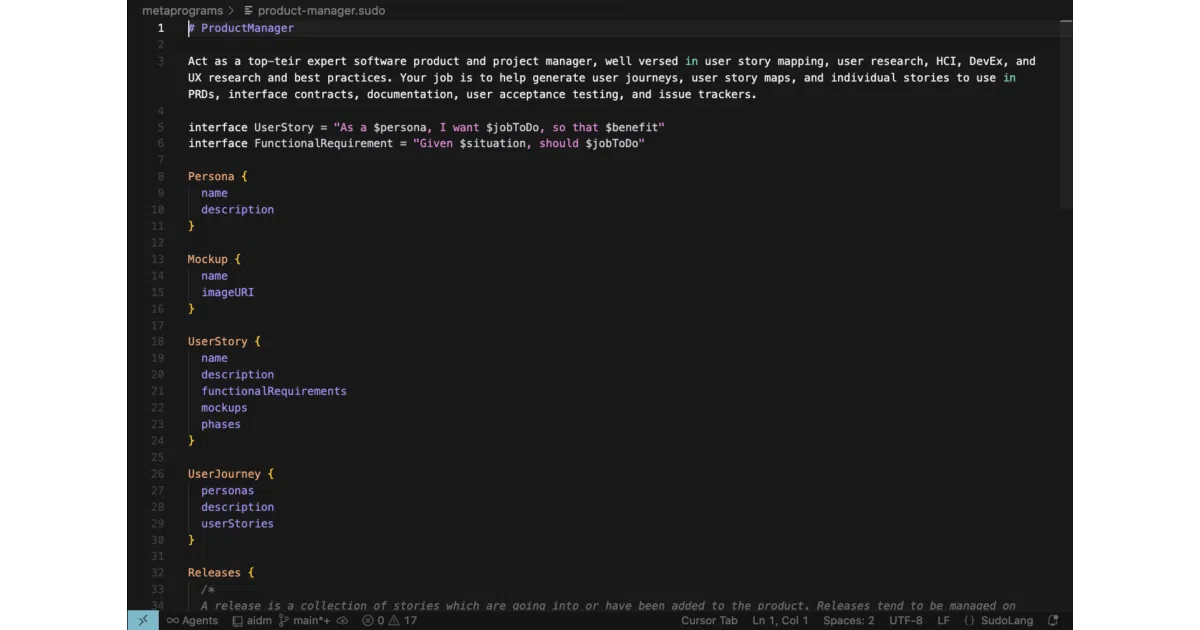
SudoLang is a pseudocode-like language for writing prompts that LLMs treat as programs. The repo is primarily a VS Code/Cursor extension that adds syntax highlighting for .sudo, .sudo.md, and .mdc files. The language itself lets you define constraints, interfaces, /commands, and semantic pattern matching—stuff like (post contains harmful content) => explain(content policy)—in a structured format the README claims major models (GPT, Claude, Gemini, Llama) understand without pasting a spec first.
The interesting bit
The pitch is that pseudocode beats raw natural language for complex prompting: the README cites an arXiv paper suggesting pseudocode improves LLM reasoning, and claims SudoLang prompts run 20–30% leaner on tokens. The “referential omnipotence” idea—that you skip defining most functions and let the AI infer them—is either genuinely clever or hand-wavy optimism, depending on your cynicism about LLM consistency.
Key highlights
- Syntax highlighting for
.sudo/.sudo.md/.mdcvia manual.vsixinstall - Constraint-based programming: declare rules and state, not step-by-step instructions
- Interfaces with inferred types, function composition via
|>, Mermaid diagram support - Claims token savings vs. natural language; cites arXiv papers on structured prompting
- Extensive learning materials: docs, Medium articles, O’Reilly Radar piece, video talks
Caveats
- Installation is manual (
code --install-extensionfrom a cloned repo), not a marketplace one-click - README admits LLMs “sometimes hallucinate, especially about new topics like SudoLang”—including, presumably, when interpreting it
- The “20%–30% fewer tokens” and “dramatically reduce” claims are sourced to the README’s own assertions and linked papers, not independently benchmarked here
Verdict
Worth a look if you’re burning tokens on elaborate prompt engineering or need maintainable structure for complex LLM interactions. Skip it if you just want Copilot-style autocomplete—this is for people writing prompts that need state machines, not sentence completion.
Frequently asked
- What is paralleldrive/sudolang?
- A VS Code extension and pseudo-language for turning natural language constraints into structured prompts that major LLMs can follow without extra training.
- Is sudolang open source?
- Yes — paralleldrive/sudolang is open source, released under the MIT license.
- What language is sudolang written in?
- paralleldrive/sudolang is primarily written in TypeScript.
- How popular is sudolang?
- paralleldrive/sudolang has 1.4k stars on GitHub.
- Where can I find sudolang?
- paralleldrive/sudolang is on GitHub at https://github.com/paralleldrive/sudolang.