oritera/Cairn
No roles, no RAG, no plan: just a blackboard and a goal
Cairn searches unknown state spaces with no predefined agent roles, using only a shared blackboard of facts and intents—proven by clearing 54 of 54 hackathon targets on its first live run.
Velocity · 7d
+123
★ / day
Trend
↗accelerating
star history
What it does
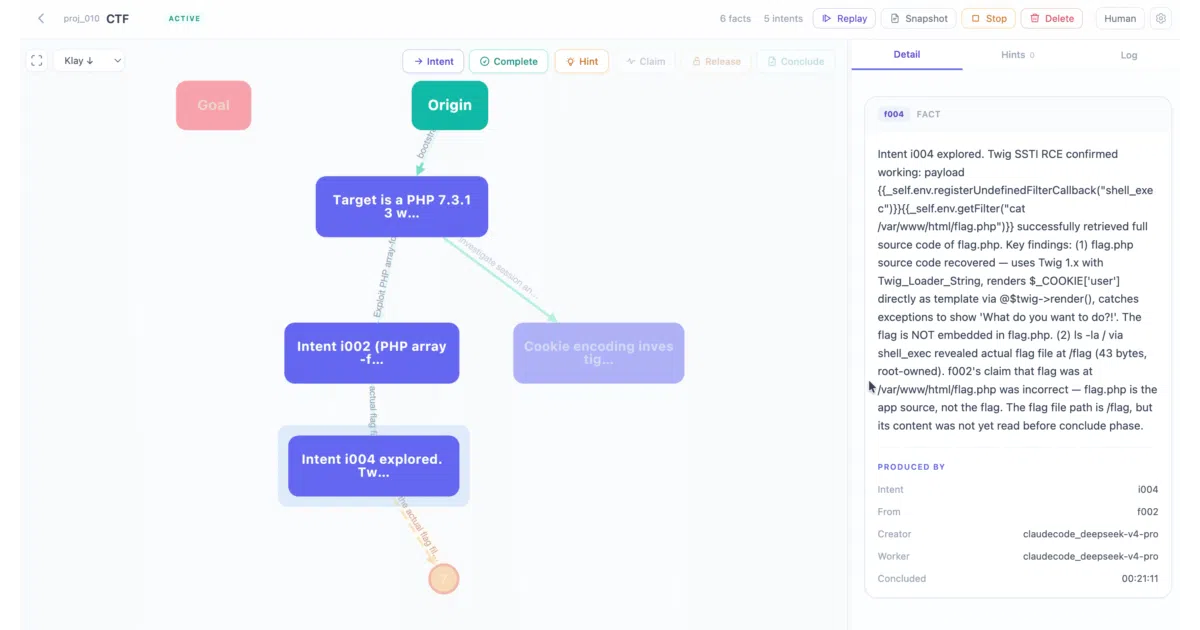
Cairn is a problem-solving engine that looks for a path from a known starting point to a defined goal through an otherwise unknown state space. It keeps a shared graph of facts, intents, and human hints on a blackboard, dispatching agent workers to explore until the goal is met. So far it has only been validated on penetration testing and CTF challenges.
The interesting bit
The agents never talk to each other directly. They coordinate through stigmergy—reading and writing to the same blackboard—so tasks emerge from the graph state instead of fixed workflows. According to the project’s own account, this architecture cleared all 54 challenges in a Tencent Cloud hackathon on its first live run, brought online at 4 AM on race day with no prior tuning, RAG, or MCP tooling.
Key highlights
- Uses only three blackboard primitives:
Fact,Intent, andHint - Agent workers run an OODA loop with no fixed roles or inter-agent messaging
- Supports worker backends including
Claude Code,Codex, andPi - Took 3rd place among 610 teams in a Tencent hackathon while being the only team to solve all 54 targets
- Dual-licensed under GNU AGPLv3 for personal use, with a commercial license available
Caveats
- General-purpose claims are unproven: the README explicitly states penetration testing is the only validated domain so far.
- Platform requirements: it currently requires macOS or Linux, Python 3.12 or higher, and Docker.
Verdict
Worth exploring if you are building agent systems and suspect that rigid roles and workflows are getting in the way. Skip it if you need a proven general-purpose solver or Windows support.
Frequently asked
- What is oritera/Cairn?
- Cairn searches unknown state spaces with no predefined agent roles, using only a shared blackboard of facts and intents—proven by clearing 54 of 54 hackathon targets on its first live run.
- Is Cairn open source?
- Yes — oritera/Cairn is open source, released under the AGPL-3.0 license.
- What language is Cairn written in?
- oritera/Cairn is primarily written in Python.
- How popular is Cairn?
- oritera/Cairn has 4.5k stars on GitHub and is currently accelerating.
- Where can I find Cairn?
- oritera/Cairn is on GitHub at https://github.com/oritera/Cairn.