openai/neural-mmo
OpenAI's abandoned MMO gym for persistent-world agents
A research environment that treats Runescape's complexity as a feature, not a bug.
Not currently ranked — collecting fresh signals.
star history
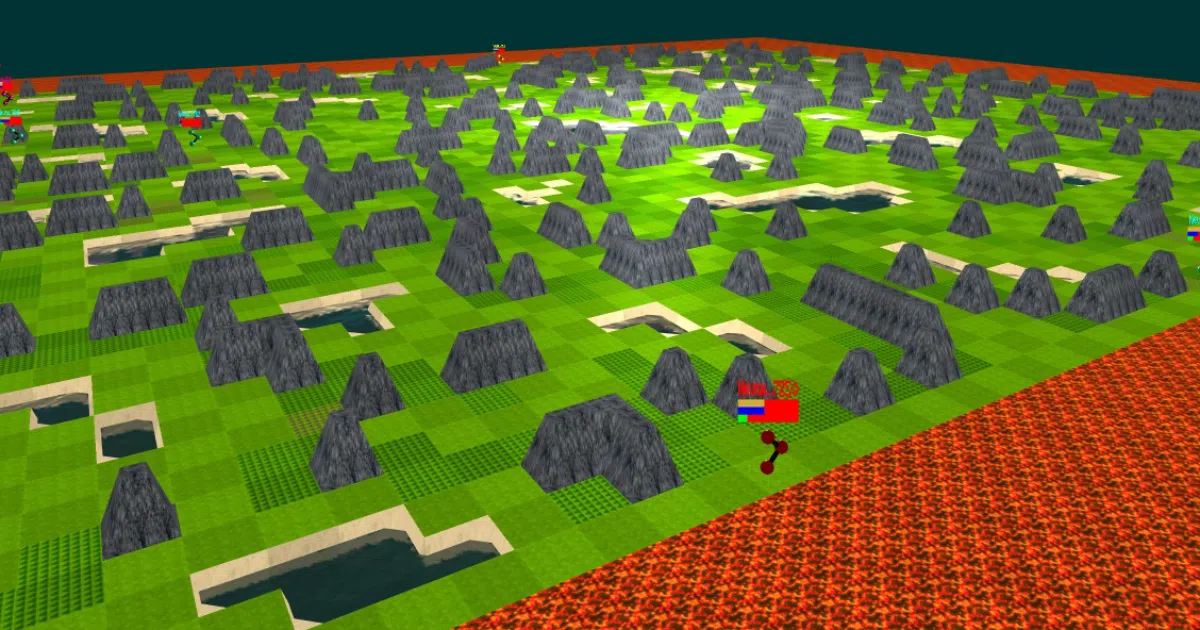
What it does Neural MMO is a Python environment for training thousands of agents in a persistent, open-ended game world inspired by MMORPGs. It provides a native API (Trinity) and a Gym-compatible wrapper for running multi-agent experiments where agents can skill, trade, fight, and die permanently. The environment ships with a THREE.js web renderer and PyTorch utilities for rollouts and optimization.
The interesting bit The authors argue that MMORPGs—not MOBAs, not Atari—are the best available proxy for real-world complexity: persistent economies, thousands of concurrent agents, and skill trees that take thousands of hours to max. They explicitly designed the environment to help agents learn rather than adversarially benchmarking them, which is a rarer philosophy than you’d think.
Key highlights
- Four named modules: Blade (env), Embyr (renderer), Trinity (API), Ethyr (neural utilities)
- Native API avoids 10–1000x interprocess overhead of VecEnv for large populations
- Persistent world:
reset()only on initialization; missing observations mean an agent died - Ships with cluster/server/agent hierarchy (Pantheon/God/Sword) for distributed training
- Can train “reasonable policies on a single CPU” per the authors
Caveats
- Archived by OpenAI in 2019; active development moved to
jsuarez5341/neural-mmo - Setup requires fixing a symlink to an external client repo and manual PyTorch installation
- Renderer only officially supports Firefox; Chrome/Safari “might work”
- The authors list three explicit failure modes, including “computational infeasibility” and the possibility that scaling either agents or environments is simply too hard
Verdict Worth a look for multi-agent and artificial-life researchers who need persistence and population scale. Everyone else should probably start with the actively maintained fork, or a less opinionated environment.
Frequently asked
- What is openai/neural-mmo?
- A research environment that treats Runescape's complexity as a feature, not a bug.
- Is neural-mmo open source?
- Yes — openai/neural-mmo is open source, released under the MIT license.
- What language is neural-mmo written in?
- openai/neural-mmo is primarily written in Python.
- How popular is neural-mmo?
- openai/neural-mmo has 1.7k stars on GitHub.
- Where can I find neural-mmo?
- openai/neural-mmo is on GitHub at https://github.com/openai/neural-mmo.