oil-oil/oil-ui
An agent skill that refuses to design in one direction
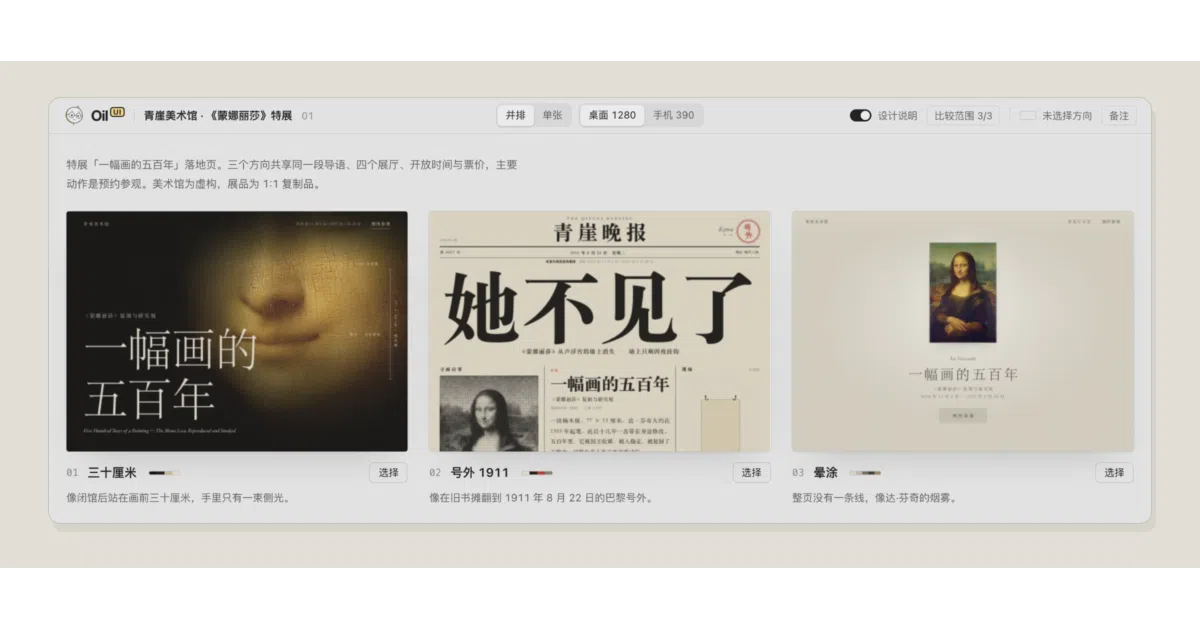
Oil UI makes coding agents produce several genuinely distinct UI directions, put them side by side, and refine against real screenshots.
Collecting fresh signals — velocity needs a few days of history.
collecting data…
star history
What it does
Oil UI is a design skill for AI agents (Claude Code, Codex, and other skill-compatible ones). Instead of letting an agent spit out a single “clean, modern” design, it forces the process into stages: identify the product category and its reference players, translate vague adjectives like “elegant” into concrete font, spacing, and color decisions, then generate several directions that are deliberately different from each other. You pick one from a comparison page, give feedback, and it iterates against actual desktop and mobile screenshots.
The interesting bit
The rules are unusually opinionated for a prompt-based skill. Two directions may share at most one of layout, typography, palette, or hero visual — no sneaking a recolor past as a “new direction.” It also mandates a squint test on the first screen’s light/dark distribution, and insists each page keep exactly one memorable moment while the rest stays quiet. That’s design critique encoded as constraints.
Key highlights
- Built-in style comparison page: renders HTML files, images, or live dev pages side by side, with desktop/mobile toggle and keyboard navigation.
- Works from screenshots — can rebuild a page from an image and fill in mobile layouts the reference doesn’t show.
- Covers websites, apps, admin panels, component libraries, and even small-game presentation and real-time 3D.
- Includes an independent review pass: scores the design and lists problems without touching files, if you just want critique.
- MIT-licensed, with a paid Pro tier adding refinement checklists, form/interaction polish, and legacy-project workflows.
Caveats
- The open-source version tops out at “make a new page look good” — usability work, admin tooling, and old-project refactors are Pro-only.
- Installing both the free and Pro versions together makes them compete for the same requests, per the README.
- The heavy lifting is prompt engineering; there’s no code library here, so quality still depends on the underlying model.
Verdict
Worth a look if you use agent-driven frontend work and are tired of every output looking like the same Tailwind template. Skip it if you need a component library or design system rather than a design process.
Frequently asked
- What is oil-oil/oil-ui?
- Oil UI makes coding agents produce several genuinely distinct UI directions, put them side by side, and refine against real screenshots.
- Is oil-ui open source?
- Yes — oil-oil/oil-ui is open source, released under the MIT license.
- What language is oil-ui written in?
- oil-oil/oil-ui is primarily written in Python.
- How popular is oil-ui?
- oil-oil/oil-ui has 1k stars on GitHub.
- Where can I find oil-ui?
- oil-oil/oil-ui is on GitHub at https://github.com/oil-oil/oil-ui.