octos-org/octos
Nine brains, one binary: an OS for AI agents
Octos treats AI agents like OS processes instead of chatbots, packing multi-tenant orchestration into a single Rust binary.
Not currently ranked — collecting fresh signals.
star history
What it does
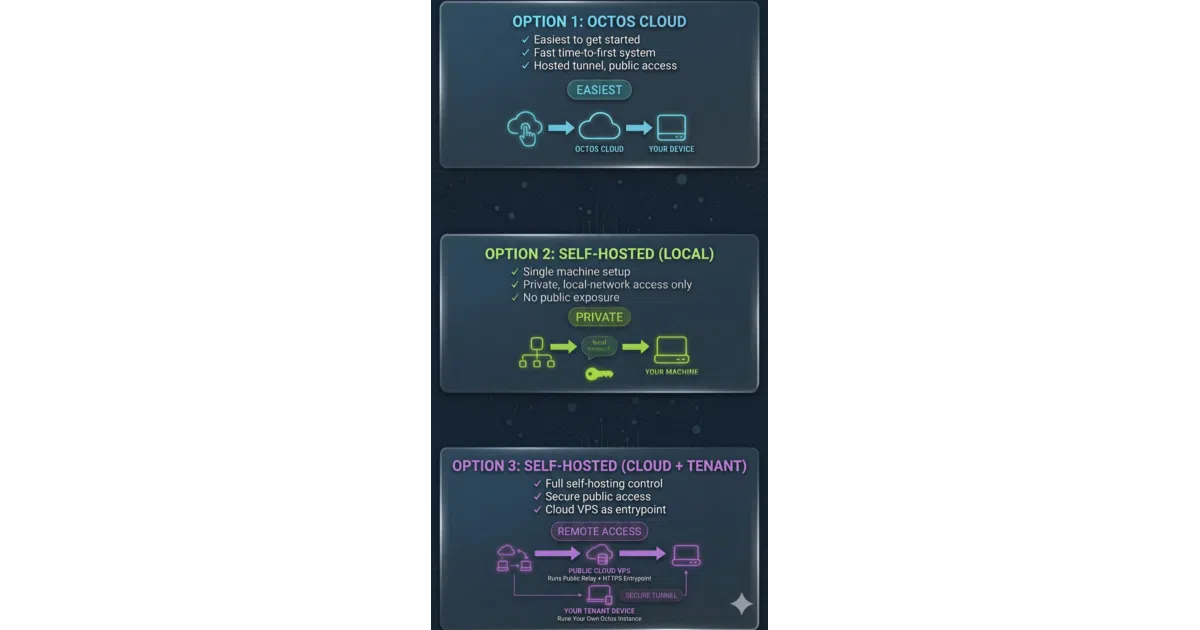
Octos is a Rust-native platform that runs AI agents as isolated OS processes under one 31MB static binary. It exposes roughly 140 REST endpoints for chat, sessions, swarms, and pipelines, letting you wire up any frontend or messaging channel while keeping memory, tools, and user data separated per profile. You can run it locally, pair a tenant device with your own cloud relay, or use their hosted signup flow.
The interesting bit
The architecture borrows from operating systems: each agent profile gets its own process and memory space, while a central dispatcher handles multi-LLM failover, swarm contracts, and DOT-graph pipelines with per-node model selection. That means you can fan out work to N sub-agents, validate their output, and hedge across providers without building the glue yourself.
Key highlights
- One 31MB binary claims to serve 200+ isolated profiles; each runs as its own OS process with separate memory and sessions.
- ~140 REST endpoints cover chat, admin, swarm dispatch, DOT pipelines, metrics, and webhooks.
- Multi-LLM pipelines use DOT graphs with per-node model selection and dynamic parallel fan-out.
- Provider failover stacks three layers—retry, chain, and adaptive routing—with hedge racing and circuit breakers.
- Tool LRU keeps the hottest ~15 ready while backgrounding
spawn_onlywork; it also generates native Office docs in pure Rust viazipandquick-xml.
Caveats
- Public self-hosting requires you to supply and configure your own domain, DNS API for wildcard ACME, and SMTP relay; the ‘zero external runtime’ promise holds for the core binary, not the surrounding tunnel stack.
- The cloud+tenant path uses FRP and Caddy under the hood, which adds moving parts beyond the single-binary local mode.
Verdict
If you are building a product that needs multi-user agent isolation, provider failover, or cross-channel bots under one roof, Octos is worth a look. If you just want a quick single-user ChatGPT wrapper, this is overkill.
Frequently asked
- What is octos-org/octos?
- Octos treats AI agents like OS processes instead of chatbots, packing multi-tenant orchestration into a single Rust binary.
- Is octos open source?
- Yes — octos-org/octos is open source, released under the Apache-2.0 license.
- What language is octos written in?
- octos-org/octos is primarily written in Rust.
- How popular is octos?
- octos-org/octos has 1k stars on GitHub.
- Where can I find octos?
- octos-org/octos is on GitHub at https://github.com/octos-org/octos.