nv-tlabs/SCube
Turning sparse street views into dense voxel-splat cities
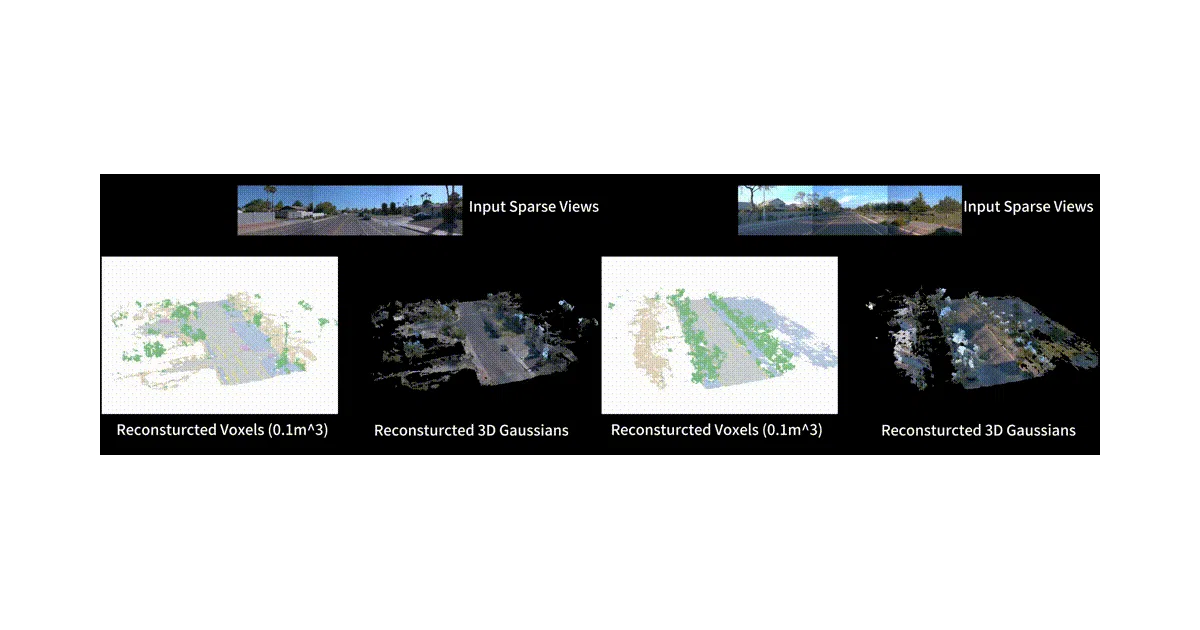
SCube reconstructs large-scale driving scenes from Waymo camera rigs by cascading voxel diffusion and Gaussian splatting into a single generative pipeline.
Not currently ranked — collecting fresh signals.
star history
What it does SCube is a NeurIPS 2024 research pipeline that reconstructs large-scale outdoor scenes—specifically Waymo driving data—by generating dense voxel grids and then wrapping them in 3D Gaussian splats. It ingests camera and LiDAR inputs, compresses geometry through coarse-to-fine VAE stages, infers structure with latent diffusion models conditioned on images and semantics, and finally paints everything with a dedicated Gaussian Splatting Model. The result is a navigable 3D scene that can be inspected as voxel grids or raw Gaussians.
The interesting bit Instead of treating reconstruction as classical multi-view stereo, the project frames it as generative modeling, stacking a VAE, two-stage diffusion, and a splatting network into a cascading pipeline. The repository also bundles XCube, suggesting NVIDIA’s Toronto lab is quietly building an ecosystem around sparse-voxel scene generation.
Key highlights
- NeurIPS 2024 work from NVIDIA’s Toronto AI lab
- Three-stage pipeline: VAE compression, latent voxel diffusion for geometry, and a Gaussian Splatting Model for appearance
- Built around the Waymo perception dataset v1.4.2 with author-provided splits
- XCube integrated into the same codebase for easier use
- Outputs can be visualized as voxel grids, point clouds, or exported 3D Gaussian splats
Caveats
- Data preparation is brutally expensive: processing 1,000 clips takes over a day on eight A100 GPUs
- Training and inference scripts are tightly coupled to WandB for experiment tracking
- README only documents Waymo support; generalization to other datasets is unclear
- Known dependency landmines include MMCV version conflicts and Metric3D v2 runtime errors
Verdict Worth exploring if you research neural scene reconstruction, generative world models, or autonomous-driving simulation. Skip it if you need a lightweight, general-purpose 3D reconstruction tool—this is a heavy, dataset-specific research artifact.
Frequently asked
- What is nv-tlabs/SCube?
- SCube reconstructs large-scale driving scenes from Waymo camera rigs by cascading voxel diffusion and Gaussian splatting into a single generative pipeline.
- Is SCube open source?
- Yes — nv-tlabs/SCube is an open-source project tracked on heatdrop.
- What language is SCube written in?
- nv-tlabs/SCube is primarily written in Python.
- How popular is SCube?
- nv-tlabs/SCube has 530 stars on GitHub.
- Where can I find SCube?
- nv-tlabs/SCube is on GitHub at https://github.com/nv-tlabs/SCube.