nv-tlabs/ChronoEdit
Image editing by generating the video you never asked for
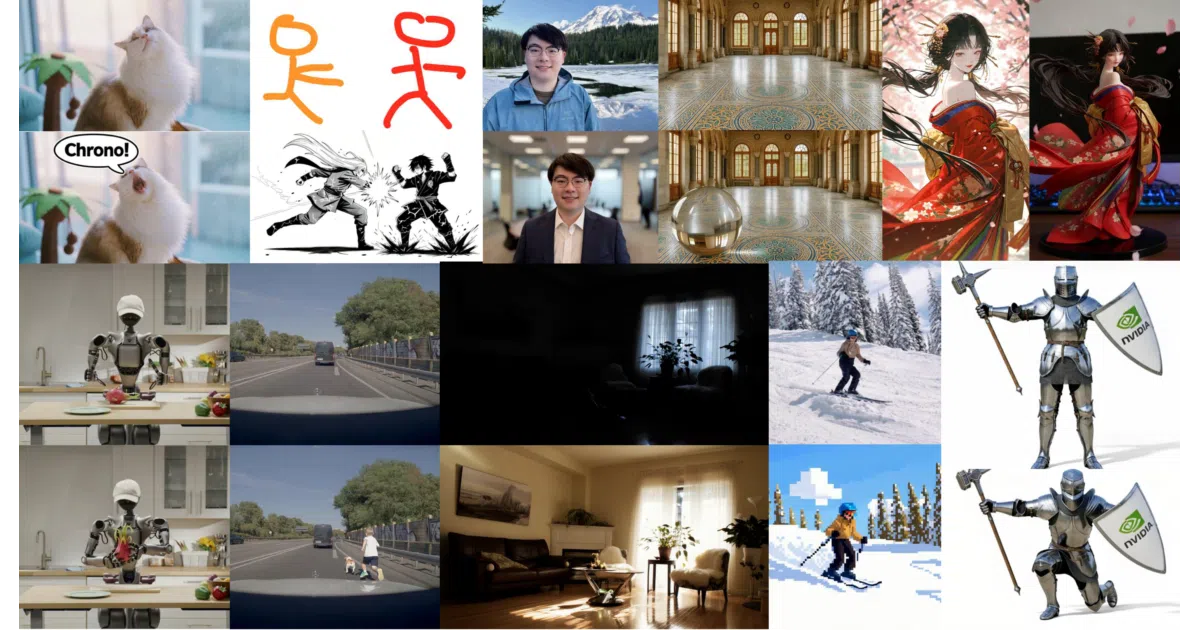
ChronoEdit reframes image editing as video generation, using start and end frames to force temporal consistency and physical plausibility.
Not currently ranked — collecting fresh signals.
star history
What it does ChronoEdit takes an input image and a text prompt, then produces an edited version by treating the original and the target as the first and last frames of a short video. It hijacks pretrained video diffusion models to enforce temporal consistency, effectively generating an editing trajectory rather than a single static result.
The interesting bit The model inserts a temporal reasoning stage that generates intermediate reasoning tokens to plan physically plausible transitions. Instead of simply hallucinating a final image, it visualizes the process of change between two states.
Key highlights
- 14B-parameter diffusion model built on video generation foundations
- Roughly 34 GB of VRAM required for standard inference with model offloading; temporal reasoning mode pushes this to about 38 GB
- Task-specific LoRAs available for upscaling and paint-brush sketch-to-object conversion, plus an 8-step distilled LoRA for faster generation
- Official pipeline integration into HuggingFace Diffusers
- Optional prompt enhancer can auto-improve prompts, though the recommended vision-language model demands up to 60 GB of peak memory
Caveats
- Linux-only; the repository explicitly states it runs only on Linux systems
- Full training infrastructure and smaller 2B checkpoints remain unreleased according to the open-source roadmap
- The recommended prompt enhancer setup is memory-hungry enough to be impractical for many local setups
Verdict Worth exploring if you need physically plausible, temporally consistent image edits and have the GPU headroom to match. Skip it if you’re looking for lightweight consumer hardware inference or a fully released training stack.
Frequently asked
- What is nv-tlabs/ChronoEdit?
- ChronoEdit reframes image editing as video generation, using start and end frames to force temporal consistency and physical plausibility.
- Is ChronoEdit open source?
- Yes — nv-tlabs/ChronoEdit is open source, released under the Apache-2.0 license.
- What language is ChronoEdit written in?
- nv-tlabs/ChronoEdit is primarily written in Python.
- How popular is ChronoEdit?
- nv-tlabs/ChronoEdit has 708 stars on GitHub.
- Where can I find ChronoEdit?
- nv-tlabs/ChronoEdit is on GitHub at https://github.com/nv-tlabs/ChronoEdit.