ningzimu/image-to-editable-ppt-skill
Reverse-engineering PowerPoint from pixels
A Codex skill that rebuilds flattened slide images and PDFs into genuinely editable PowerPoint decks by dispatching subagents to measure, reconstruct, and self-correct every page.
Velocity · 7d
+67
★ / day
Trend
↗accelerating
star history
What it does
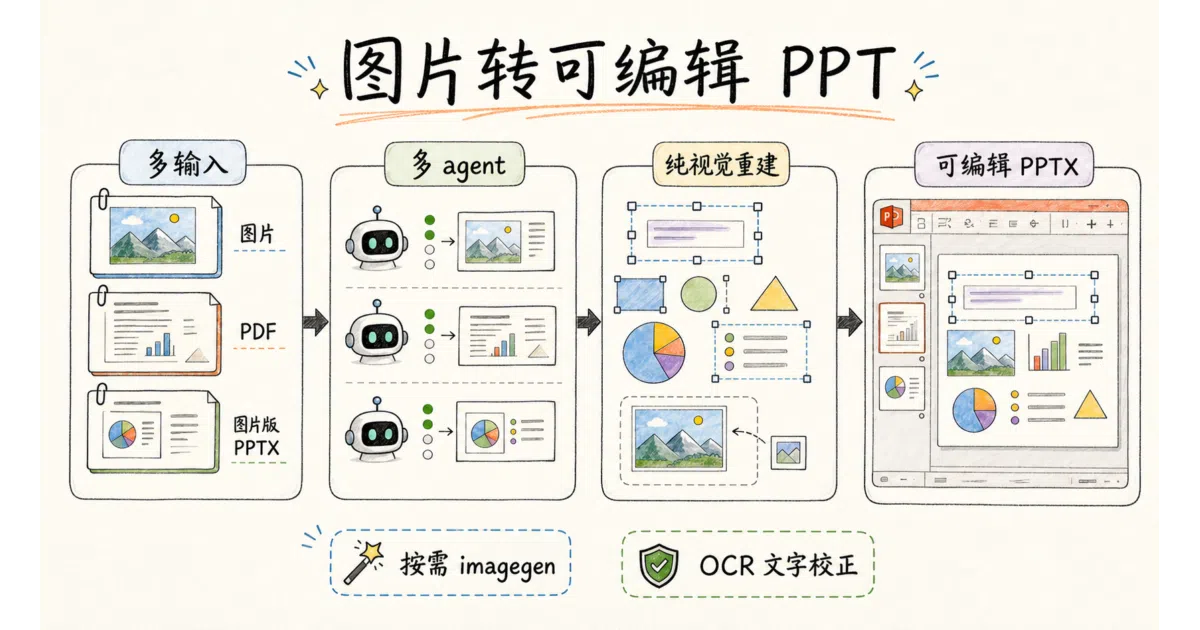
This Codex skill ingests slide images, PDFs, or image-based PPTX files and reconstructs them as native, editable PowerPoint decks. Text becomes real text boxes sized by OCR measurements, simple shapes are redrawn as PowerPoint objects, and complex visuals are extracted as separate image assets. It is essentially a pixel-to-structure converter for presentations that have been flattened into pictures.
The interesting bit
The project treats slide reconstruction as a multi-agent manufacturing line rather than a single-pass conversion. A main agent normalizes input into per-page tasks, then dispatches page workers that loop through “rebuild → self-check → fix” cycles until the output satisfies the model’s own quality bar. It even uses Baidu’s PaddleOCR-VL to measure font sizes and box coordinates so the AI isn’t guessing text placement by eye.
Key highlights
- Supports single images, multi-page PDFs, and image-based PPTX inputs, preserving original page order and speaker notes
- Uses measured OCR data (box coordinates, font size grouping) instead of visual estimation to place and size text
- Splits complex visuals via gpt-image-2: foreground icons and background elements become separate, reusable assets
- Multi-page jobs run concurrently through page worker subagents; single pages execute locally through the same pipeline
- Automatically manages image backend selection (Codex OAuth → OpenAI-compatible API fallback) and installs its own CLI tooling during execution
Caveats
- Token consumption is brutal: the README warns that a 10-page deck can burn through a ChatGPT Pro 5-hour quota, and single pages often take 10+ minutes
- Requires “full access” mode in Codex because it chains OCR, image generation, file I/O, and subagent dispatch; “ask for approval” mode will deadlock the pipeline
- Below gpt-5.5 model support is explicitly not guaranteed, and even then the output may have slight text or element misalignment
Verdict
Worth exploring if you regularly need to edit slide decks that were delivered as screenshots or flattened PDFs. Skip it if you just want to tweak an image—OpenAI’s native image editing is cheaper and faster for one-off fixes.
Frequently asked
- What is ningzimu/image-to-editable-ppt-skill?
- A Codex skill that rebuilds flattened slide images and PDFs into genuinely editable PowerPoint decks by dispatching subagents to measure, reconstruct, and self-correct every page.
- Is image-to-editable-ppt-skill open source?
- Yes — ningzimu/image-to-editable-ppt-skill is open source, released under the MIT license.
- What language is image-to-editable-ppt-skill written in?
- ningzimu/image-to-editable-ppt-skill is primarily written in Python.
- How popular is image-to-editable-ppt-skill?
- ningzimu/image-to-editable-ppt-skill has 2.8k stars on GitHub and is currently accelerating.
- Where can I find image-to-editable-ppt-skill?
- ningzimu/image-to-editable-ppt-skill is on GitHub at https://github.com/ningzimu/image-to-editable-ppt-skill.