nexu-io/open-design
Claude Design went viral and stayed closed; here is the open reply
Open Design turns the coding agents already on your laptop into a local-first design engine for prototypes, decks, motion graphics, and brand systems.
Feature · 10 Jun 2026
The Open-Source Bet Against Anthropic's Design Lock-In
Open Design treats your existing coding agents as a design studio, wiring Claude Code, Codex, Cursor and nineteen others into a local-first artifact engine that exports real HTML, not mockups.
Read the in-depth article →
Velocity · 7d
+250
★ / day
Trend
↗accelerating
star history
What it does
Open Design is a desktop app that treats your existing coding-agent CLI—Claude Code, Codex, Cursor, or any of 20+ others—as the creative engine. You type a brief, pick a design system, and the agent generates real artifacts: single-page HTML prototypes, live dashboards, pitch decks, images, and MP4 motion graphics, all exportable to HTML, PDF, PPTX, or MP4. Everything runs locally through a daemon that spawns the agent in a real project folder with filesystem access, sandboxed previews, and SQLite persistence.
The interesting bit
Instead of bundling its own model, the app auto-detects whatever coding agent is already on your PATH and wires it in via an MCP server; if you have no CLI, a built-in BYOK proxy normalizes streams from Anthropic, OpenAI, Google, or Ollama back into the same loop. It also imports Claude Design export ZIPs so you can pick up where Anthropic left off.
Key highlights
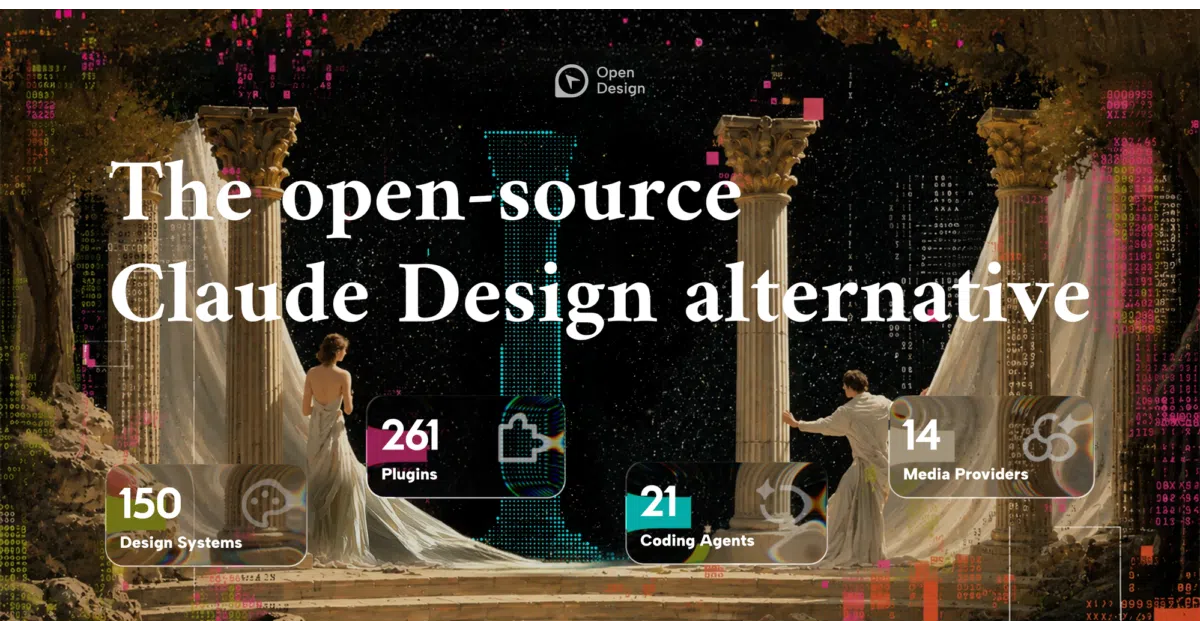
- 150 built-in brand-grade design systems (Linear, Stripe, Apple, etc.) and 261 plugins
- 137+ skills covering prototypes, decks, images, video, and motion graphics (HyperFrames)
- Sandboxed iframe preview with real CSS and fonts; exports to HTML, PDF, PPTX, MP4
- Local-first: SQLite projects, daemon spawns agents on-disk, no cloud lock-in
- Imports Claude Design exports and runs on macOS and Windows
Caveats
- The project is iterating fast on
main; the README explicitly flags aggressive shipping and asks for bug reports - Some local runtimes like ComfyUI are listed as planned adapters, not yet available
- Every agent adapter carries a Windows
ENAMETOOLONGfallback, a tell that cross-platform CLI spawning is still being smoothed out
Verdict
If you want Claude Design’s artifact-first workflow without the cloud lock-in, this is worth the disk space. If you don’t already use a coding-agent CLI, you’ll lean heavily on the BYOK proxy and miss half the local-first charm.
Frequently asked
- What is nexu-io/open-design?
- Open Design turns the coding agents already on your laptop into a local-first design engine for prototypes, decks, motion graphics, and brand systems.
- Is open-design open source?
- Yes — nexu-io/open-design is open source, released under the Apache-2.0 license.
- What language is open-design written in?
- nexu-io/open-design is primarily written in TypeScript.
- How popular is open-design?
- nexu-io/open-design has 104k stars on GitHub and is currently accelerating.
- Where can I find open-design?
- nexu-io/open-design is on GitHub at https://github.com/nexu-io/open-design.