nateherkai/AIS-OS
Turning Claude Code into the intern who never forgets
Because Claude Code works better when it has an employee handbook, a weekly review, and a 3D map of everything you told it.
Velocity · 7d
+8.9
★ / day
Trend
↘cooling
star history
What it does
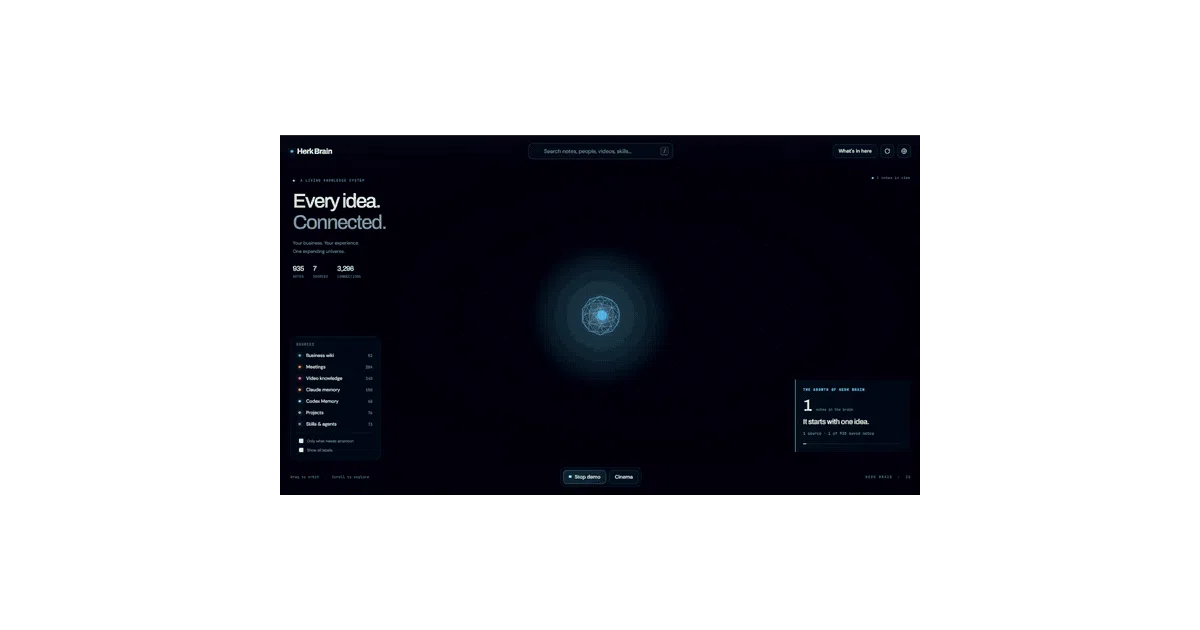
AIS-OS is a collection of six slash-command skills—/onboard, /grill-me, /audit, /link, /level-up, and /3d-brain—plus two trademarked frameworks designed to turn Claude Code or Codex into a persistent business assistant. It interviews you about your work, saves the answers as structured context, and provides a weekly ritual for closing operational gaps one at a time. A local 3D globe visualizer lets you explore your saved notes as a branching knowledge graph.
The interesting bit
The whole thing is built around a litmus test: while you’re away, the system should observe a real-world event and produce output faster and more accurate than you could yourself. Every skill is scored against that standard, and the /audit command actually runs retrieval probes and compatibility checks rather than just patting you on the back.
Key highlights
- Six slash-command skills that generate files, check system health, and route new information into the AI’s context window
- A “Four Cs” architecture (Context, Connections, Capabilities, Cadence) that acts as a maturity model for AI readiness
- A local 3D knowledge globe built from your Markdown notes, served by a prebuilt renderer that needs only Node.js 22
- Weekly
/level-upinterviews that force you to ship one concrete automation rather than endlessly planning - Automatic audit history that tracks findings across runs and distinguishes actual fixes from better evidence
Caveats
- The 3D brain only reads local Markdown/text by default; other formats need adapters
- Skills are authored in
.claude/skills/and synced to Codex via a shell script, so cross-platform edits need manual reconciliation - Audit reports and brainstorm captures are gitignored by default, which keeps history local but also makes it easy to lose
Verdict
Grab this if you’re already living in Claude Code or Codex and want a structured methodology for turning scattered chats into repeatable business context. Skip it if you’re looking for actual infrastructure—this is a thinking framework with a JavaScript visualization layer, not a runtime.
Frequently asked
- What is nateherkai/AIS-OS?
- Because Claude Code works better when it has an employee handbook, a weekly review, and a 3D map of everything you told it.
- Is AIS-OS open source?
- Yes — nateherkai/AIS-OS is an open-source project tracked on heatdrop.
- What language is AIS-OS written in?
- nateherkai/AIS-OS is primarily written in JavaScript.
- How popular is AIS-OS?
- nateherkai/AIS-OS has 1.8k stars on GitHub and is currently cooling off.
- Where can I find AIS-OS?
- nateherkai/AIS-OS is on GitHub at https://github.com/nateherkai/AIS-OS.