mostly-ai/mostlyai
Train synthetic tables and text without leaving your laptop
This toolkit trains generative models on your own hardware to produce privacy-safe synthetic tables, time-series, and text without defaulting to the cloud.
Not currently ranked — collecting fresh signals.
star history
What it does The Synthetic Data SDK is a Python library for training generative models on real tabular or language data and producing synthetic copies that preserve statistical properties without exposing raw records. It runs in LOCAL mode by default, keeping training and generation on your own hardware, or switches to CLIENT mode if you prefer to point it at a remote endpoint. The package also includes connectors for external databases and cloud storage, and generates automated HTML reports measuring fidelity and privacy.
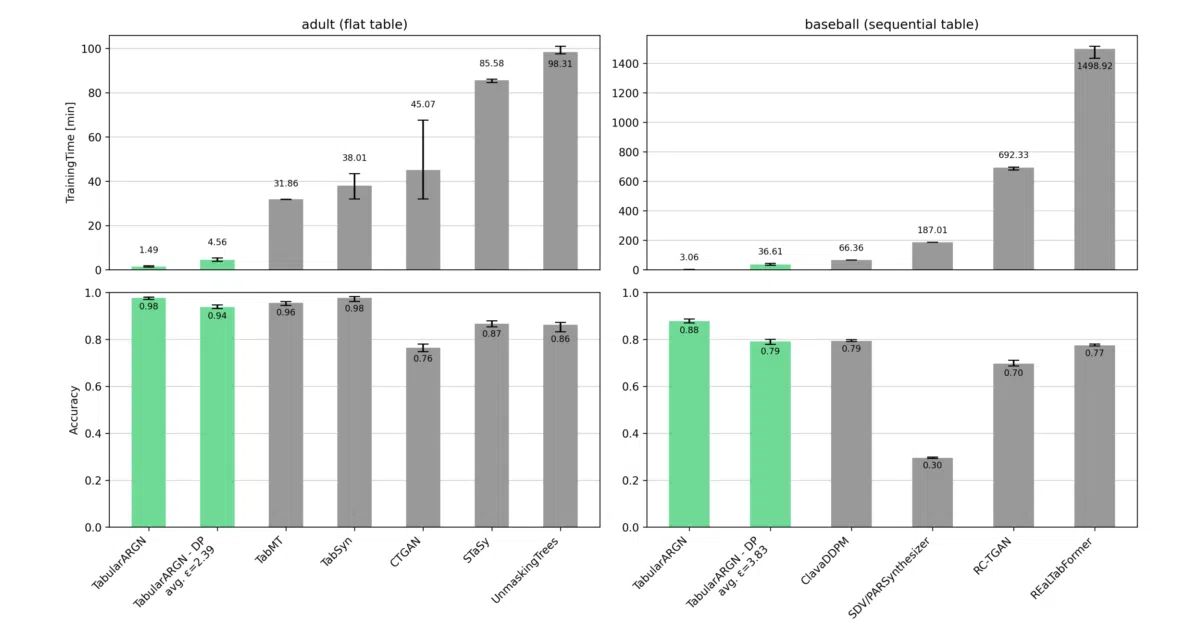
The interesting bit The toolkit is built around TabularARGN, an architecture the authors claim is one to two orders of magnitude more efficient than comparable tabular models, allowing CPU-based training on millions of rows in minutes. That local-first default is a deliberate departure from API-only synthetic-data services, and the SDK extends the same philosophy to language models by letting you fine-tune Hugging Face transformers locally rather than defaulting to a managed LLM endpoint.
Key highlights
- Runs fully offline in LOCAL mode by default; CLIENT mode is available for remote endpoints.
- Supports mixed-type tabular data, multi-table schemas, time-series, and text synthesis.
- Claims to generate millions of synthetic tabular records in minutes on CPU via TabularARGN.
- Offers differential privacy, conditional generation, statistical fairness controls, and automated HTML quality reports.
- Can fine-tune Hugging Face causal LMs or use a lightweight built-in LSTM for simpler text domains.
Caveats
- Language model training and inference are highly dependent on a modern GPU; the CPU path is effectively limited to tabular work.
- The README warns that Google Colab users may need to restart the runtime after installing local extras.
- Performance and quality depend heavily on dataset size, structure, and chosen training epochs; the documentation explicitly recommends a crawl/walk/run approach rather than expecting optimal results out of the box.
Verdict Worth evaluating if you need to share or test against realistic datasets without exposing production data, especially in regulated environments. Skip it if you are looking for a zero-config, fully managed synthetic-data API and do not want to think about model selection or compute resources.
Frequently asked
- What is mostly-ai/mostlyai?
- This toolkit trains generative models on your own hardware to produce privacy-safe synthetic tables, time-series, and text without defaulting to the cloud.
- Is mostlyai open source?
- Yes — mostly-ai/mostlyai is open source, released under the Apache-2.0 license.
- What language is mostlyai written in?
- mostly-ai/mostlyai is primarily written in Python.
- How popular is mostlyai?
- mostly-ai/mostlyai has 803 stars on GitHub.
- Where can I find mostlyai?
- mostly-ai/mostlyai is on GitHub at https://github.com/mostly-ai/mostlyai.