monid-ai/monid
One key, 2,000 tools — and the glue is written by agents
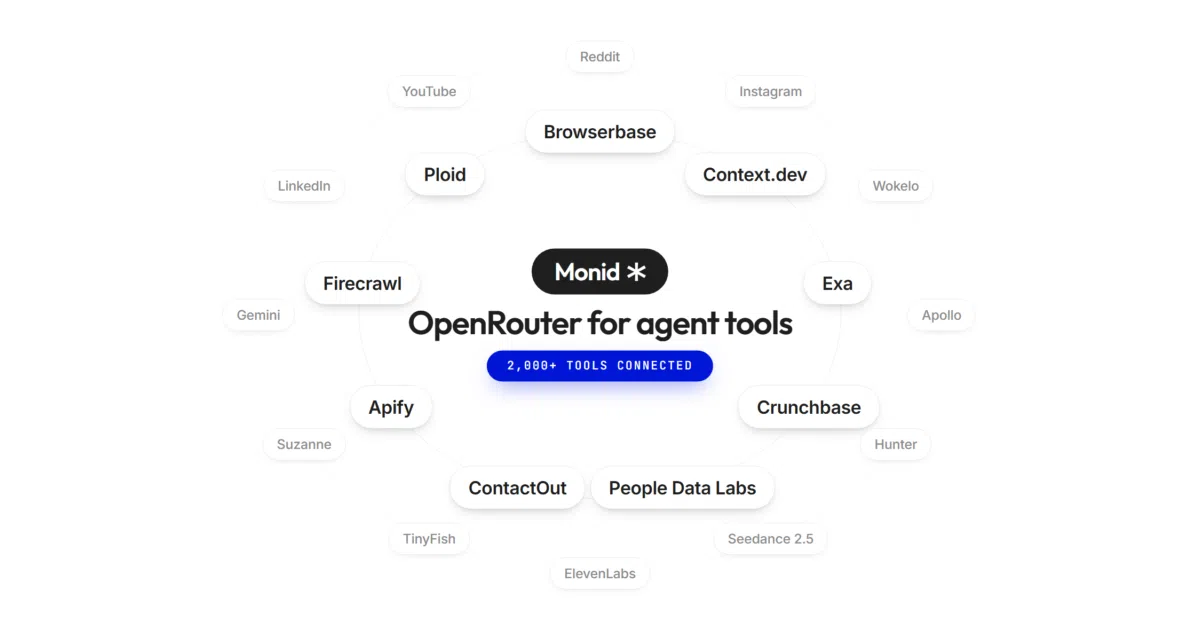
Monid puts 2,000+ tools from 72+ providers behind one base URL and one key, and its connector format is flat enough that a coding agent can write the next integration.
Velocity · 7d
+204
★ / day
Trend
↗accelerating
star history
What it does
Monid is an aggregation layer for the tools agents actually call — web search and scraping, people and company enrichment, social platforms, reviews and market data, and video, image and voice generation. Rather than pinning a vendor per capability months in advance, an agent describes the job and picks from ranked candidates at call time. This repo is the connector layer: the declarative TypeScript contract every endpoint is described in, plus the compiler and engine that run it. Adding a provider is a pull request, and once merged those endpoints appear in discover for every agent on the platform.
The interesting bit
The connector format is deliberately flat — defineProvider for identity, auth, and usage model; defineEndpoint for the request and input schema; no client, no adaptor, no per-provider execution path — because the intended author is often a coding agent: hand it AGENT.md, your API docs, and connectors/exa/ as the worked example, and it produces the schemas and tests. Since CI is typecheck plus 188 replay tests with zero network, review becomes “does this describe your API correctly,” not “does it run.” The glue is the product here, and the bet is that glue an agent can write is glue that scales.
Key highlights
discoverranks the whole catalog per job and returns each candidate’s price, live health, and observed p50/p95 latency, plus hints naming a cheaper or better-fitting endpoint — vendor choice happens at call time, not commit time.- Billing anchors to the wire: usage models (per call, per returned result, or per unit like a thousand characters or a second of video) settle on the raw response envelope before any output mapping, so vendor errors and empty matches settle at zero.
discoverandinspectare free; onlyrunis metered. - Endpoints execute from sealed units: functions become content-hash references interned git-blob style, so one artifact runs identically locally with your vendor key, in CI against replayed fixtures, and hosted — where credentials are injected inside the transport and never enter the engine process.
- Connector copy is load-bearing:
meta.descriptionis the textdiscoverranks, and the README’s advice is to write it “like it is the product, because to an agent it is.” - Apify actors get a head start: a scaffold reads the actor’s published input schema and generates the endpoint’s zod for you to review.
Caveats
- The toolchain is Deno 2.x, not Node — which narrows the contributor pool for what is otherwise a deliberately low-barrier PR format.
- This repo is the connector layer and engine, not the hosted marketplace; the README doesn’t say how many connectors live here versus the platform’s 2,000-tool catalog (it names a handful: exa, tinyfish, contactout, saperly).
- It’s a metered layer:
runbills per use, though some connectors (TinyFish, for one) declare free usage — routing convenience, not a free proxy.
Verdict Agent builders tired of being stuck with whichever vendor happened to get integrated first — and API providers who want agents to find them — should pay attention. If you’re after a self-hosted, free aggregator, note where the repo ends and the hosted, metered platform begins.
Frequently asked
- What is monid-ai/monid?
- Monid puts 2,000+ tools from 72+ providers behind one base URL and one key, and its connector format is flat enough that a coding agent can write the next integration.
- Is monid open source?
- Yes — monid-ai/monid is open source, released under the MIT license.
- What language is monid written in?
- monid-ai/monid is primarily written in TypeScript.
- How popular is monid?
- monid-ai/monid has 6.2k stars on GitHub and is currently accelerating.
- Where can I find monid?
- monid-ai/monid is on GitHub at https://github.com/monid-ai/monid.