modelfoxdotdev/modelfox
AutoML in Rust that doesn't make you write Python
ModelFox trains models from a CSV, then lets you predict from seven languages and monitor drift in a local web app.
Not currently ranked — collecting fresh signals.
star history
What it does
ModelFox is a Rust CLI and library stack for training, running, and monitoring ML models without touching a notebook. Point it at a CSV, it featurizes the data, trains linear and gradient-boosted tree models, and writes a .modelfox file. You then load that file in Elixir, Go, JavaScript, PHP, Python, Ruby, or Rust to make predictions. A local web app (modelfox app) serves up model inspection, tuning, and production monitoring dashboards.
The interesting bit
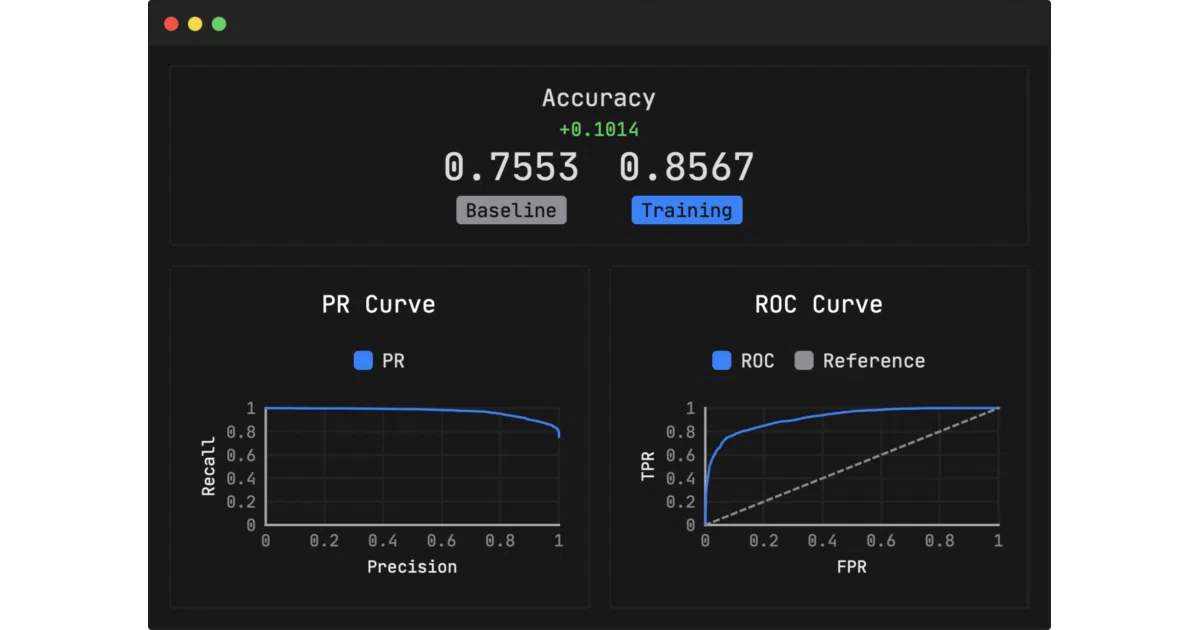
The monitoring layer is baked in, not bolted on. Each prediction gets an identifier; later you log the true value, and the app tracks drift, accuracy, precision, and recall over time. That closed loop—train, predict, log, compare—is usually the hard part of MLOps, and here it is just two API calls and a browser tab.
Key highlights
- CLI training from CSV with automatic feature engineering and model selection
- Prediction libraries for seven languages, all loading the same
.modelfoxartifact - Built-in web UI for model inspection, hyperparameter tuning, and production monitoring
- Drift detection and metric alerts via opt-in prediction logging
- Entire stack is a Cargo workspace; builds with nightly Rust
Caveats
- The
crates/appdirectory (the monitoring web app) is source-available and free for testing, but requires a paid license for production use; the rest is MIT - README mentions v0.8.0 as the latest release, which may or may not still be current
- Requires nightly Rust toolchain to build from source
Verdict
Worth a look if you want low-ceremony AutoML with polyglot deployment and don’t mind the licensing split on the monitoring app. Skip it if you need deep custom architectures or fully open-source production observability.
Frequently asked
- What is modelfoxdotdev/modelfox?
- ModelFox trains models from a CSV, then lets you predict from seven languages and monitor drift in a local web app.
- Is modelfox open source?
- Yes — modelfoxdotdev/modelfox is an open-source project tracked on heatdrop.
- What language is modelfox written in?
- modelfoxdotdev/modelfox is primarily written in Rust.
- How popular is modelfox?
- modelfoxdotdev/modelfox has 1.5k stars on GitHub.
- Where can I find modelfox?
- modelfoxdotdev/modelfox is on GitHub at https://github.com/modelfoxdotdev/modelfox.