miguelgfierro/ai_projects
A blog in notebook form: one researcher's ML curriculum
A personal collection of tutorial notebooks that double as reference implementations for common ML patterns.
Not currently ranked — collecting fresh signals.
star history
What it does
This repo is a curated set of Jupyter notebooks covering CNNs, transfer learning, NLP, recommendation systems, fraud detection, and distributed training. Each project pairs working code with a detailed blog post on the author’s site. Think of it as a course syllabus where every lecture is executable.
The interesting bit
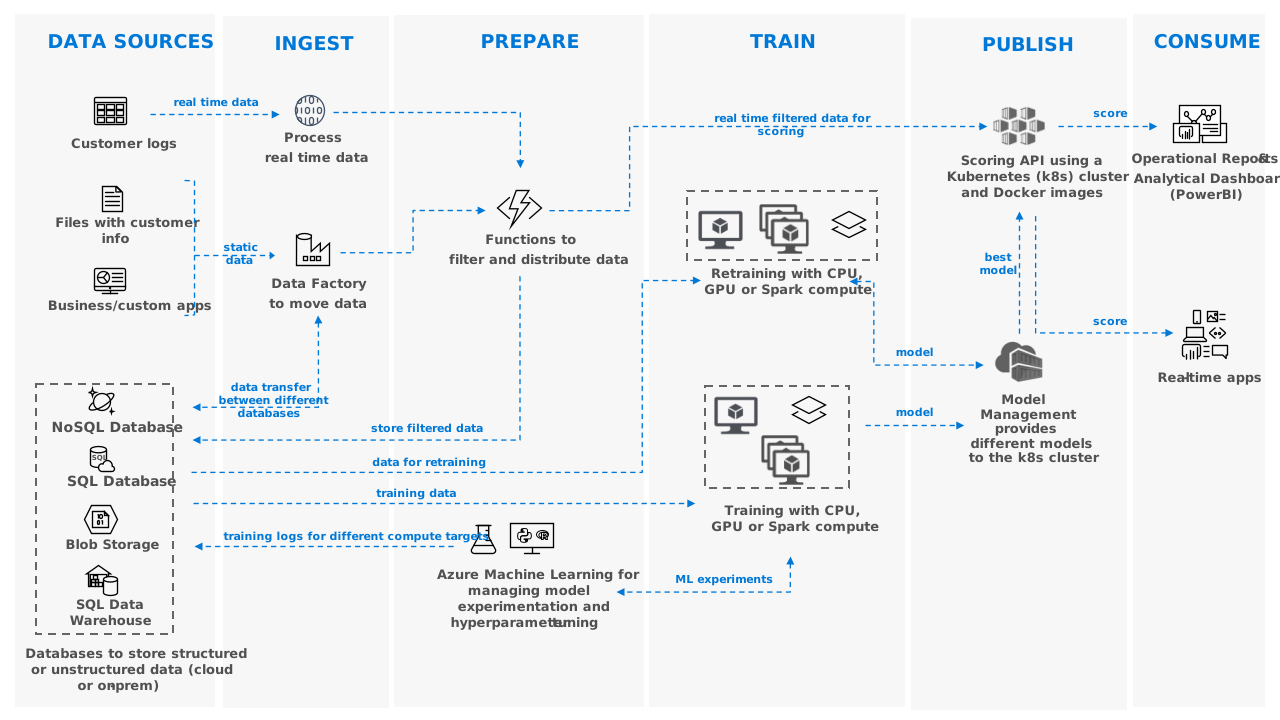
The breadth is deliberately eclectic—MXNet and PyTorch sit next to CNTK and fastText, while a t-SNE visualization notebook rubs shoulders with a DeepSpeed distributed training example. The author isn’t chasing framework uniformity; he’s chasing topic coverage. The included ML reference architecture diagram suggests some attempt at systematic thinking amid the sprawl.
Key highlights
- 12 featured projects spanning computer vision, NLP, time series, and recommender systems
- Each notebook links to a companion blog post with deeper explanation
- Includes operationalization examples (Flask APIs, websockets) not just model training
- One of the few tutorial repos that covers distributed training with DeepSpeed
- Fraud detection notebook includes GPU-accelerated LightGBM plus real-time serving
Caveats
- Framework heterogeneity means inconsistent APIs and dependencies across notebooks
- Some linked libraries (CNTK, MXNet) have declined in community traction since publication
- No centralized requirements or environment setup; each folder is its own island
Verdict
Good for practitioners who learn by reading code plus prose, and who don’t mind context-switching between PyTorch, Keras, and legacy Microsoft frameworks. Skip if you need a unified, production-ready toolkit—this is explicitly a learning scrapbook, not a product.
Frequently asked
- What is miguelgfierro/ai_projects?
- A personal collection of tutorial notebooks that double as reference implementations for common ML patterns.
- Is ai_projects open source?
- Yes — miguelgfierro/ai_projects is an open-source project tracked on heatdrop.
- What language is ai_projects written in?
- miguelgfierro/ai_projects is primarily written in Jupyter Notebook.
- How popular is ai_projects?
- miguelgfierro/ai_projects has 870 stars on GitHub.
- Where can I find ai_projects?
- miguelgfierro/ai_projects is on GitHub at https://github.com/miguelgfierro/ai_projects.