microsoft/qlib
Microsoft's quant research stack now comes with an LLM agent
Qlib provides a full-stack ML pipeline for quantitative finance—from alpha research to order execution—and now plugs into an LLM agent to automate R&D.
Velocity · 7d
+31
★ / day
Trend
↗accelerating
star history
What it does
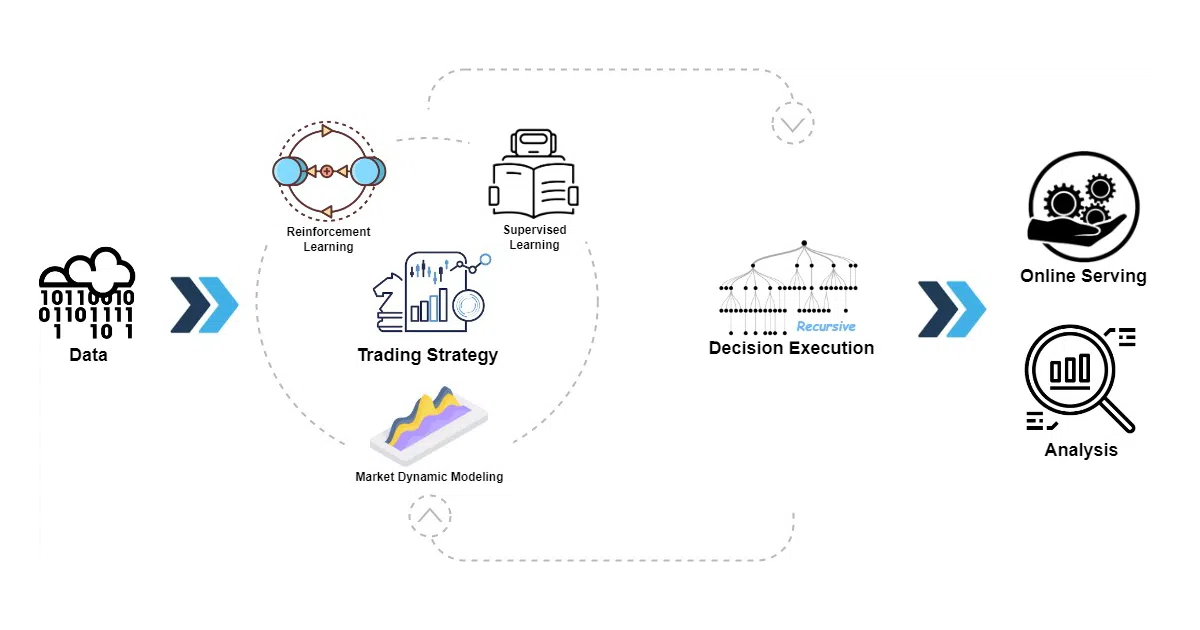
Qlib is an open-source Python platform for quantitative investment that covers the entire workflow: data processing, model training, back-testing, risk modeling, portfolio optimization, and order execution. It treats quant research as a modular ML pipeline where components like data providers, models, and execution strategies are loosely coupled. The project also integrates with Microsoft’s separate RD-Agent project to automate factor mining and model optimization using LLMs.
The interesting bit
Most quant libraries stop at back-testing; Qlib attempts to own the whole chain from signal generation to trade execution. It also doubles as a living repository of recent academic quant research, shipping implementations of papers like HIST, IGMTF, and KRNN alongside the infrastructure. The recent addition of LLM-driven agents suggests the maintainers want to automate not just execution but the research itself.
Key highlights
- Covers full quant lifecycle: alpha seeking, risk modeling, portfolio optimization, and order execution
- Supports diverse ML paradigms: supervised learning, market dynamics modeling, and reinforcement learning
- Modular, loosely-coupled architecture lets components be used standalone
- Ships with a “Quant Model Zoo” implementing recent SOTA research papers
- Now integrates with RD-Agent for LLM-based automated factor mining and model optimization
Caveats
- RD-Agent integration lives in a separate repository; it is not bundled natively
- Several advertised features (e.g., BPQP) are still under review or marked “coming soon”
- The documentation surface is sprawling, which may steepen the learning curve
Verdict
Worth a look if you are a quant researcher or data scientist who wants a unified Python stack for testing ML-driven strategies end-to-end. Skip it if you are looking for a simple trading bot or a lightweight back-tester—this is closer to a research operating system than a script.
Frequently asked
- What is microsoft/qlib?
- Qlib provides a full-stack ML pipeline for quantitative finance—from alpha research to order execution—and now plugs into an LLM agent to automate R&D.
- Is qlib open source?
- Yes — microsoft/qlib is open source, released under the MIT license.
- What language is qlib written in?
- microsoft/qlib is primarily written in Python.
- How popular is qlib?
- microsoft/qlib has 49.7k stars on GitHub and is currently accelerating.
- Where can I find qlib?
- microsoft/qlib is on GitHub at https://github.com/microsoft/qlib.