microsoft/nni
Microsoft’s kitchen-sink AutoML toolkit
It automates the tedious deep-learning lifecycle—tuning, architecture search, compression, and feature engineering—across local laptops and Kubernetes clusters.
Not currently ranked — collecting fresh signals.
star history
What it does NNI is Microsoft’s open-source control plane for automating the unglamorous stages of deep learning. It orchestrates hyperparameter optimization, neural architecture search, and model compression—pruning and quantization—while also claiming support for feature engineering. Experiments can run on a local machine, remote SSH servers, or be farmed out to Kubernetes through backends like Kubeflow and OpenPAI.
The interesting bit Rather than forcing you to duct-tape a separate tuner, NAS library, and compression tool together, NNI bundles them under one WebUI and dispatch layer. The algorithm catalog is deliberately broad: Bayesian optimization and population-based training for HPO, one-shot methods like DARTS and ProxylessNAS for architecture search, plus a half-dozen pruning and quantization strategies. It is the rare toolkit that tries to own the entire post-data-prep pipeline.
Key highlights
- Unifies HPO, NAS, pruning, and quantization in a single codebase and interface.
- Algorithm selection spans TPE, SMAC, BOHB, evolution, Hyperband, DARTS, ENAS, FBNet, and movement or L1 pruning.
- Training services include local, remote SSH, Azure Machine Learning, and Kubernetes variants (Kubeflow, AdaptDL, FrameworkController, PAI DLC).
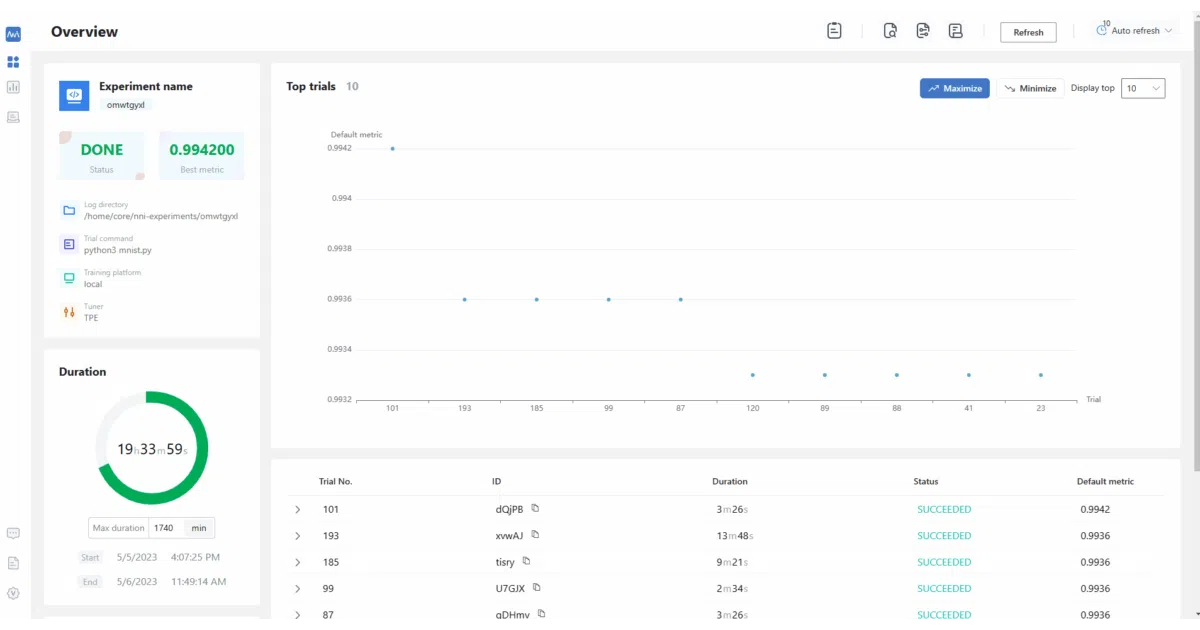
- Ships with a WebUI for monitoring experiments.
- Includes published research artifacts from OSDI 2022 and CVPR 2022.
Caveats
- The README’s “What’s NEW!” section still spotlights a v3.0 preview and video demos from 2022, which suggests the front page has gone stale.
- Feature engineering is name-checked in the description but barely visible in the detailed capability matrix, so its maturity is unclear.
- Framework support lists legacy stacks such as Caffe2 and MXNet alongside modern options like PyTorch and TensorFlow.
Verdict Worth a look if you want one dashboard to manage distributed tuning, architecture search, and compression. Skip it if you prefer a lightweight, single-concern library or the bleeding edge in just one domain.
Frequently asked
- What is microsoft/nni?
- It automates the tedious deep-learning lifecycle—tuning, architecture search, compression, and feature engineering—across local laptops and Kubernetes clusters.
- Is nni open source?
- Yes — microsoft/nni is open source, released under the MIT license.
- What language is nni written in?
- microsoft/nni is primarily written in Python.
- How popular is nni?
- microsoft/nni has 14.4k stars on GitHub.
- Where can I find nni?
- microsoft/nni is on GitHub at https://github.com/microsoft/nni.