microsoft/fara
A 7-billion-parameter model that surfs the web by sight
Fara-7B is a 7-billion-parameter vision model that controls a browser by predicting raw mouse and keyboard actions from screenshots instead of generating text.
Not currently ranked — collecting fresh signals.
star history
What it does
Fara-7B is a small vision-language model that acts as a Computer Use Agent. It looks at webpage screenshots and decides where to click, scroll, or type, executing multi-step tasks like booking flights or filling forms without relying on accessibility trees or separate HTML parsers. It is built on Qwen2.5-VL-7B and fine-tuned on 145K synthetic trajectories generated through Microsoft’s Magentic-One multi-agent framework.
The interesting bit
It predicts exact screen coordinates from raw pixels, cutting out the middleware stack and the cloud bill. Microsoft is unusually thorough about evaluation: alongside the model, they released WebTailBench (609 real-world web tasks) and CUAVerifierBench, a meta-benchmark that scores the judges that score the agents using human-verified ground truth.
Key highlights
- At 7B parameters, it targets on-device deployment and keeps data local rather than shipping screenshots to cloud APIs.
- It averages roughly 16 steps per task, compared to about 41 for comparable models mentioned in the README.
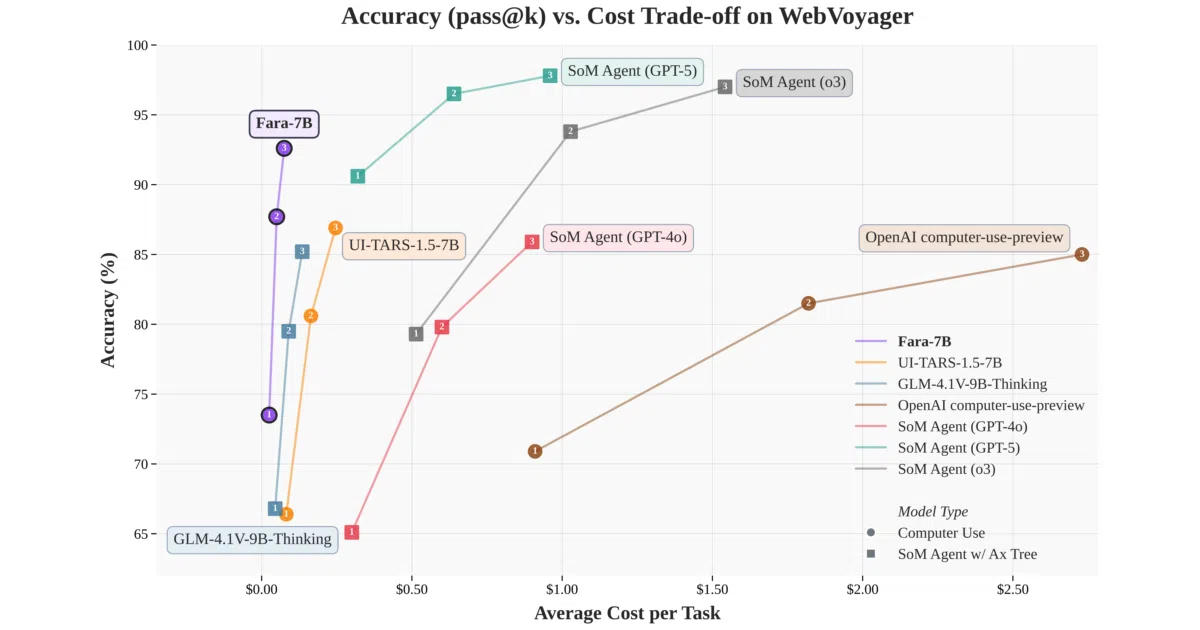
- On WebTailBench, it outperforms other dedicated computer-use models—including larger API-based ones like OpenAI’s computer-use-preview—across all 11 task categories, though it trails stronger Set-of-Mark agents that use GPT-4o.
- The repo ships with a full evaluation harness, the WebTailBench loader, and the Universal Verifier (
MMRubricAgent), a multimodal rubric-based judge ensemble. - A refreshed V2 of WebTailBench was needed because the original V1 tasks contained calendar-bound dates that expired in November 2025.
Caveats
- The benchmark suite had to be revised shortly after release because calendar-bound tasks expired, suggesting real-world web automation remains brittle to shifting UI and time-sensitive content.
- The README recommends WSL2 for Windows users and notes that local inference may require tensor parallelism if memory is tight, so “local” still assumes reasonably modern hardware.
- While it leads among dedicated computer-use models, the published tables show it still trails stronger Set-of-Mark agents powered by frontier models like GPT-4o-0513.
Verdict
Researchers and developers building browser automation or evaluating agent reliability should look here, especially if they need a self-hosted vision agent. If you just need a quick cloud API to control a browser, larger SoM-based stacks remain more accurate.
Frequently asked
- What is microsoft/fara?
- Fara-7B is a 7-billion-parameter vision model that controls a browser by predicting raw mouse and keyboard actions from screenshots instead of generating text.
- Is fara open source?
- Yes — microsoft/fara is open source, released under the MIT license.
- What language is fara written in?
- microsoft/fara is primarily written in Python.
- How popular is fara?
- microsoft/fara has 6.2k stars on GitHub.
- Where can I find fara?
- microsoft/fara is on GitHub at https://github.com/microsoft/fara.