microsoft/0xDeCA10B
Microsoft's blockchain ML experiment: training models where gas is the gradient
A framework that lets strangers collaboratively train machine learning models on Ethereum, with economic mechanisms to punish bad data instead of trusting contributors.
Not currently ranked — collecting fresh signals.
star history
What it does
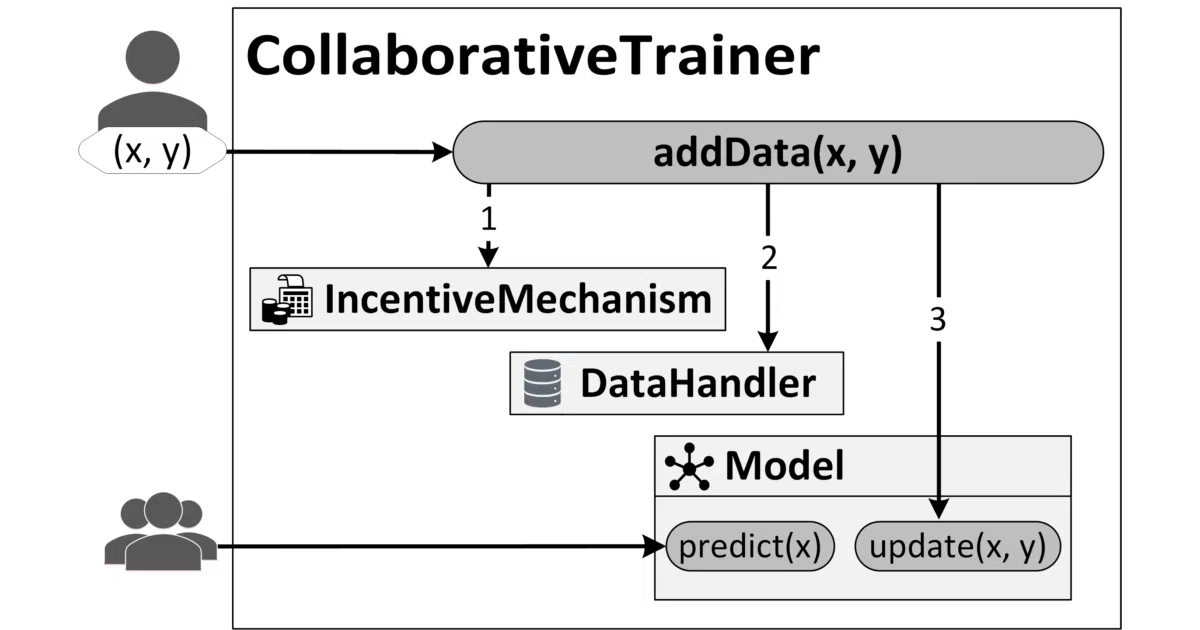
0xDeCA10B hosts publicly trainable ML models as Ethereum smart contracts. Anyone can query predictions for free; adding data requires passing a three-step validation through an incentive mechanism, data handler, and on-chain model update. The project includes Solidity demos with a local test chain and React dashboard, plus Python simulations to test incentive designs before deployment.
The interesting bit
The core insight is economic, not algorithmic: instead of curating data contributors, you make them stake money that they lose if their data hurts model performance. The “Deposit, Refund, and Take: Self-Assessment” mechanism essentially lets other contributors vote with their wallets to confiscate bad deposits. It’s a prediction market wearing a gradient descent costume.
Key highlights
- Supports simple on-chain models (Perceptron, Naive Bayes, Nearest Centroid) with hooks for off-chain computation via oracles or secure multiparty computation
- Three-component architecture: IncentiveMechanism (economic validation), DataHandler (on-chain storage), and model (trainable contract)
- Includes working demo with local blockchain and simulation tools for rapid mechanism testing
- Two published papers: framework overview (Blockchain-2019) and self-assessment mechanism analysis (2020)
- Explicitly acknowledges Ethereum gas costs and model complexity as fundamental constraints
Caveats
- README notes this is largely proof-of-concept; complex models require off-chain workarounds that “are not in the true spirit of this system”
- Last substantive update appears to be 2020; Ethereum has since completed its proof-of-stake transition, making some cost claims dated
- The QR code and aka.ms links suggest this was a Microsoft Research demo project, not active production infrastructure
Verdict
Worth studying if you’re designing decentralized data economies or teaching blockchain limitations through a concrete example. Skip it if you need a working, maintained ML platform—this is research code with a clever incentive mechanism at its core.
Frequently asked
- What is microsoft/0xDeCA10B?
- A framework that lets strangers collaboratively train machine learning models on Ethereum, with economic mechanisms to punish bad data instead of trusting contributors.
- Is 0xDeCA10B open source?
- Yes — microsoft/0xDeCA10B is open source, released under the MIT license.
- What language is 0xDeCA10B written in?
- microsoft/0xDeCA10B is primarily written in Python.
- How popular is 0xDeCA10B?
- microsoft/0xDeCA10B has 612 stars on GitHub.
- Where can I find 0xDeCA10B?
- microsoft/0xDeCA10B is on GitHub at https://github.com/microsoft/0xDeCA10B.