maximhq/bifrost
An AI gateway that claims to outrun the competition by 50x
Bifrost is a Go-based gateway trying to replace LiteLLM with microsecond overhead and enough enterprise features to fill a procurement checklist.
Velocity · 7d
+26
★ / day
Trend
↘cooling
star history
What it does Bifrost sits between your application and 23+ LLM providers—OpenAI, Anthropic, Bedrock, Vertex, Ollama, Groq, and others—exposing them all through a single OpenAI-compatible API. It handles failover, load balancing across API keys, semantic caching, budget controls, and now MCP (Model Context Protocol) tool calling. You can run it as an HTTP gateway with a web UI, embed it directly via Go SDK, or use it as a drop-in base URL replacement for existing SDKs.
The interesting bit The performance claims are aggressive: 11 µs of added latency per request at 5,000 RPS on a t3.xlarge, with ~10 ns key selection time. That’s the kind of overhead that disappears in network jitter. Whether this holds under real provider latency and not just internal benchmarks is the open question.
Key highlights
- Single OpenAI-compatible endpoint for 23+ providers, including streaming and multimodal
- Semantic caching via vector similarity to cut redundant expensive calls
- MCP gateway support for external tool use (filesystem, search, databases)
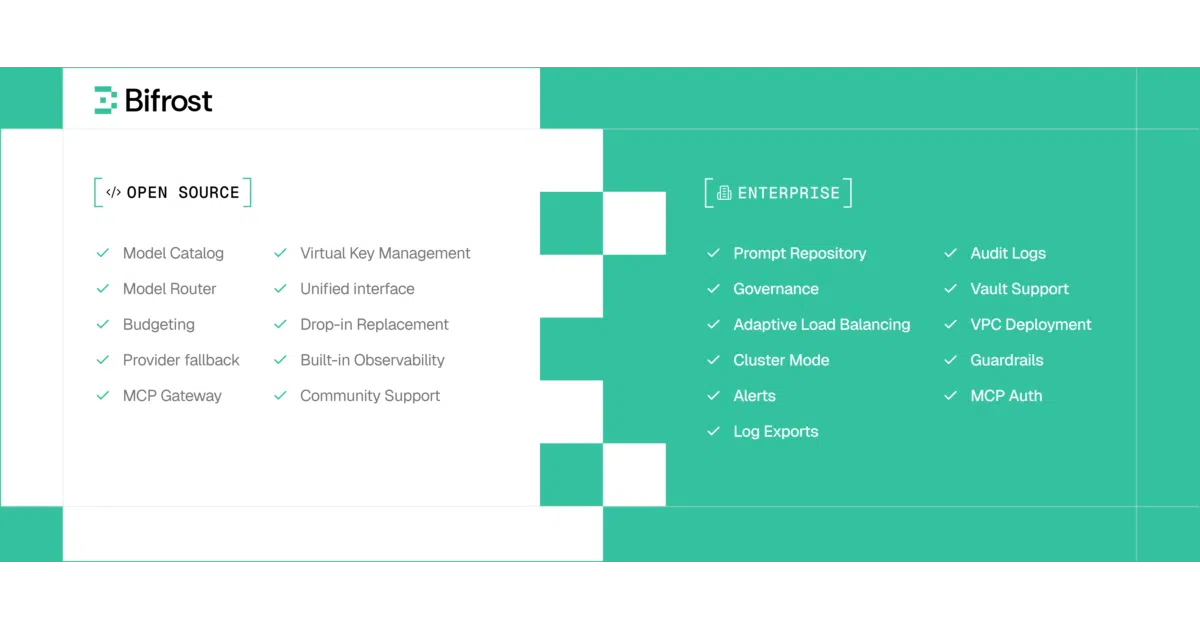
- Enterprise tier adds adaptive load balancing, clustering, guardrails, and OIDC provisioning
- Plugin architecture for custom middleware, observability, and governance hooks
- Weighted API key rotation with ~10 ns selection time
Caveats
- The “50x faster than LiteLLM” claim in the repo description lacks any cited benchmark methodology in the README
- Enterprise features (clustering, adaptive load balancing, guardrails) are gated behind commercial deployment; the open source core appears to be standard gateway functionality
- README is heavy on quickstart commands and light on architectural depth
Verdict Worth evaluating if you’re running high-volume LLM traffic in Go and need provider abstraction with minimal overhead. Skip if you’re already happy with LiteLLM or need deep custom routing logic—the differentiation is speed and packaging, not paradigm.
Frequently asked
- What is maximhq/bifrost?
- Bifrost is a Go-based gateway trying to replace LiteLLM with microsecond overhead and enough enterprise features to fill a procurement checklist.
- Is bifrost open source?
- Yes — maximhq/bifrost is open source, released under the Apache-2.0 license.
- What language is bifrost written in?
- maximhq/bifrost is primarily written in Go.
- How popular is bifrost?
- maximhq/bifrost has 9.1k stars on GitHub and is currently cooling off.
- Where can I find bifrost?
- maximhq/bifrost is on GitHub at https://github.com/maximhq/bifrost.