maum-ai/voicefilter
A beginner's VoiceFilter that outgrew its own shoes
An early-career researcher's PyTorch reimplementation of Google's speaker-conditioned speech separator, now explicitly disowned by its own author.
Not currently ranked — collecting fresh signals.
star history
What it does
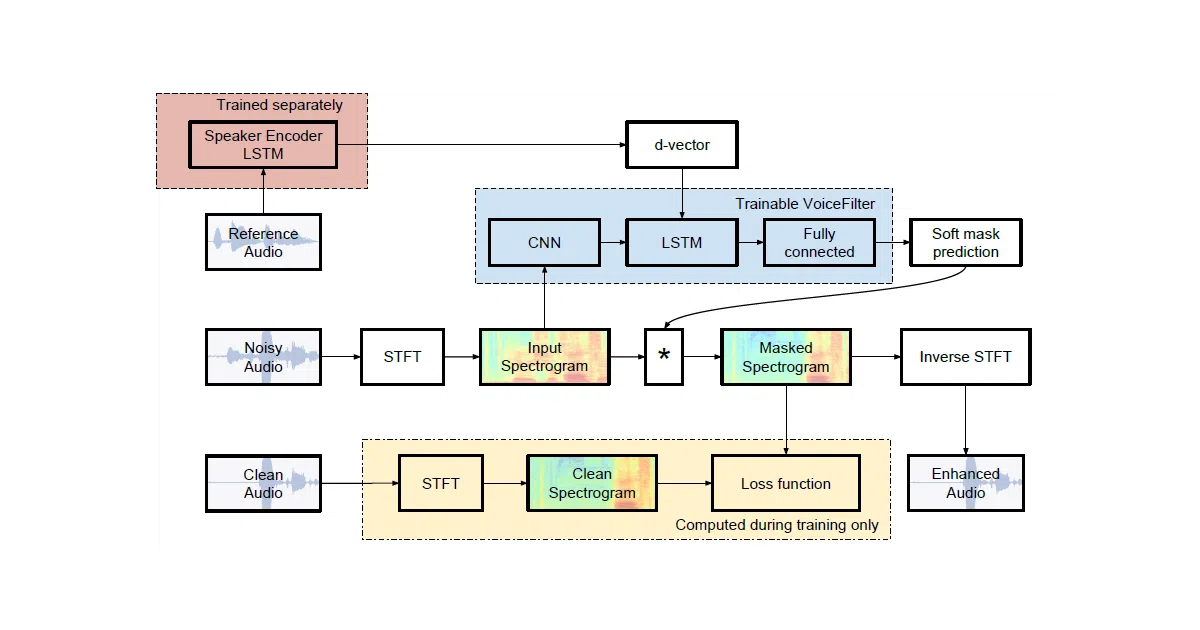
VoiceFilter isolates a target speaker from a mixed audio clip by conditioning on a short reference utterance from that speaker. You feed it a noisy recording plus a clean sample of the voice you want to keep; it returns a spectrogram mask that suppresses everyone else. The repo includes training and inference scripts, a pretrained speaker embedder, and TensorBoard logging.
The interesting bit
The author wrote this three months into learning deep learning, without a supervisor in speech separation. It became the only open-source VoiceFilter implementation on GitHub in March 2019, was cited by the original paper’s first author, and then the author grew skilled enough to recognize its flaws and publicly steer users toward better alternatives. That is an unusually honest lifecycle for a research repo.
Key highlights
- Reproduces Google’s VoiceFilter paper in PyTorch, with median SDR of 10.2 versus the paper’s 12.6
- Includes a pretrained d-vector embedder trained on VoxCeleb2 (EER ~7.4% on a VoxCeleb1 subset)
- Training takes roughly 20 hours on a single V100
- Author now recommends VoiceFilter-Lite and other community implementations instead
- Suggests PyTorch Lightning as a superior project template to the ad-hoc structure used here
Caveats
- The author explicitly warns the code is “quite unreliable” and contains “obvious mistakes” from early inexperience
- No active maintenance: issues and pull requests are not being reviewed
- Uses older PyTorch 1.0.1 and Python 3.6; dependencies may need pinning
- SDR convergence plateaus below paper results, and the author notes incorrect validation practices were used
Verdict
Worth a quick browse if you want to see how a self-taught researcher iterated publicly, or if you need a historical baseline for VoiceFilter. Skip it for production work; the author has already done the homework of finding you better maintained alternatives.
Frequently asked
- What is maum-ai/voicefilter?
- An early-career researcher's PyTorch reimplementation of Google's speaker-conditioned speech separator, now explicitly disowned by its own author.
- Is voicefilter open source?
- Yes — maum-ai/voicefilter is an open-source project tracked on heatdrop.
- What language is voicefilter written in?
- maum-ai/voicefilter is primarily written in Python.
- How popular is voicefilter?
- maum-ai/voicefilter has 1.2k stars on GitHub.
- Where can I find voicefilter?
- maum-ai/voicefilter is on GitHub at https://github.com/maum-ai/voicefilter.