lululxvi/deepxde
Neural nets that actually respect the laws of physics
A Python library for solving differential equations by encoding physics constraints directly into neural network training, rather than learning from labeled data alone.
Not currently ranked — collecting fresh signals.
star history
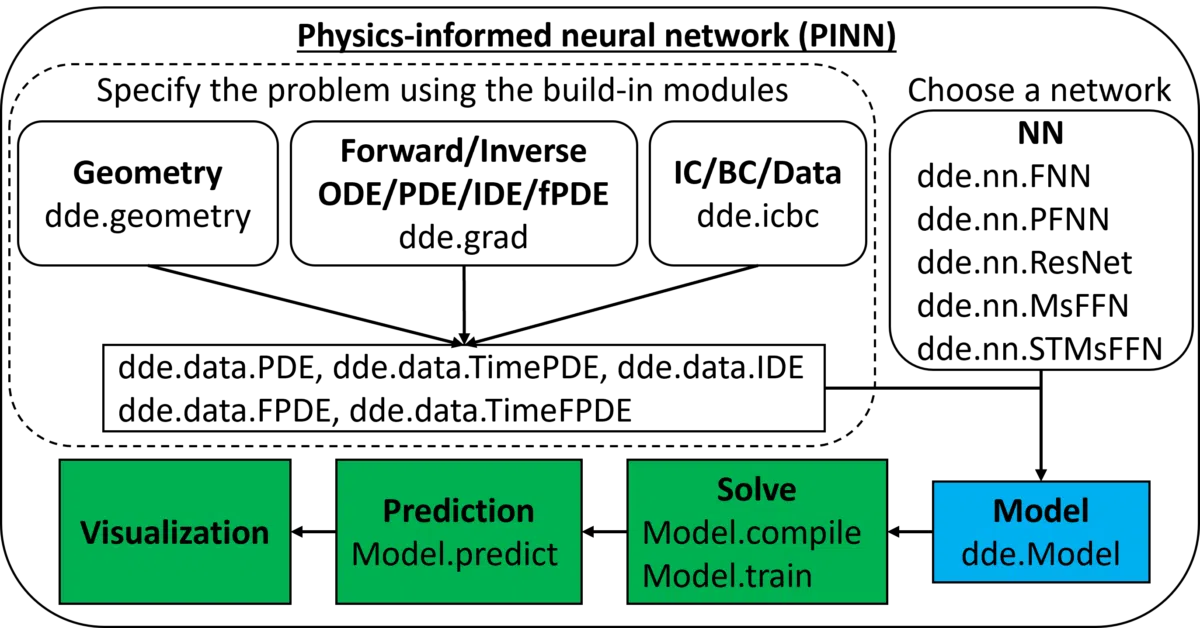
What it does DeepXDE trains neural networks to solve differential equations—ODEs, PDEs, even fractional and stochastic variants—without relying on traditional numerical solvers or mesh generation. You define the equation and boundary conditions; the library handles the rest through physics-informed neural networks (PINNs) and operator learning (DeepONet). It also tackles inverse problems, where you infer unknown parameters from observed data.
The interesting bit The library treats geometry as a first-class citizen. Instead of wrestling with mesh generation, you compose domains via constructive solid geometry—unions, differences, intersections of primitives like spheres, polygons, and point clouds. This is the unglamorous infrastructure that makes PINNs practical for real geometries rather than toy 1D problems.
Key highlights
- Five backend options: TensorFlow 1.x/2.x, PyTorch, JAX, and PaddlePaddle
- Three automatic differentiation modes: reverse, forward, and zero coordinate shift (ZCS)
- Hard constraints via approximate distance functions, plus five boundary condition types
- Adaptive sampling, multi-scale Fourier features, and gradient-enhanced PINNs for accuracy
- Multi-GPU data-parallel training, uncertainty quantification via dropout, and mixed precision support
Caveats
- The README is thorough on algorithms but sparse on performance benchmarks or convergence behavior
- Backend switching requires careful dependency management; JAX and PaddlePaddle support is less battle-tested in the wild than PyTorch/TensorFlow
- Operator learning (DeepONet variants) is a rapidly moving research area; API stability is unclear
Verdict Worth a look if you’re doing computational physics, inverse problems, or any domain where labeled data is scarce but governing equations are known. Skip it if you need mature, production-grade CFD or FEA workflows—this is research tooling with a 4,200-star community, not a replacement for COMSOL.
Frequently asked
- What is lululxvi/deepxde?
- A Python library for solving differential equations by encoding physics constraints directly into neural network training, rather than learning from labeled data alone.
- Is deepxde open source?
- Yes — lululxvi/deepxde is open source, released under the LGPL-2.1 license.
- What language is deepxde written in?
- lululxvi/deepxde is primarily written in Python.
- How popular is deepxde?
- lululxvi/deepxde has 4.5k stars on GitHub.
- Where can I find deepxde?
- lululxvi/deepxde is on GitHub at https://github.com/lululxvi/deepxde.