lucidrains/soundstorm-pytorch
SoundStorm in PyTorch: parallel audio by masking SoundStream tokens
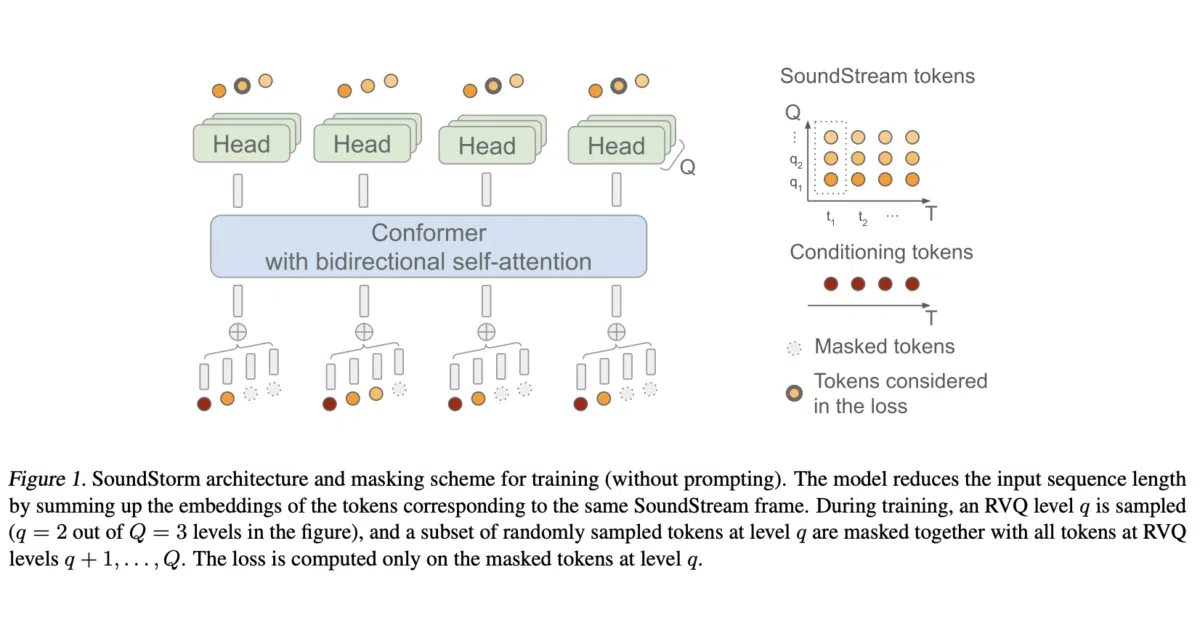
This repo implements Google DeepMind’s SoundStorm, applying MaskGiT’s parallel demasking strategy to SoundStream residual vector-quantized codes for fast, non-autoregressive audio synthesis.
Not currently ranked — collecting fresh signals.
star history
What it does
The project is a PyTorch port of SoundStorm, an efficient non-autoregressive audio generator from Google DeepMind. It consumes residual vector-quantized token sequences from a SoundStream codec and iteratively demasks them—using the Conformer architecture—to produce raw audio or semantic speech representations. When wired to a trained TextToSemantic transformer, it can function as a text-to-speech pipeline, though that upstream component remains a work in progress.
The interesting bit
The clever twist is borrowing MaskGiT’s image-generation playbook for audio: instead of sampling tokens left-to-right, the model starts with a fully masked sequence and unmasks the most confident predictions over a fixed schedule—18 steps by default. It swaps Shaw’s old relative positional embeddings for rotary embeddings and defaults to Flash Attention, which keeps the Conformer blocks lean.
Key highlights
- Trains on pre-encoded
SoundStreamRVQ codes or raw audio passed through an integrated codec. - Uses Conformer blocks with rotary position embeddings and Flash Attention enabled by default.
- Supports variable-length sequences via masking and grouped RVQ via concatenated embeddings.
- Includes acoustic prompting and per-level quantizer decoding for finer control.
- Ships with a Hugging Face Accelerate-based trainer and has been verified end-to-end by community contributors.
Caveats
- Full text-to-speech is blocked by unfinished upstream work:
spear-tts-pytorchstill needs pretraining, pseudo-labeling, and backtranslation logic. - The todo list shows cross-attention, adaptive layernorm conditioning, and a command-line interface are not yet implemented.
- The repository is explicitly labeled a work-in-progress.
Verdict
Audio researchers and TTS hackers who want a non-autoregressive, parallel decoder to pair with their own SoundStream or semantic encoder should look here. If you need a polished, batteries-included speech synthesis product, this is still too early.
Frequently asked
- What is lucidrains/soundstorm-pytorch?
- This repo implements Google DeepMind’s SoundStorm, applying MaskGiT’s parallel demasking strategy to SoundStream residual vector-quantized codes for fast, non-autoregressive audio synthesis.
- Is soundstorm-pytorch open source?
- Yes — lucidrains/soundstorm-pytorch is open source, released under the MIT license.
- What language is soundstorm-pytorch written in?
- lucidrains/soundstorm-pytorch is primarily written in Python.
- How popular is soundstorm-pytorch?
- lucidrains/soundstorm-pytorch has 1.5k stars on GitHub.
- Where can I find soundstorm-pytorch?
- lucidrains/soundstorm-pytorch is on GitHub at https://github.com/lucidrains/soundstorm-pytorch.