lucidrains/iTransformer
Attention takes on time-series forecasting, inverted
It unofficially ports the iTransformer paper to PyTorch, offering modular attention-based models for multivariate time-series forecasting with improvised experimental variants.
Not currently ranked — collecting fresh signals.
star history
What it does
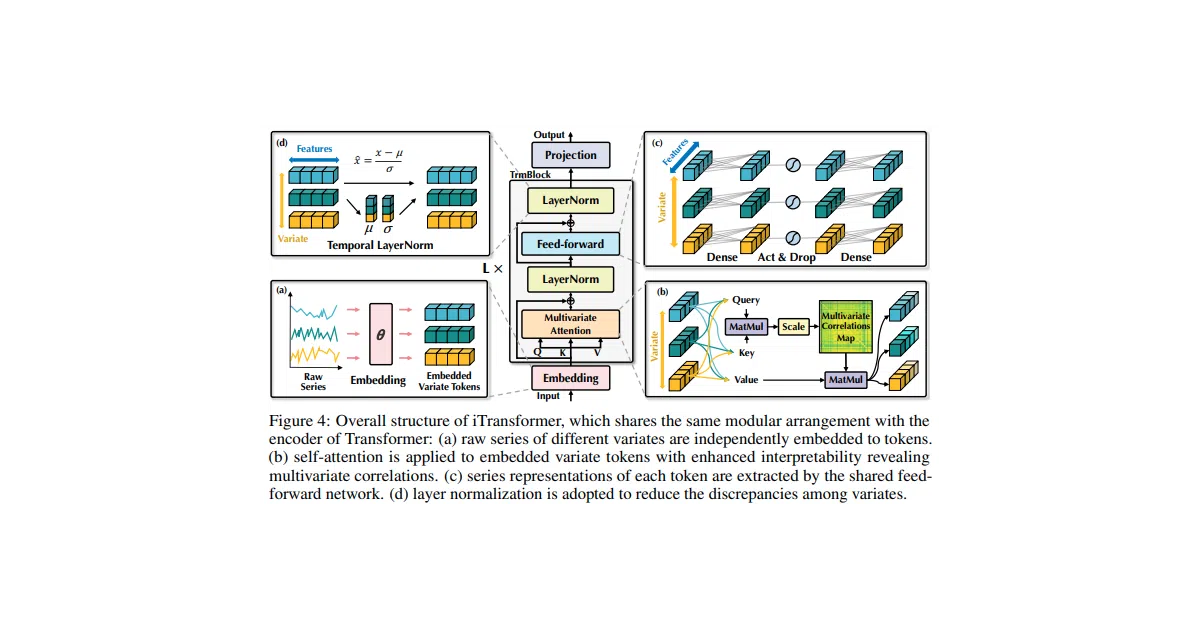
iTransformer is an unofficial PyTorch implementation of the Tsinghua/Ant Group paper on time-series forecasting with attention networks. The repository provides the core iTransformer module, an improvised iTransformer2D variant that also attends across patched time tokens, and an experimental iTransformerFFT that mixes in Fourier tokens, all returning predictions for multiple future horizons in one pass. It is strictly a model-building block, not a full training framework; the README shows model definitions but leaves data pipelines and loss functions to you.
The interesting bit
The README wryly notes that only tabular data remains—where xgboost still reigns—before the field can truly declare “Attention is all you need.” Beyond the joke, the repository treats the architecture as a testbed, improvising 2D and Fourier variants that go beyond the original paper’s design.
Key highlights
- Returns simultaneous multi-horizon forecasts (e.g., 12, 24, 36, 48 steps) from a single forward pass.
iTransformer2Dimprovises attention across both variates and patched time tokens.iTransformerFFTis an experimental variant that adds Fast Fourier Transform tokens to the mix.- Optional reversible instance normalization is included, though the author muses it may be redundant.
- Ships as bare PyTorch modules with no training loop or data pipeline attached.
Caveats
- This is an unofficial implementation; the authors’ official code is linked in the README.
iTransformer2D,iTransformerFFT, andnum_tokens_per_variateare explicitly labeled experimental or improvised.- The README contains no benchmarks, training recipes, or reproducibility details.
Verdict
Grab this if you want an unofficial, hackable PyTorch module for experimenting with recent time-series attention architectures. Skip it if you need an official reference implementation or a batteries-included training framework.
Frequently asked
- What is lucidrains/iTransformer?
- It unofficially ports the iTransformer paper to PyTorch, offering modular attention-based models for multivariate time-series forecasting with improvised experimental variants.
- Is iTransformer open source?
- Yes — lucidrains/iTransformer is open source, released under the MIT license.
- What language is iTransformer written in?
- lucidrains/iTransformer is primarily written in Python.
- How popular is iTransformer?
- lucidrains/iTransformer has 541 stars on GitHub.
- Where can I find iTransformer?
- lucidrains/iTransformer is on GitHub at https://github.com/lucidrains/iTransformer.