lucidrains/enformer-pytorch
Attention meets DNA: Enformer, now in PyTorch
It gives DeepMind’s attention-based gene-expression model a native PyTorch home, ported weights and all.
Not currently ranked — collecting fresh signals.
star history
What it does
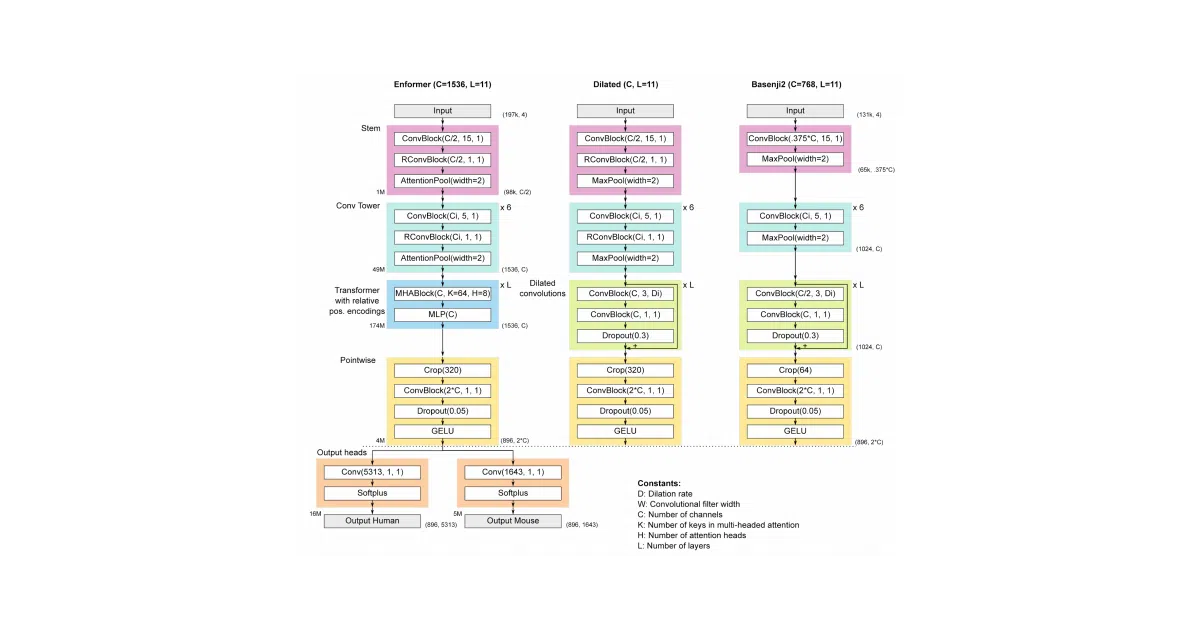
This repository re-implements DeepMind’s Enformer, a transformer-style network that predicts gene expression from long DNA sequences, entirely in PyTorch. It bundles the official TensorFlow Sonnet weights—ported to PyTorch and hosted on HuggingFace—along with task-specific fine-tuning wrappers and a GenomicIntervalDataset helper that reads .bed files, handles chromosome name remapping, and applies shift or reverse-complement augmentations on the fly.
The interesting bit
The heavy lifting here is numerical archaeology: the author tracked down a xlogy gamma discrepancy between TensorFlow and PyTorch that was causing layer-by-layer drift, then locked in precomputed gamma positions so the ported model actually hits the paper’s reported Pearson R values. Beyond the port, the repository exposes intermediate embeddings and offers three distinct adapter wrappers—head, static context, and cross-attention context—so you can freeze the backbone and still specialize the model for new cell types or tracks.
Key highlights
- Pretrained weights (~1 GB) load via HuggingFace with corrected gamma positions to fix the original port’s rounding errors.
- Accepts DNA sequences as integer indices or one-hot floats, with an optional
return_embeddingsflag for feature extraction. - Fine-tuning wrappers include
HeadAdapterWrapper,ContextAdapterWrapper, andContextAttentionAdapterWrapperfor new tracks or contextual conditioning. GenomicIntervalDatasetdynamically pads and lengthens intervals, maps chromosome names between.bedand FASTA files, and returns augmentation metadata.- Built-in Poisson loss and Pearson correlation coefficient computation for training and evaluation.
Caveats
- The ported checkpoint is explicitly labeled “rough” because numerical differences can still accrue across layers; v0.8.0 fixes the known
xlogymismatch, but the README notes the original port showed absolute errors as high as 0.5, and models instantiated manually viafrom_hparamsstill needuse_tf_gamma = Trueto avoid drift. - Basic training utilities such as gradient accumulation remain on the todo list, so expect to supply your own loop logic.
Verdict
Computational biologists and ML researchers who want Enformer’s long-sequence attention in native PyTorch should start here. If you need a fully packaged training framework with all scaffolding included, it is still a bit too bare-bones.
Frequently asked
- What is lucidrains/enformer-pytorch?
- It gives DeepMind’s attention-based gene-expression model a native PyTorch home, ported weights and all.
- Is enformer-pytorch open source?
- Yes — lucidrains/enformer-pytorch is open source, released under the MIT license.
- What language is enformer-pytorch written in?
- lucidrains/enformer-pytorch is primarily written in Python.
- How popular is enformer-pytorch?
- lucidrains/enformer-pytorch has 575 stars on GitHub.
- Where can I find enformer-pytorch?
- lucidrains/enformer-pytorch is on GitHub at https://github.com/lucidrains/enformer-pytorch.