limix-ldm-ai/LimiX
Tabular data finally gets a foundation model
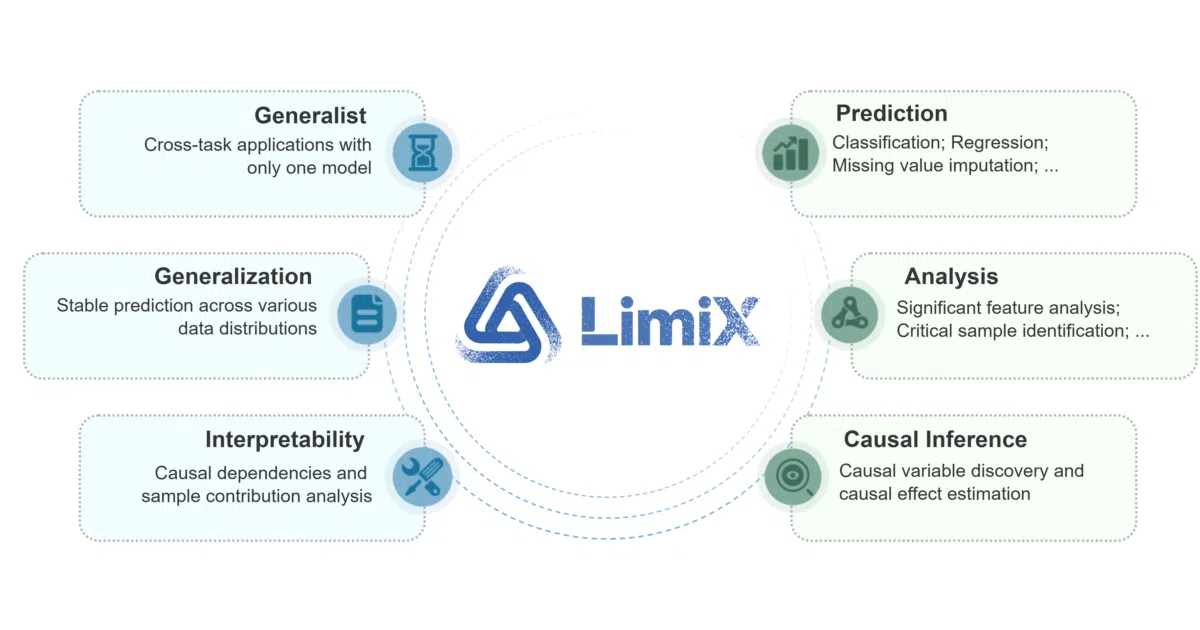
LimiX is a transformer-based model that treats tables as token sequences, applying attention across both rows and columns to handle classification, regression, and missing-value imputation with a single pretrained recipe.
Not currently ranked — collecting fresh signals.
star history
What it does
LimiX is a transformer architecture designed to unify tabular machine learning. It embeds features and targets into tokens, then applies attention across both sample and feature dimensions to identify patterns before routing representations to task-specific heads. The project releases pretrained weights in two sizes—16M and 2M parameters—and wraps inference in a LimiXPredictor class that accepts NumPy arrays and handles classification, regression, and missing-value imputation.
The interesting bit
The authors are pitching a shift from bespoke pipelines—where every new dataset demands a fresh model—to a foundation-style “one model, many tables” approach. An optional retrieval mechanism ensembles over similar training samples during inference, letting you trade GPU memory for accuracy, or disable it entirely to run leaner on modest hardware.
Key highlights
- Claims state-of-the-art performance on multiple benchmarks, though the README presents charts rather than explicit metric tables.
- Supports mixed-precision inference and distributed data parallel for multi-GPU setups.
- Exposes categorical-feature indices and outlier stripping via a standard-deviation threshold directly in the predictor interface.
- Ships with separate JSON presets for retrieval and no-retrieval modes, so you can toggle the accuracy-speed tradeoff without rewriting code.
Caveats
- The README advertises feature selection, sample selection, and causal inference as supported tasks, yet only classification, regression, and missing-value imputation are actually demonstrated in the inference tutorials.
- Ensemble retrieval inference currently requires hardware stricter than an NVIDIA RTX 4090, which limits accessibility.
- Weights and inference code are tightly coupled to specific PyTorch, CUDA, and
flash_attnversions.
Verdict
Teams drowning in one-off tabular notebooks may find LimiX worth a look if they have the GPU budget. If your work is CPU-bound or you need transparent, tweakable tree-based models, keep walking.
Frequently asked
- What is limix-ldm-ai/LimiX?
- LimiX is a transformer-based model that treats tables as token sequences, applying attention across both rows and columns to handle classification, regression, and missing-value imputation with a single pretrained recipe.
- Is LimiX open source?
- Yes — limix-ldm-ai/LimiX is an open-source project tracked on heatdrop.
- What language is LimiX written in?
- limix-ldm-ai/LimiX is primarily written in Python.
- How popular is LimiX?
- limix-ldm-ai/LimiX has 4.4k stars on GitHub.
- Where can I find LimiX?
- limix-ldm-ai/LimiX is on GitHub at https://github.com/limix-ldm-ai/LimiX.