langchain-ai/open-canvas
Open Canvas: ChatGPT Canvas, but you can actually see the wiring
An open-source, MIT-licensed collaboration surface for writing and coding with LLMs that remembers who you are across sessions.
Not currently ranked — collecting fresh signals.
star history
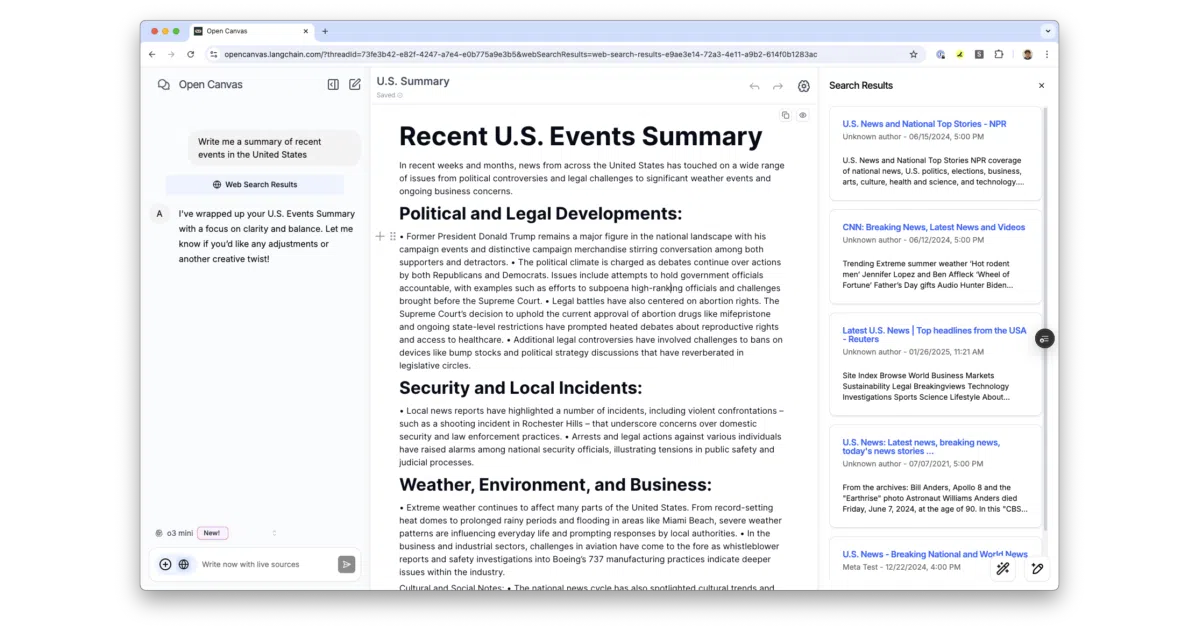
What it does Open Canvas is a web app for writing documents and code alongside LLM agents. It pairs a chat sidebar with a central editor that handles both Markdown and code, and it versions every artifact so you can rewind. The hosted version runs at opencanvas.langchain.com; the full stack—Next.js frontend, LangGraph agents, reflection memory—is open source.
The interesting bit The project is explicitly framed as an open response to OpenAI’s Canvas, but the architectural bet is different: everything is agent-orchestrated through LangGraph, including a reflection agent that distills style rules and user facts into a shared memory store. That memory persists across sessions, which is the rare feature that makes “personalization” concrete rather than marketing.
Key highlights
- Built-in memory: A reflection agent automatically generates and stores memories about you and your history; subsequent sessions include them.
- Custom quick actions: User-defined prompts tied to your account, invoked in one click and applied to the current artifact.
- Artifact versioning: Every document or code block keeps a version history; you can browse prior states.
- Live Markdown rendering: Edit and preview Markdown simultaneously without toggling views.
- Multi-model by design: Ships with Claude 3 Haiku, Llama 3 70B via Fireworks, and GPT-4o Mini; supports Ollama locally if you bring your own hardware.
Caveats
- Setup is not casual: Requires Yarn, Supabase for auth, LangGraph CLI, LangSmith, and at minimum OpenAI and Anthropic API keys. The README devotes most of its length to troubleshooting port conflicts, thread ID cookies, and missing model configs.
- Local LLMs are second-class: The README warns that open-source models “are typically not as good at instruction following” and may throw errors or behave unexpectedly.
- Monorepo build step: You must
yarn buildfrom root before the LangGraph server and frontend will talk to each other correctly.
Verdict Worth a look if you’re building agentic writing tools and want a reference architecture for memory, versioning, and multi-model routing in LangGraph. Skip it if you just want a polished drop-in replacement for ChatGPT; the setup tax is real, and the hosted version is the easier on-ramp.
Frequently asked
- What is langchain-ai/open-canvas?
- An open-source, MIT-licensed collaboration surface for writing and coding with LLMs that remembers who you are across sessions.
- Is open-canvas open source?
- Yes — langchain-ai/open-canvas is open source, released under the MIT license.
- What language is open-canvas written in?
- langchain-ai/open-canvas is primarily written in TypeScript.
- How popular is open-canvas?
- langchain-ai/open-canvas has 5.5k stars on GitHub.
- Where can I find open-canvas?
- langchain-ai/open-canvas is on GitHub at https://github.com/langchain-ai/open-canvas.