kubeflow/manifests
The YAML you need to run Kubeflow on someone else's computer
Curated Kubernetes manifests that wire together a dozen ML services so you don't have to.
Not currently ranked — collecting fresh signals.
star history
What it does
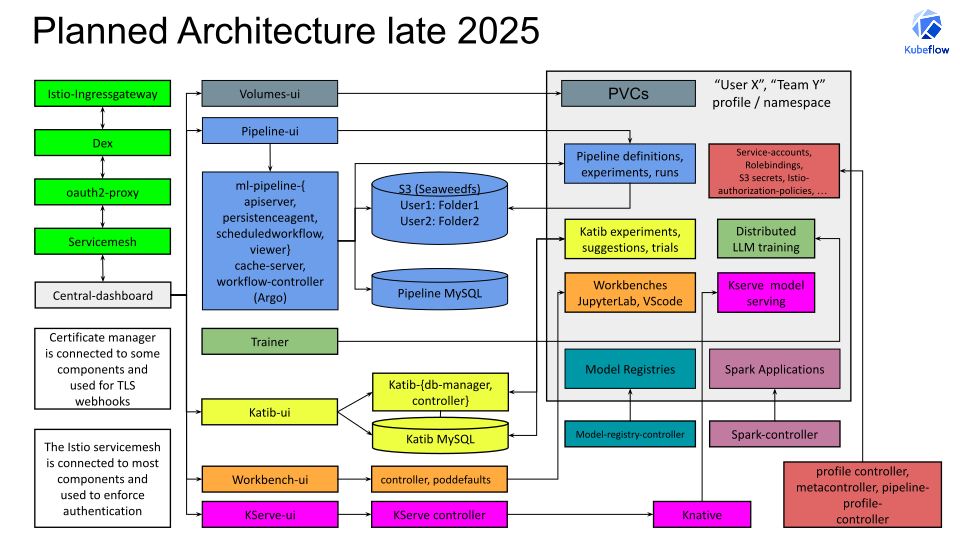
This repo is the official assembly manual for the Kubeflow Platform: a collection of Kustomize (and some experimental Helm) manifests that install Pipelines, KServe, Katib, Notebooks, Istio, Knative, and roughly fifteen other moving parts onto Kubernetes clusters ranging from Kind on a laptop to EKS/AKS/GKE in production. It targets shops with legal, security, and multi-tenancy requirements—plus academics who want to kick the tires without writing their own YAML spaghetti.
The interesting bit
The value isn’t any single component; it’s the integration testing and release cadence. The maintainers run end-to-end CI on every PR, pin upstream versions in a public matrix, and cut twice-yearly date-stamped releases (e.g., 26.03, 26.10) aligned with KubeCon. That predictability matters when you’re the platform team explaining to auditors why your ML infrastructure won’t change underneath them.
Key highlights
- Single-command install via
example/kustomization.yamlor à-la-carte component selection - Explicit resource budget: ~4.4 CPU cores, ~12 GiB RAM, 65 GB PVC for the full stack
- Supports Kind, Minikube, Rancher, EKS, AKS, GKE; OpenShift “possible” per docs
- Experimental Helm charts and third-party integrations (Ray, Spark) live under
experimental/ - 6 months best-effort community support per release; commercial support available
Caveats
- ARM64/aarch64 is not fully supported; some images lack
linux/arm64manifests and the project is actively seeking help via a 2026 GSoC project - Default credentials are
user@example.com/12341234—the README warns this must change for production, but it’s still the out-of-box experience kubectl applymay need multiple runs due to CRD/CR ordering races; the install docs include a bash retry loop rather than fixing the ordering
Verdict
Platform engineers building an internal MLaaS offering should bookmark this. Solo practitioners on M-series Macs or teams wanting a fully managed experience should look elsewhere—or at least budget time for the ARM64 workaround thread.
Frequently asked
- What is kubeflow/manifests?
- Curated Kubernetes manifests that wire together a dozen ML services so you don't have to.
- Is manifests open source?
- Yes — kubeflow/manifests is open source, released under the Apache-2.0 license.
- What language is manifests written in?
- kubeflow/manifests is primarily written in YAML.
- How popular is manifests?
- kubeflow/manifests has 1k stars on GitHub.
- Where can I find manifests?
- kubeflow/manifests is on GitHub at https://github.com/kubeflow/manifests.