keijiro/AIShader
Unity shaders by way of ChatGPT API
A Unity plug-in that generates shaders by calling the ChatGPT API.
Not currently ranked — collecting fresh signals.
star history
What it does
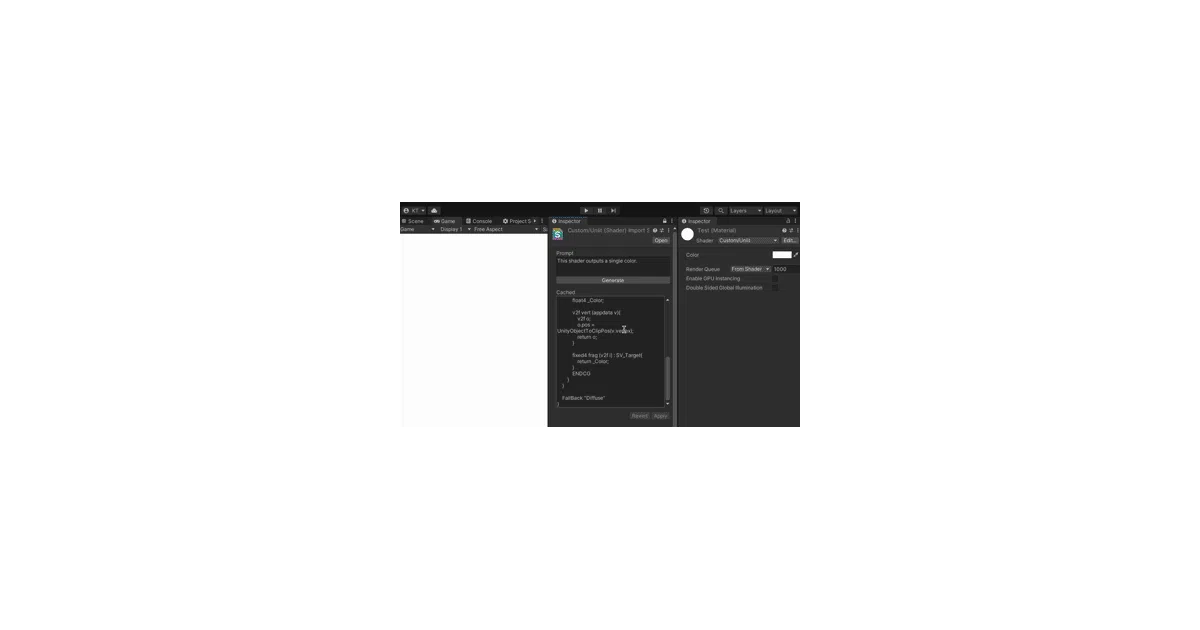
This Unity editor plug-in is a proof-of-concept that generates shaders by calling the ChatGPT API. The README labels it a shader generator but stays quiet on exactly how you prompt it or what the generated code looks like. It does handle API key storage sensibly, tucking the key into UserSettings/AIShaderSettings.asset so it stays outside version control by default.
The interesting bit
The convenience is in keeping the workflow inside the editor: instead of tabbing out to a browser, you request shaders from within Unity itself. It is mostly glue code between OpenAI’s API and Unity’s project settings, which is honest and often exactly what you need.
Key highlights
- Proof-of-concept Unity editor integration for LLM-generated shaders
- API key managed inside Unity’s Project Settings (
AI Shaderpanel) - Key stored in
UserSettings/AIShaderSettings.asset, typically excluded from version control - C# implementation that keeps the workflow inside the editor
Caveats
- The README is extremely sparse: it does not describe the prompting interface, supported shader types, or how the generated code is delivered.
- Requires an OpenAI API key and a live network connection; there is no offline mode.
Verdict
Worth a look if you are experimenting with LLM-assisted content creation inside Unity. Skip it if you need a production-ready shader authoring tool or were hoping for offline generation.
Frequently asked
- What is keijiro/AIShader?
- A Unity plug-in that generates shaders by calling the ChatGPT API.
- Is AIShader open source?
- Yes — keijiro/AIShader is an open-source project tracked on heatdrop.
- What language is AIShader written in?
- keijiro/AIShader is primarily written in C#.
- How popular is AIShader?
- keijiro/AIShader has 2.4k stars on GitHub.
- Where can I find AIShader?
- keijiro/AIShader is on GitHub at https://github.com/keijiro/AIShader.