junruxiong/IncarnaMind
Query Piles of PDFs with a Single Adaptive RAG Pipeline
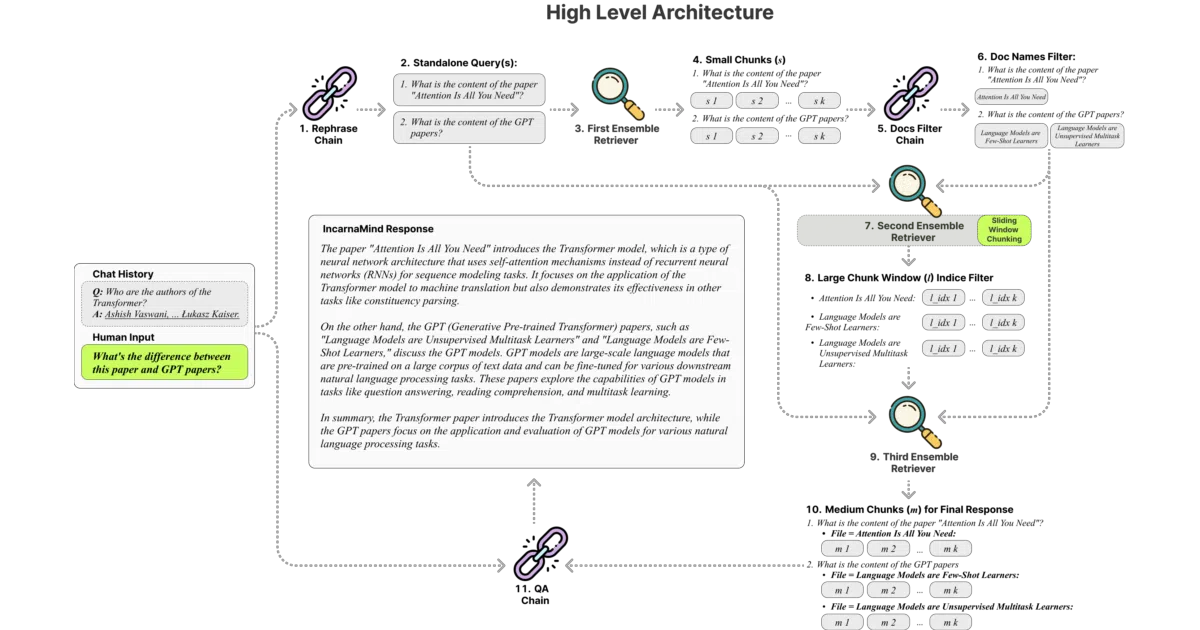
This project exists to replace fixed-size chunking and single-document silos with a sliding-window retriever that can query multiple PDFs and text files at once for both fine details and broad context.
Not currently ranked — collecting fresh signals.
star history
What it does
This is a retrieval-augmented generation setup that lets you ask questions across multiple PDF and TXT files in a single conversation. It feeds retrieved context from your documents to various backend LLMs—OpenAI GPT, Anthropic Claude, or local quantized models like Llama 2—through a terminal interface. The core pitch is that you are not restricted to one document at a time or to rigid text splits.
The interesting bit
Instead of chopping documents into fixed-size blocks, it uses a sliding-window chunking mechanism that dynamically adjusts window size and position based on data complexity. This is paired with an ensemble retriever that attempts to balance semantic similarity against precise keyword-style matching, aiming to solve the usual trade-off between context breadth and retrieval accuracy.
Key highlights
- Multi-document QA: handles simple and multi-hop queries across several PDFs or TXT files at once, rather than locking you into a single document.
- Adaptive chunking: a sliding-window approach tries to preserve both fine-grained details and coarse-grained context instead of relying on static chunk sizes.
- Broad LLM support: works with OpenAI GPT, Anthropic Claude, and local open-source models (notably Llama 2, including GGUF quantized versions).
- Hardware honesty: the README notes you’ll need more than 35 GB of GPU RAM to run the recommended local GGUF model, and suggests Together.ai as a lighter alternative.
- Built on familiar pieces: leans on LangChain, ChromaDB, and llama-cpp-python for retrieval and local inference.
Caveats
- Citations are not yet implemented, so the tool won’t show you exactly which chunk or page produced a given answer.
- Asynchronous processing is limited, which may bottleneck large ingestion or query workloads.
- Only PDF and TXT formats are supported for now; OCR and additional file types are listed as upcoming.
Verdict
Worth a look if you need a terminal-based RAG experiment that spans multiple documents and you want to compare commercial and local LLMs without rewriting chunking logic yourself. Skip it if you need a web UI, source citations, or production-grade async handling today.
Frequently asked
- What is junruxiong/IncarnaMind?
- This project exists to replace fixed-size chunking and single-document silos with a sliding-window retriever that can query multiple PDFs and text files at once for both fine details and broad context.
- Is IncarnaMind open source?
- Yes — junruxiong/IncarnaMind is open source, released under the Apache-2.0 license.
- What language is IncarnaMind written in?
- junruxiong/IncarnaMind is primarily written in Python.
- How popular is IncarnaMind?
- junruxiong/IncarnaMind has 801 stars on GitHub.
- Where can I find IncarnaMind?
- junruxiong/IncarnaMind is on GitHub at https://github.com/junruxiong/IncarnaMind.