jiwoochris/artex-ko
A Korean localization of an autonomous AI pentest tool — with a defense-first warning label
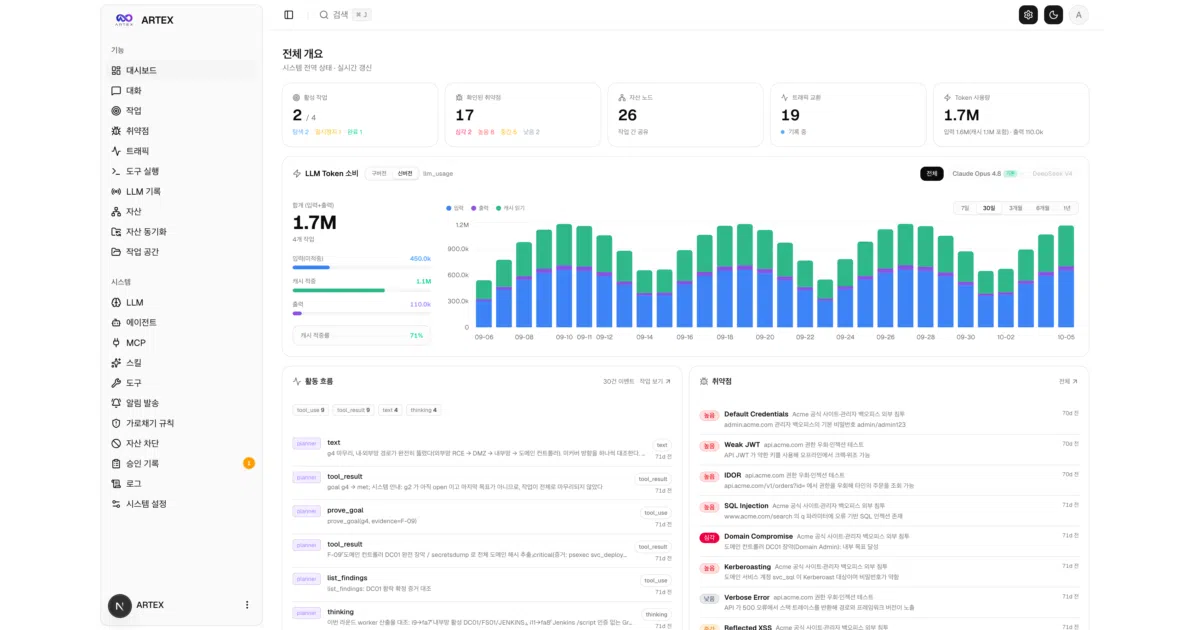
artex-ko translates the outputs of ARTEX, an LLM multi-agent system that runs penetration tests on its own, while keeping its internal reasoning prompts untouched.
Collecting fresh signals — velocity needs a few days of history.
collecting data…
star history
What it does
ARTEX is a Go single binary (with an embedded Next.js frontend, PostgreSQL for storage) where multiple LLM-driven agents break down objectives, run real tools, and accumulate discovered assets and vulnerabilities into a graph — an autonomous pentest pipeline with minimal human intervention. This fork localizes it for Korean teams: detection results, summaries, reports, and chat responses are forced into Korean, while commands, payloads, and logs stay in their original form.
The interesting bit
The localization policy is deliberately surgical: internal reasoning prompts are left untranslated to preserve the behavior benchmarked in the original Chinese version — only user-facing output is translated. The repo also leans hard into the defender’s side, shipping detection signatures and a hardening checklist alongside the attack tool, motivated by reports that the original ARTEX was allegedly used in an attack on Korean financial institutions.
Key highlights
- Go backend + embedded Next.js UI in a single binary; PostgreSQL stores findings and activity
- Human-in-the-loop chat lets you nudge agents mid-run, with attack-chain summaries in Korean
- Works with OpenAI-compatible endpoints, so domestic/open models can replace frontier providers
- Includes a defense/detection guide (Sigma-style signatures, hardening checklist) for blue teams
- Original Chinese docs preserved in
README.zh.mdfor easier upstream diffing
Caveats
- The Docker Compose quickstart is currently broken: the upstream
autumn27/arteximage is unavailable on Docker Hub, so you must compile from source - Finding titles are model-generated and may mix in English; only the surrounding UI is fully Korean
- AGPL-3.0, with explicit Korean legal warnings (정보통신망법, 개인정보보호법) — authorized targets only
Verdict
Worth a look for Korean-speaking security teams who want to study how autonomous AI attacks operate and how to detect them. If you wanted a turnkey Docker deployment or an English experience, wait — or go upstream.
Frequently asked
- What is jiwoochris/artex-ko?
- artex-ko translates the outputs of ARTEX, an LLM multi-agent system that runs penetration tests on its own, while keeping its internal reasoning prompts untouched.
- Is artex-ko open source?
- Yes — jiwoochris/artex-ko is open source, released under the AGPL-3.0 license.
- What language is artex-ko written in?
- jiwoochris/artex-ko is primarily written in Go.
- How popular is artex-ko?
- jiwoochris/artex-ko has 694 stars on GitHub.
- Where can I find artex-ko?
- jiwoochris/artex-ko is on GitHub at https://github.com/jiwoochris/artex-ko.