jianchang512/pyvideotrans
A Swiss Army knife for dubbing YouTube videos into Klingon (or anything else)
pyVideoTrans wires together speech recognition, LLM translation, and voice synthesis into a single pipeline for local or API-driven video localization.
Velocity · 7d
+14
★ / day
Trend
↘cooling
star history
What it does
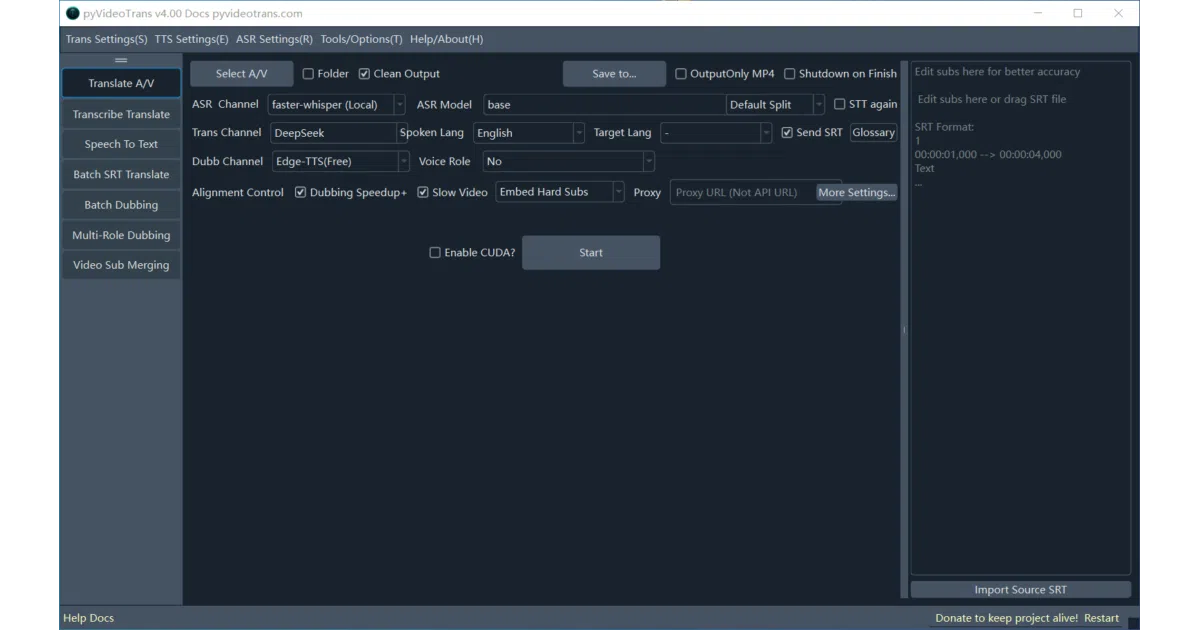
pyVideoTrans is a Python-based pipeline that ingests a video in one language and spits out a dubbed, subtitled version in another. It handles the full chain: speech-to-text, translation, text-to-speech, and final audio-video sync. There’s a PySide6 GUI for click-happy users and a CLI for headless batch jobs.
The interesting bit
The project doesn’t force you into a single vendor or model. It plugs into local engines like Faster-Whisper, Ollama, and F5-TTS for zero-shot voice cloning, but will also happily bill your credit card via OpenAI, Azure, DeepSeek, or a dozen other APIs. The “interactive editing” feature lets you pause the pipeline at any stage to fix transcripts or translations before the TTS robot speaks them into existence.
Key highlights
- Supports speaker diarization, so different voices can be assigned different AI dubbing actors
- Voice cloning via F5-TTS, CosyVoice, and GPT-SoVITS for keeping the original speaker’s timbre
- Pre-packaged
.exefor Windows users who fear the command line - GPU acceleration available via CUDA, though the README demands specific versions (CUDA 12.8, cuDNN 9.11)
- Bundled utility tools: vocal separation, subtitle merging, audio-video alignment
Caveats
- The README is vague on actual output quality and provides no benchmarks or sample comparisons
- “Powerful” appears in the project’s own tagline, which is never a good sign
- Heavy reliance on third-party APIs means cost and rate-limit surprises are your problem
Verdict
Content creators, localization teams, or anyone sitting on a pile of untranslated video should take a look. If you just need to translate a single TikTok, the setup overhead probably isn’t worth it.
Frequently asked
- What is jianchang512/pyvideotrans?
- pyVideoTrans wires together speech recognition, LLM translation, and voice synthesis into a single pipeline for local or API-driven video localization.
- Is pyvideotrans open source?
- Yes — jianchang512/pyvideotrans is open source, released under the GPL-3.0 license.
- What language is pyvideotrans written in?
- jianchang512/pyvideotrans is primarily written in Python.
- How popular is pyvideotrans?
- jianchang512/pyvideotrans has 19.6k stars on GitHub and is currently cooling off.
- Where can I find pyvideotrans?
- jianchang512/pyvideotrans is on GitHub at https://github.com/jianchang512/pyvideotrans.