jfrog/boost
Agent log compression that knows when it cut too much
Coding agents burn tokens wading through their own command output — Boost wraps those commands and hands the agent the summary instead of the scrollback.
Not currently ranked — collecting fresh signals.
star history
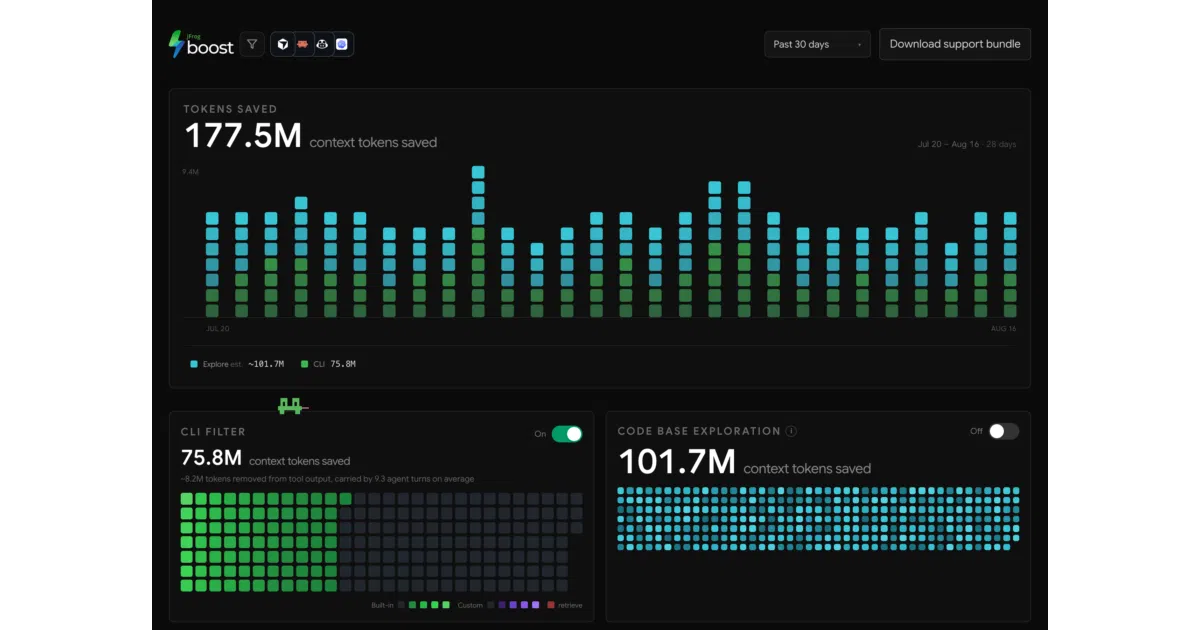
What it does Boost, from JFrog, is a wrapper that sits between your coding agent — Cursor, Claude Code, Copilot, Codex CLI — and the shell commands it runs. Where a dependency install can dump ~9,800 tokens of noise into context (their example), Boost’s command-aware filters hand back a ~640-token summary that keeps the signal: errors, timings, counts, cache hits. When something fails, the failing test or stack frame survives the trim. It also caches packages locally, so repeat installs get faster as well as quieter. (There’s a frog mascot. It’s JFrog; there was going to be one.)
The interesting bit The compression is self-correcting. If an agent keeps retrieving the full output behind a filter — a tell that the trim dropped something it actually needed — Boost auto-disables that filter. Add approval prompts that show the original executable rather than the wrapper, and you get compression with a feedback loop, not just a narrower pipe.
Key highlights
- Command-aware filters for npm, pytest, Docker, Git, and GitHub CLI, plus TOML filters for your own internal tools
- JFrog’s Terminal-Bench 2.0 run: identical task pass rate, ~12% lower cost
- Full output stays recoverable; raw logs and command history never leave the machine
- A web dashboard and terminal report track tokens saved over time
- OpenTelemetry-native, signed release binaries, secrets redacted before write or export
Caveats
- Preview software under JFrog’s Online Preview Agreement, and the copyright line reads “all rights reserved” — public repo, but not standard open source
- Usage metadata (timings, exit codes, cache stats) goes to JFrog; local-first, not silent
- The savings numbers and the comparison table (vs. RTK, Headroom, Caveman) are the vendor’s own
Verdict If long agent sessions are eating your token budget, the retrieval-feedback design makes this worth a try. If you need a permissively licensed, telemetry-free tool, read the preview agreement first.
Frequently asked
- What is jfrog/boost?
- Coding agents burn tokens wading through their own command output — Boost wraps those commands and hands the agent the summary instead of the scrollback.
- Is boost open source?
- Yes — jfrog/boost is an open-source project tracked on heatdrop.
- What language is boost written in?
- jfrog/boost is primarily written in Shell.
- How popular is boost?
- jfrog/boost has 545 stars on GitHub.
- Where can I find boost?
- jfrog/boost is on GitHub at https://github.com/jfrog/boost.