jazzyalex/agent-sessions
Your AI coding agents forget their past. This Mac app doesn't.
Corrals scattered session histories from nine AI coding tools into a single searchable, resumable archive.
Not currently ranked — collecting fresh signals.
star history
What it does
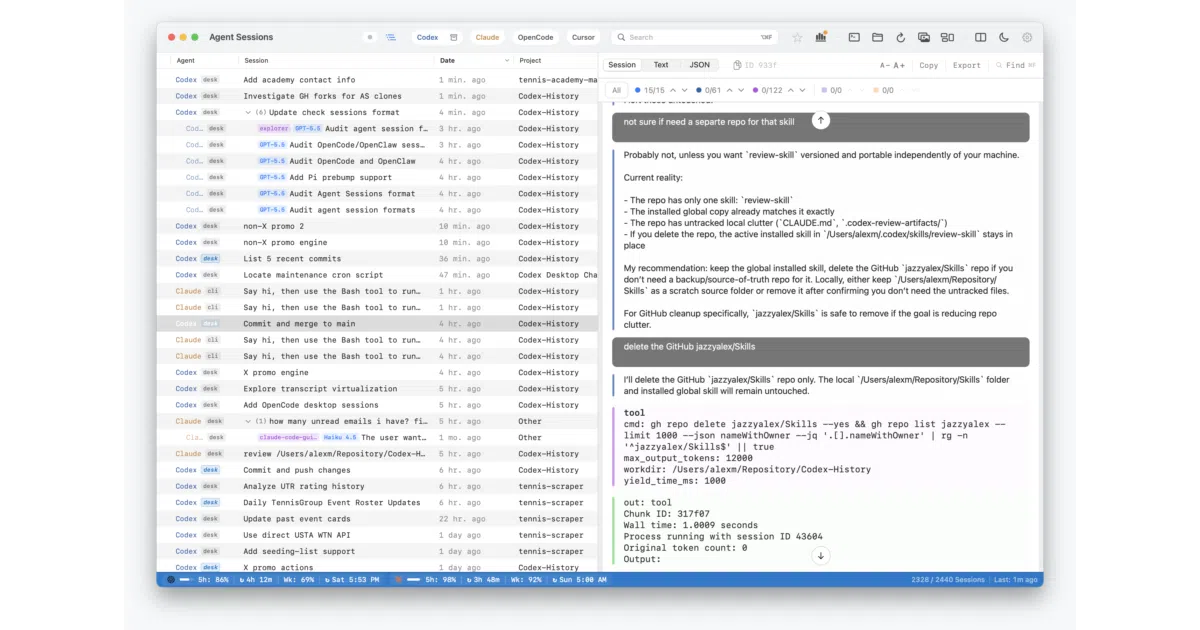
Agent Sessions reads the local session files left behind by AI coding agents—Codex, Claude Code, Cursor, OpenCode, Hermes, OpenClaw, Copilot CLI, Pi, and Gemini CLI—and presents them in a unified, searchable browser. You can inspect transcripts, browse generated images, save sessions for later, and copy resume commands to pick up where you left off in Terminal.app, iTerm2, or Warp. A beta Agent Cockpit adds a live dashboard for active Codex, Claude, and OpenCode sessions running in iTerm2.
The interesting bit
The app acts like a librarian for a library where every author uses a different filing system: it reads disparate local storage formats in read-only mode, builds its own search indexes, and keeps everything on your Mac. That local-first stance is increasingly rare in a toolchain that usually wants your data in the cloud.
Key highlights
- Supports nine distinct AI coding agents, each with its own local storage format, from JSONL to SQLite to custom directory structures.
- Resume workflows reconstruct previous CLI sessions and launch them in Terminal.app, iTerm2, or Warp.
- Agent Cockpit provides a live, at-a-glance command center for active iTerm2 sessions.
- Image Browser surfaces visual outputs across sessions without digging through hidden folders.
- Strictly local: no telemetry, analytics, or session uploads; optional Sparkle update checks are the only network traffic.
Caveats
- Agent Cockpit is beta and requires iTerm2; it does not support Terminal.app or Warp.
- macOS 14+ only; there is no Windows or Linux version.
- Resume and live-session features are limited to specific CLI agents and terminals.
Verdict
Useful if you juggle multiple AI coding agents and need to resurrect yesterday’s context without re-prompting from scratch. If you live entirely inside one IDE with its own session history, it is likely overkill.
Frequently asked
- What is jazzyalex/agent-sessions?
- Corrals scattered session histories from nine AI coding tools into a single searchable, resumable archive.
- Is agent-sessions open source?
- Yes — jazzyalex/agent-sessions is open source, released under the MIT license.
- What language is agent-sessions written in?
- jazzyalex/agent-sessions is primarily written in Swift.
- How popular is agent-sessions?
- jazzyalex/agent-sessions has 916 stars on GitHub.
- Where can I find agent-sessions?
- jazzyalex/agent-sessions is on GitHub at https://github.com/jazzyalex/agent-sessions.