jayleicn/animeGAN
When your GAN training is just a toy project, but the dataset is 143k anime faces
A learning exercise that accidentally produced a clean pipeline for scraping, cleaning, and generating anime portraits with DCGAN.
Not currently ranked — collecting fresh signals.
star history
What it does
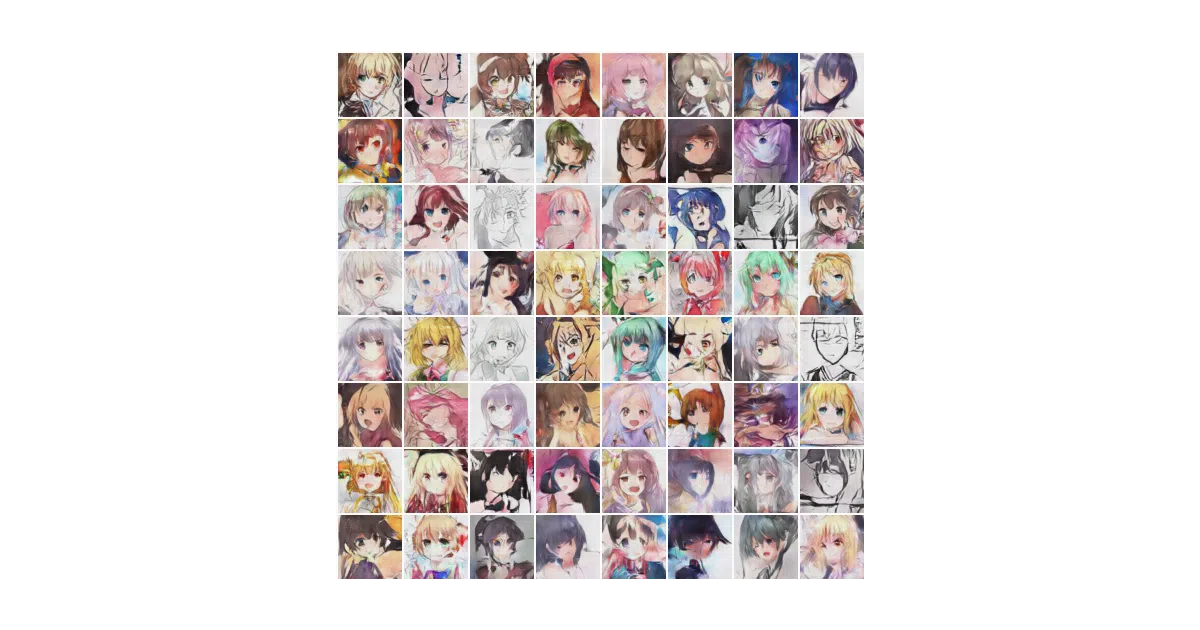
AnimeGAN trains a DCGAN on ~143,000 cropped anime faces to generate new character portraits and interpolate between latent codes. It ships with a pretrained model, a Jupyter notebook for tinkering, and a full data pipeline from Danbooru tags to face crops.
The interesting bit
The author is admirably honest: this is “a toy project to learn PyTorch and GANs.” Yet the README doubles as a field report on what actually stabilizes training—adding noise to the discriminator’s inputs and labels, keeping the generator deeper than the discriminator, and the surprising discovery that binary noise {-1, 1} works but looks worse than Gaussian. The dataset construction guide is the hidden gem: multi-process scraping with gallery-dl, face detection via python-animeface, and a cleaned 115,085-image release.
Key highlights
- Pretrained DCGAN model included; run inference in the bundled notebook
- Full dataset pipeline documented: scrape by tag, detect faces, crop, clean
- Curated dataset release (115k images, 126 tags) on GitHub Releases and BaiduYun
- Author’s training notes read like a lab notebook—unverified but specific
- Single-command training:
python main.py --dataRoot path_to_dataset/
Caveats
- Code is “mostly borrowed” from the official PyTorch DCGAN example; heavy influence from chainer-DCGAN and IllustrationGAN
- Dataset tags become semantically meaningless after face cropping (e.g., “uniform” may show no uniform)
- Author explicitly notes: “I did not carefully verify them” regarding training tips
Verdict
Grab this if you want a minimal, working DCGAN baseline with a ready-made niche dataset and honest notes on training instability. Skip it if you need architectural novelty or production-grade generation; the author would agree.
Frequently asked
- What is jayleicn/animeGAN?
- A learning exercise that accidentally produced a clean pipeline for scraping, cleaning, and generating anime portraits with DCGAN.
- Is animeGAN open source?
- Yes — jayleicn/animeGAN is open source, released under the MIT license.
- What language is animeGAN written in?
- jayleicn/animeGAN is primarily written in Jupyter Notebook.
- How popular is animeGAN?
- jayleicn/animeGAN has 1.3k stars on GitHub.
- Where can I find animeGAN?
- jayleicn/animeGAN is on GitHub at https://github.com/jayleicn/animeGAN.