iusztinpaul/energy-forecasting
MLOps by example: seven lessons and a Danish energy forecast
A seven-lesson curriculum that teaches MLOps by building an end-to-end batch-forecasting system for Danish electricity consumption.
Not currently ranked — collecting fresh signals.
star history
What it does
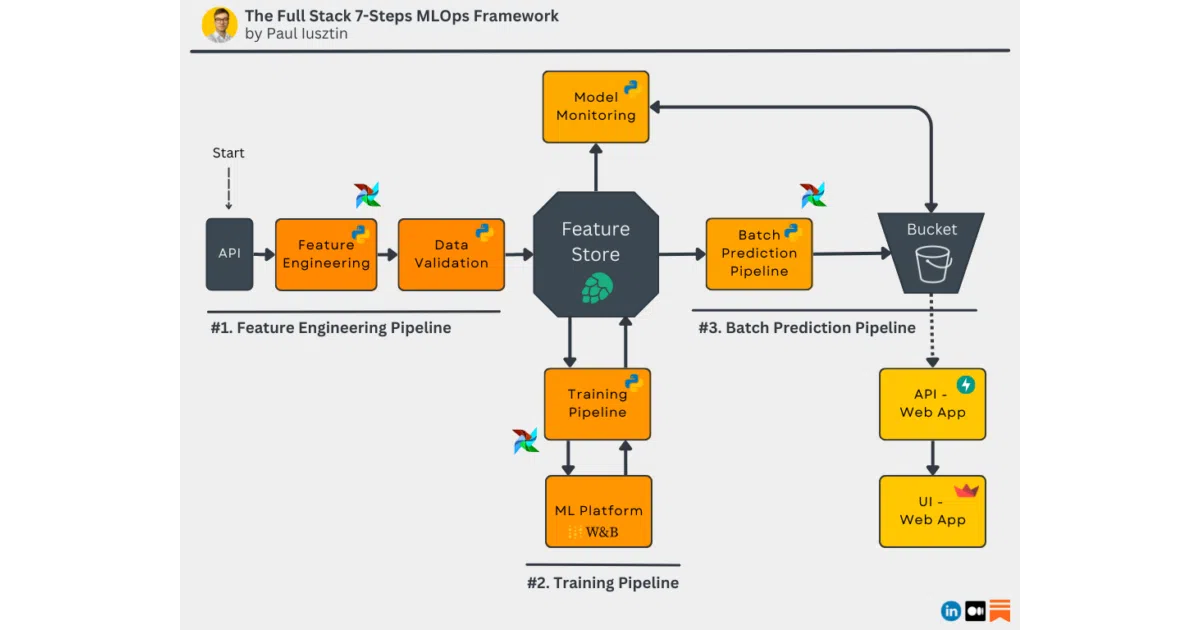
This repository is a curriculum, not a library. It walks through building an end-to-end batch ML system that forecasts hourly electricity consumption across Denmark. The codebase is split into a pipeline trio—feature engineering, training, and batch prediction—and a web app trio for serving, visualization, and monitoring, all orchestrated by Airflow and containerized with Docker.
The interesting bit
Instead of inventing a new framework, it serves as opinionated glue code that wires together a standard MLOps toolkit: Hopsworks, Weights & Biases, Great Expectations, FastAPI, Streamlit, and GCP. The refreshing part is a bonus lesson that openly dissects the architecture’s imperfections and trade-offs rather than pretending the design is flawless.
Key highlights
- Uses a real Danish energy dataset with hourly consumption readings by price area and consumer type, though the original API is now obsolete and replaced by a static file.
- Integrates a feature store, experiment tracker, model registry, data validation, and CI/CD into one coherent batch architecture.
- Bundles 2.5 hours of reading and video material hosted on Medium, though the narrative walkthrough sits behind a paywall.
- Provides explicit cost guidance: expect roughly $20 in GCP fees to run the final deployment.
- Targets intermediate-to-advanced MLEs and software engineers transitioning into ML roles.
Caveats
- The upstream data API is obsolete; the course now relies on a mocked static file downloaded from Google Drive, which limits real-time experimentation.
- The setup is tested only on Ubuntu 20.04/22.04 with Python 3.9, so mileage on other platforms is unclear.
- Several lessons and the detailed walkthrough live behind Medium’s paywall, so the “free” label applies mainly to the source code.
Verdict
Grab this if you want a guided, opinionated tour of a full MLOps stack and don’t mind paying for Medium and GCP to complete the arc. Skip it if you are looking for a reusable library or a tool-agnostic framework.
Frequently asked
- What is iusztinpaul/energy-forecasting?
- A seven-lesson curriculum that teaches MLOps by building an end-to-end batch-forecasting system for Danish electricity consumption.
- Is energy-forecasting open source?
- Yes — iusztinpaul/energy-forecasting is open source, released under the MIT license.
- What language is energy-forecasting written in?
- iusztinpaul/energy-forecasting is primarily written in Python.
- How popular is energy-forecasting?
- iusztinpaul/energy-forecasting has 987 stars on GitHub.
- Where can I find energy-forecasting?
- iusztinpaul/energy-forecasting is on GitHub at https://github.com/iusztinpaul/energy-forecasting.