itayinbarr/little-coder
A coding agent harness built for small models, not data centers
Because a 9.7B Qwen can outperform its weight class when the agent loop is sized right.
Not currently ranked — collecting fresh signals.
star history
What it does
little-coder is a bundle of 20 extensions, 30 skill markdown files, and a Python benchmark harness layered on top of the minimal pi agent framework. It targets small local models served via llama.cpp, Ollama, or LM Studio, using standard read/write/edit/bash tools against your local project directory. Bash commands are pre-screened against a built-in safe-prefix whitelist before the underlying agent loop ever sees them.
The interesting bit
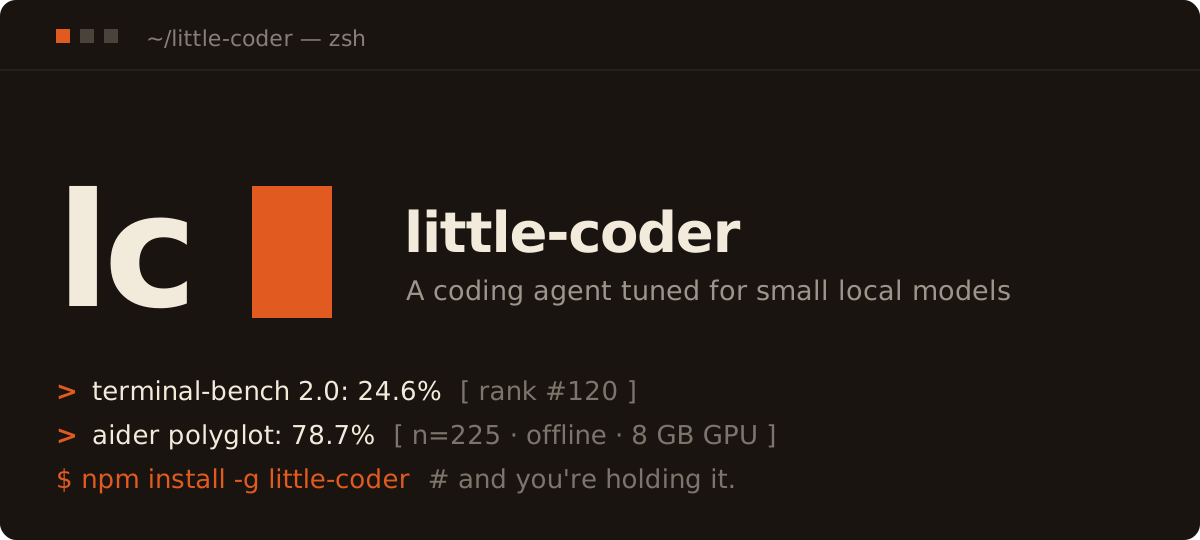
The harness treats scaffold–model fit as the critical variable: small-model-specific extensions automatically disable when you switch to a large cloud model, so they don’t get in the way. The authors claim a 9.7B Qwen running through this setup beat frontier entries on Aider Polyglot; the visible benchmark table shows it scored 45.56%, more than double the vanilla-Aider baseline of 19.11% for the same model.
Key highlights
- Ships as bundled extensions and skills atop
pi, which remains a plain dependency rather than being forked - Bash tool gated by a whitelist that excludes
rmandsudoby default; extra prefixes can be added via environment variables - Supports local inference stacks including llama.cpp (with MoE offloading), Ollama, and LM Studio, plus cloud providers
- Model and provider overrides live in user config files outside the package install path
- Includes a benchmark harness for reproducible evaluation on coding tasks
Caveats
- The documentation assumes prior familiarity with the
piframework’s extension and RPC model - Even with a
bunglobal install, the launcher still requires Node.js 22.19+ on your PATH - Common build commands like
makearen’t in the default bash whitelist and must be explicitly added via environment variables
Verdict
Worth a look if you want a coding agent that runs fully offline on modest hardware and you’re willing to tune a whitelist. Skip it if you already have a comfortable cloud-agent workflow and no interest in local inference.
Frequently asked
- What is itayinbarr/little-coder?
- Because a 9.7B Qwen can outperform its weight class when the agent loop is sized right.
- Is little-coder open source?
- Yes — itayinbarr/little-coder is open source, released under the Apache-2.0 license.
- What language is little-coder written in?
- itayinbarr/little-coder is primarily written in TypeScript.
- How popular is little-coder?
- itayinbarr/little-coder has 2.7k stars on GitHub.
- Where can I find little-coder?
- itayinbarr/little-coder is on GitHub at https://github.com/itayinbarr/little-coder.