isjiamu/gzh-design-skill
Markdown to WeChat HTML that survives the paste
An AI-agent skill that turns Markdown into inline HTML for WeChat's notoriously picky editor, complete with six curated themes and a validation pipeline that enforces the platform's arcane constraints.
Velocity · 7d
+7.3
★ / day
Trend
↘cooling
star history
What it does
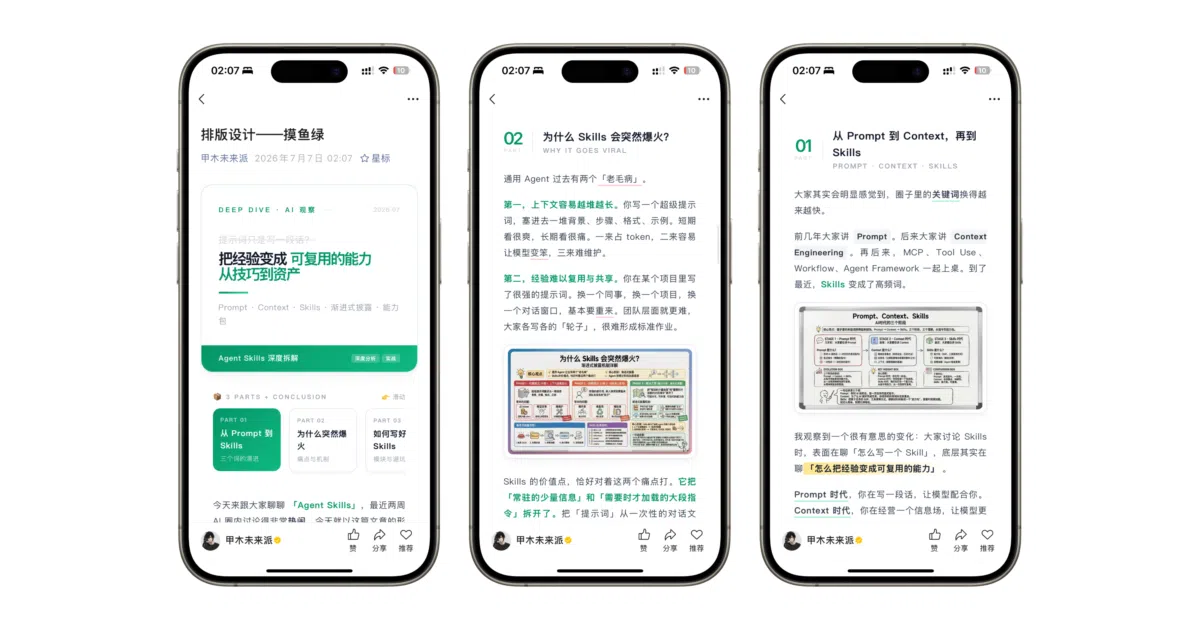
gzh-design-skill is an AI agent skill for Claude Code, Codex, and Cursor that takes your Markdown and emits fully inline-styled HTML ready to paste into WeChat’s Official Account editor. It ships with six complete visual themes—from “graphite minimal” to “zen whitespace”—each built as a thick component library with design tokens, visual hierarchy tables, and article-type recipes. The output avoids everything WeChat filters: no <style> tags, no <div>, no classes, no CSS variables, no positioning—just aggressively inlined styles and every text node wrapped in <span leaf="">.
The interesting bit
The real craft is in the paranoia. The project encodes WeChat’s restrictions into two Python validation scripts—component_lint.py for the source library and validate_gzh_html.py for the final output—creating a deterministic “edit → validate → fix” loop instead of hoping the LLM remembers the rules. There’s even a theme generator that can spin up a new component library from a single sentence or reference image.
Key highlights
- Six curated themes with full component libraries, not just color swaps; each includes visual hierarchy tables and article-type recipes so tutorials, essays, and tool reviews get different layouts.
- All styles are inlined and every text node is wrapped in
<span leaf="">to survive WeChat’s paste filter, which strips<style>,<div>, classes, grid, positioning, and external fonts. - Dual validation pipeline:
component_lint.pychecks the source component library for banned patterns, andvalidate_gzh_html.pyaudits the final output for platform compliance and half-width punctuation. - Theme generator can create an entirely new theme from a text description or reference image, producing a reusable local component library.
- One-click preview page with a “copy” button that places rich text on the clipboard, so you paste directly into the editor without manual selection.
Caveats
- It is strictly a typesetting tool, not a writer: you must supply the Markdown first.
- The README is upfront that it is useless for normal web pages, PPTs, or social cards—this is glue code purpose-built for WeChat’s ecosystem.
- Six themes cover common article genres, but if your aesthetic falls outside those buckets you’ll need to generate a custom theme or wait for contributions.
Verdict
Worth a look if you publish long-form content to WeChat and are tired of fighting its editor. Skip it if you don’t touch WeChat Official Accounts—this is a hyper-specific tool for a hyper-specific walled garden.
Frequently asked
- What is isjiamu/gzh-design-skill?
- An AI-agent skill that turns Markdown into inline HTML for WeChat's notoriously picky editor, complete with six curated themes and a validation pipeline that enforces the platform's arcane constraints.
- Is gzh-design-skill open source?
- Yes — isjiamu/gzh-design-skill is an open-source project tracked on heatdrop.
- What language is gzh-design-skill written in?
- isjiamu/gzh-design-skill is primarily written in HTML.
- How popular is gzh-design-skill?
- isjiamu/gzh-design-skill has 3.9k stars on GitHub and is currently cooling off.
- Where can I find gzh-design-skill?
- isjiamu/gzh-design-skill is on GitHub at https://github.com/isjiamu/gzh-design-skill.