isekOS/ISEK
Your LLM agents need friends, a relay, and maybe a wallet
ISEK is a framework for turning isolated LLM agents into a peer-to-peer network where they can discover teammates, share context, and tackle tasks collectively without a central conductor.
Not currently ranked — collecting fresh signals.
star history
What it does
Developers run agents locally and plug them into the ISEK network over peer-to-peer connections. Once joined, agents discover one another, form communities, and handle requests using Google’s A2A protocol. An optional ERC-8004 identity layer on Ethereum-compatible chains handles registration and reputation, though it skips on-chain steps entirely if no registry is configured.
The interesting bit
ISEK treats agents as participants in a shared ecosystem rather than solitary API wrappers. The blockchain identity is pragmatically optional—you get a local wallet and agent ID even if you never deploy a smart contract—so the “decentralized” label is more of a sliding scale than a hard requirement.
Key highlights
- Agents communicate over P2P relays; local execution is the default posture.
- Built around Google’s A2A protocol for agent-to-agent messaging.
- Optional on-chain identity and reputation via ERC-8004 contracts.
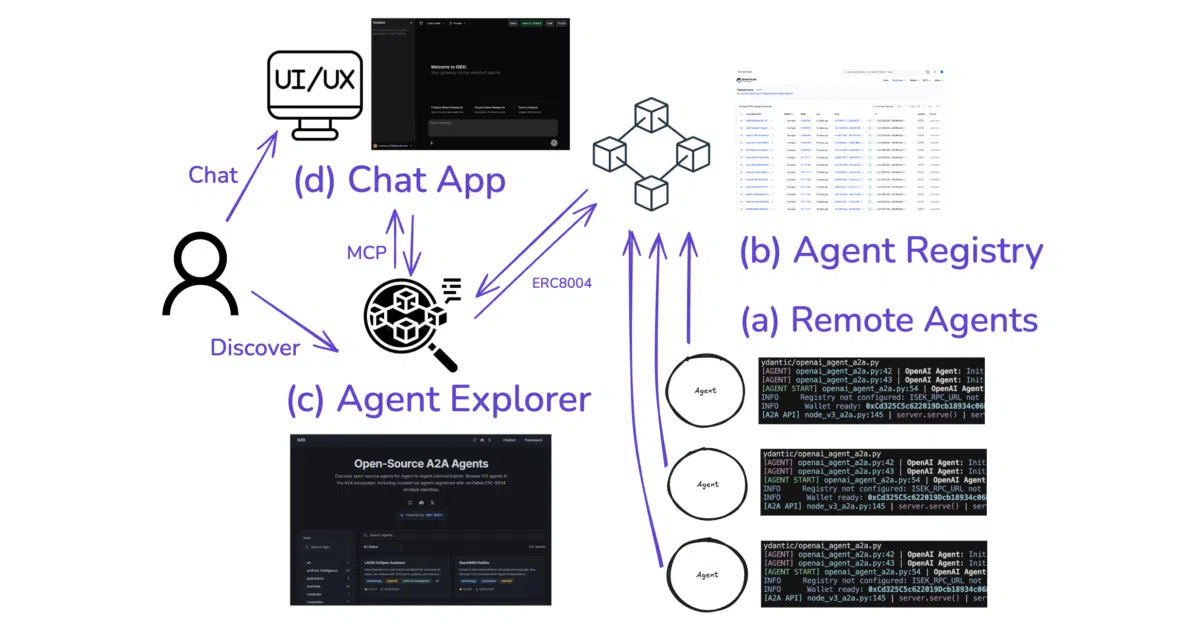
- Ships with companion tools: an agent explorer, a chat app, and a Chrome extension.
- P2P mode requires Node.js in addition to Python.
Caveats
- The README shows visible rough edges: a misspelled Python module (
isek_identiey), a placeholder GitHub issues link, and conflicting Discord URLs. - The “decentralized” identity layer is strictly optional; without a registry address the framework falls back to local-only identity.
- P2P functionality pulls in a Node.js dependency, so this isn’t a pure-Python stack.
Verdict
Worth a spin if you’re experimenting with multi-agent coordination or trustless agent discovery. If you need a mature, centralized orchestrator with crisp documentation, this is still early.
Frequently asked
- What is isekOS/ISEK?
- ISEK is a framework for turning isolated LLM agents into a peer-to-peer network where they can discover teammates, share context, and tackle tasks collectively without a central conductor.
- Is ISEK open source?
- Yes — isekOS/ISEK is open source, released under the MIT license.
- What language is ISEK written in?
- isekOS/ISEK is primarily written in Python.
- How popular is ISEK?
- isekOS/ISEK has 569 stars on GitHub.
- Where can I find ISEK?
- isekOS/ISEK is on GitHub at https://github.com/isekOS/ISEK.