infobyte/faraday
Pentesting's second-hardest job: keeping track of findings
Faraday doesn't find vulnerabilities — it collects, normalizes, and tracks what your 80+ scanners already found, so findings outlive the terminal scrollback.
Not currently ranked.
star history
What it does
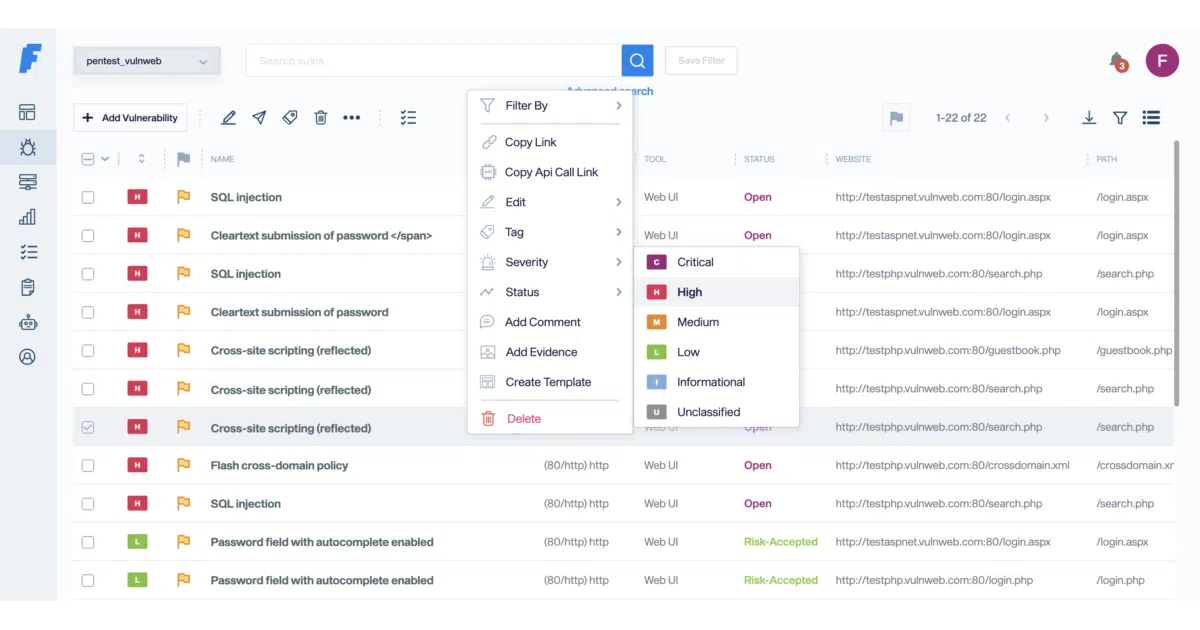
Faraday is an open-source vulnerability manager, not a scanner. It sits downstream of your tools: plugins ingest output from the likes of nmap, Burp, and OWASP ZAP, normalize it into a common data model, and land it in shared multiuser workspaces you can browse through a web UI with dashboards. The pitch, in their own words: you focus on discovering vulnerabilities, Faraday handles the bookkeeping.
The interesting bit
The plugin architecture has a nice split: console plugins parse tool output live while you work in the terminal, and report plugins import artifacts (XML, JSON) after the fact — so interactive pentesters and pipeline-driven scans feed the same dataset. The unglamorous normalization is the actual product: a pile of incompatible output formats becomes one queryable body of findings, with a REST API and CLI layered on top.
Key highlights
- 80+ supported tools via plugins, split into console (live output) and report (artifact import) types
- Multiuser workspaces with web dashboards aimed at analysts and managers alike
faraday-clifor terminal-driven workflows, CI/CD integration, and workspace metrics- Agents Dispatcher runs scanners remotely from the platform and pulls results back in
- Distributed as Docker images, a PyPI package, and native Debian/RPM installers
Caveats
- Requires Postgres as its backing store — visible in the Docker setup
- The ecosystem is spread across separate repos: plugins, CLI, and agents each live in their own
- The repo description advertises AI-powered autonomous pentesting, but the README says nothing about it — that story lives elsewhere
Verdict
Worth a look if your team’s findings currently live in scattered scan output and spreadsheets. Skip it if you came for the scanner itself — or for the advertised autonomous AI pentester, which this README never mentions.
Frequently asked
- What is infobyte/faraday?
- Faraday doesn't find vulnerabilities — it collects, normalizes, and tracks what your 80+ scanners already found, so findings outlive the terminal scrollback.
- Is faraday open source?
- Yes — infobyte/faraday is open source, released under the GPL-3.0 license.
- What language is faraday written in?
- infobyte/faraday is primarily written in Python.
- How popular is faraday?
- infobyte/faraday has 6.9k stars on GitHub.
- Where can I find faraday?
- infobyte/faraday is on GitHub at https://github.com/infobyte/faraday.