huseinzol05/Stock-Prediction-Models
From LSTM to curiosity agents: a stock-forecasting notebook zoo
A sprawling notebook catalog that pits recurrent networks, attention models, and curiosity-driven RL agents against historical stock data to see what sticks.
Not currently ranked — collecting fresh signals.
star history
What it does This repository gathers dozens of Jupyter notebooks that apply machine learning and deep learning to stock-price forecasting and automated trading. It bundles recurrent architectures, sequence-to-sequence models, attention mechanisms, and stacked ensembles alongside reinforcement-learning agents and Monte Carlo simulations. Each approach is presented as a standalone notebook with plotted results rather than as a unified framework.
The interesting bit The breadth is the point: you get everything from a Dilated-CNN-Seq2seq to a Neuro-evolution agent with Novelty search, plus a TensorFlow.js port that lets you upload a CSV and forecast in a browser. It reads less like a product and more like a hands-on survey course for financial ML.
Key highlights
- A broad catalog of recurrent and convolutional architectures—LSTM, GRU, Seq2seq, attention, and dilated CNN variants—plus stacked ensembles that mix auto-encoders, ARIMA, and gradient boosting.
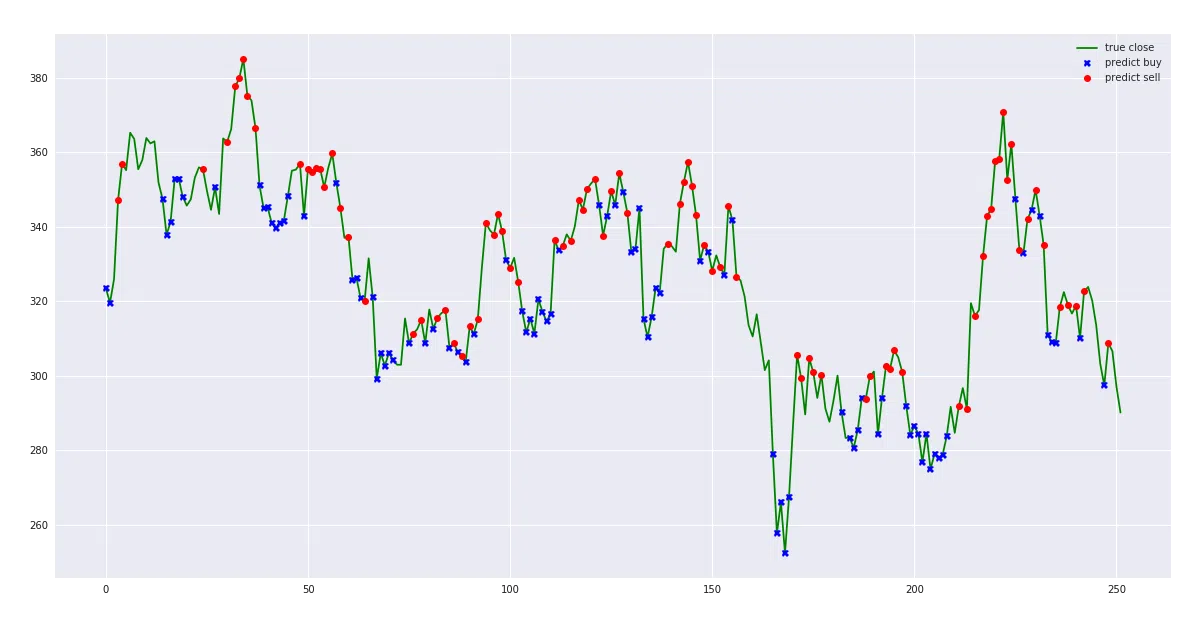
- 23 trading agents ranging from classic Turtle and moving-average rules to policy-gradient, actor-critic, and curiosity-driven Q-learning variants.
- Monte Carlo simulations covering simple drift, dynamic volatility, and multivariate BTC/USDT scenarios with sentiment data.
- A TensorFlow.js demo page for running LSTM and simple-agent forecasts on custom historical CSVs directly in the browser.
- Accuracy and per-epoch timing benchmarks for a fixed train/test split (last 30 days held out), though the underlying dataset is unspecified.
Caveats
- The trading agents are hard-coded to buy or sell exactly one unit per transaction, which limits practical strategy evaluation.
- Reported accuracy figures come from a single undisclosed dataset with a specific 30-day holdout, and the author states that tuning parameters “will help you by a lot,” so treat the benchmarks as starting points.
- The repository is a gallery of standalone notebooks, not a maintained library with shared APIs or backtesting infrastructure.
Verdict Worth browsing if you want to see how a specific paper or technique translates to stock data without writing the boilerplate yourself. Skip it if you need a production trading stack or rigorous out-of-sample validation.
Frequently asked
- What is huseinzol05/Stock-Prediction-Models?
- A sprawling notebook catalog that pits recurrent networks, attention models, and curiosity-driven RL agents against historical stock data to see what sticks.
- Is Stock-Prediction-Models open source?
- Yes — huseinzol05/Stock-Prediction-Models is open source, released under the Apache-2.0 license.
- What language is Stock-Prediction-Models written in?
- huseinzol05/Stock-Prediction-Models is primarily written in Jupyter Notebook.
- How popular is Stock-Prediction-Models?
- huseinzol05/Stock-Prediction-Models has 9.5k stars on GitHub.
- Where can I find Stock-Prediction-Models?
- huseinzol05/Stock-Prediction-Models is on GitHub at https://github.com/huseinzol05/Stock-Prediction-Models.