hunkim/deep_architecture_genealogy
A family tree for neural nets, maintained by PR
A crowdsourced genealogy map of deep learning architectures, because keeping track of ResNet's cousins is now a community problem.
Not currently ranked — collecting fresh signals.
star history
What it does
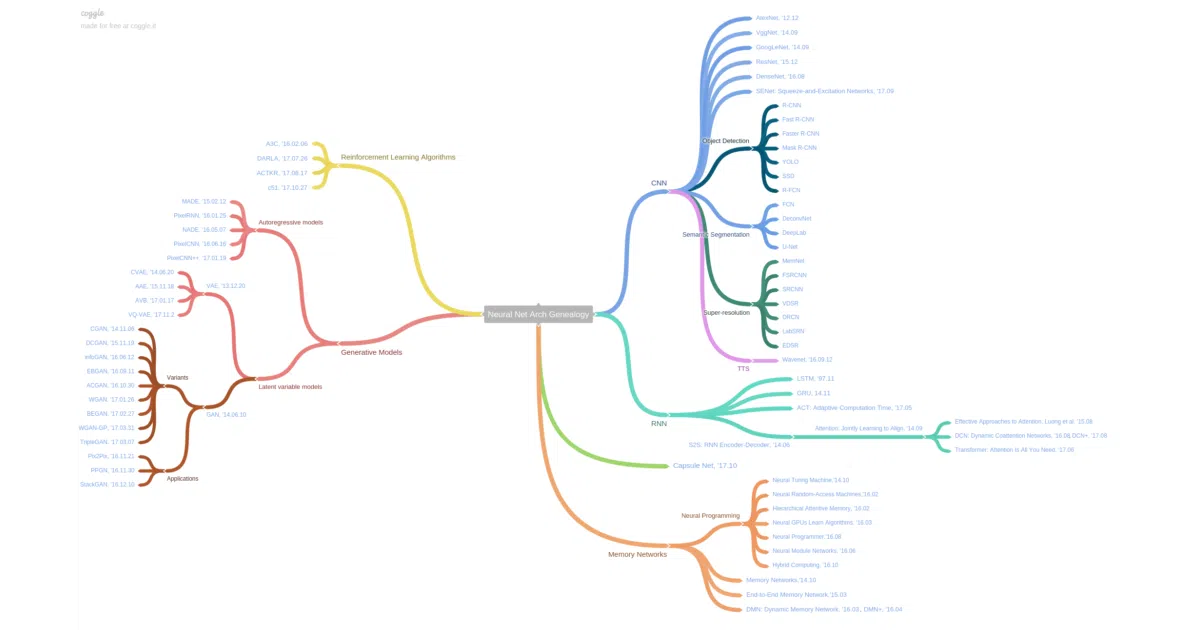
This repo is a living bibliography of deep learning architectures, organized as a hierarchical mindmap and rendered into a text README. It covers CNNs, RNNs, GANs, reinforcement learning, memory networks, and capsule nets, with arXiv links and dates for each paper. The README is auto-generated from a plain text source file; contributors edit the .txt, not the Markdown.
The interesting bit The project treats paper lineage as a public utility rather than a literature review. The Coggle mindmap visualizes how branches split—object detection from CNNs, attention from seq2seq, WGAN from GAN—making the pace of 2014–2017 deep learning feel almost geological.
Key highlights
- Hierarchical coverage: CNNs (with sub-branches for detection, segmentation, super-resolution), RNNs, generative models, RL, memory networks, capsule nets
- Each entry links to the original paper; dates range from LSTM (‘97) to Transformer and Capsule Net (‘17)
- Auto-generated README: edit
Neural Net Arch Genealogy.txt, the rest is scripted - Open to PRs for new architectures “worth paying attention to”
- Visual mindmap hosted on Coggle with embedded PNG fallback
Caveats
- Stopped updating around 2017; no transformers beyond the original “Attention Is All You Need,” no modern LLMs, diffusion models, or state-space models
- “Automatically generated” is stated twice but the generation script isn’t visible in the README
- Some arXiv links may have rotted; no CI or validation is mentioned
Verdict Useful if you need a quick historical map of mid-2010s deep learning or want a template for crowdsourced taxonomy. Skip it if you need current architectures; this is a time capsule, not a living reference.
Frequently asked
- What is hunkim/deep_architecture_genealogy?
- A crowdsourced genealogy map of deep learning architectures, because keeping track of ResNet's cousins is now a community problem.
- Is deep_architecture_genealogy open source?
- Yes — hunkim/deep_architecture_genealogy is an open-source project tracked on heatdrop.
- What language is deep_architecture_genealogy written in?
- hunkim/deep_architecture_genealogy is primarily written in Python.
- How popular is deep_architecture_genealogy?
- hunkim/deep_architecture_genealogy has 1.2k stars on GitHub.
- Where can I find deep_architecture_genealogy?
- hunkim/deep_architecture_genealogy is on GitHub at https://github.com/hunkim/deep_architecture_genealogy.