huanngzh/MV-Adapter
Turn Your Favorite SD Model Into a Multi-View Camera Array
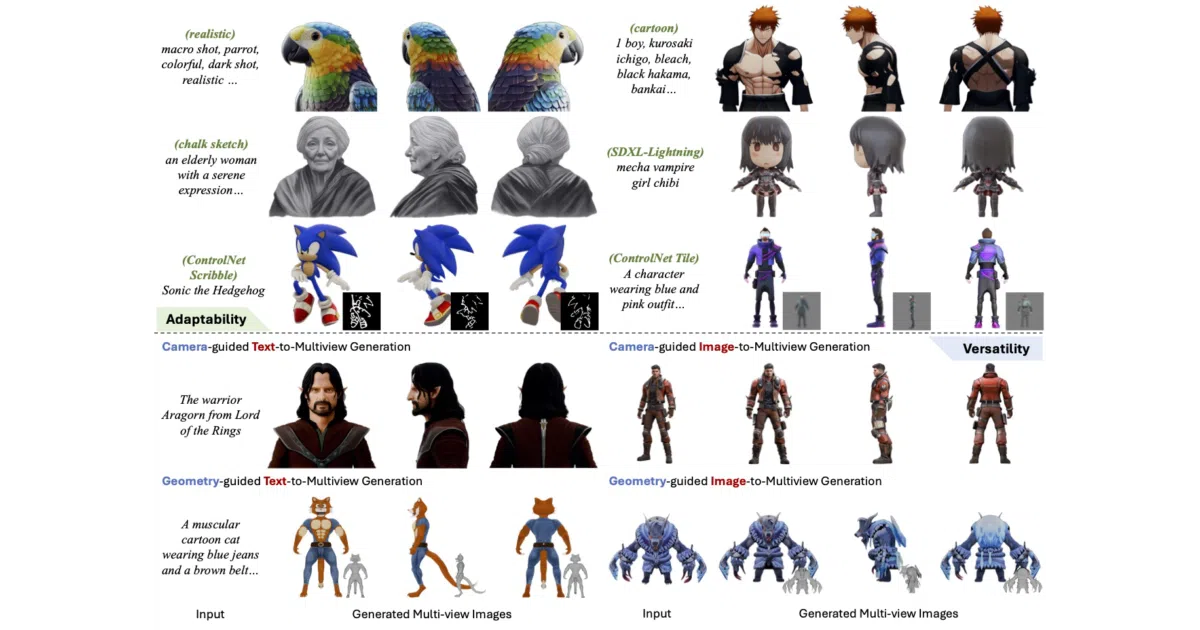
MV-Adapter lets you retrofit existing text-to-image diffusion models to generate geometry-consistent views without retraining them from scratch.
Not currently ranked — collecting fresh signals.
star history
What it does
MV-Adapter is a plug-in adapter that retrofits existing Stable Diffusion models—SDXL, SD2.1, and popular derivatives like DreamShaper or Animagine—to emit spatially consistent multi-view images instead of flat 2D snapshots. Feed it a text prompt or a single image, and it generates rendered views at up to 768 px resolution. It also accepts geometry guidance for text-to-texture and image-to-texture generation.
The interesting bit
Rather than training a monolithic multi-view diffusion model from scratch, the project treats multi-view consistency as an adapter layer you strap onto off-the-shelf T2I weights. The base model’s style, LoRAs, and even ControlNet extensions remain usable while the adapter handles the multi-view generation.
Key highlights
- Works with SDXL (higher quality, higher VRAM) and SD2.1 (<10 GB VRAM).
- Supports personalized models, distilled samplers (LCM), and multiple LoRAs.
- Geometry-conditioned pipelines for text-to-texture and image-to-texture generation.
- Released training data (Objaverse-Ortho10View / Rand6View) and training scripts.
- ICCV 2025 accepted; includes Gradio demos, inference scripts, and a ComfyUI integration.
Caveats
- Image-to-multiview generation demands roughly 14 GB of GPU memory.
- SD2.1 variants are lighter but deliver slightly lower performance.
- Texture generation requires an extra CV-CUDA dependency.
Verdict
Worth a look if you already have a Stable Diffusion workflow and want to generate consistent object views or texture 3D assets without abandoning your model zoo. Give it a pass if your hardware budget tops out well below 10 GB of VRAM.
Frequently asked
- What is huanngzh/MV-Adapter?
- MV-Adapter lets you retrofit existing text-to-image diffusion models to generate geometry-consistent views without retraining them from scratch.
- Is MV-Adapter open source?
- Yes — huanngzh/MV-Adapter is open source, released under the Apache-2.0 license.
- What language is MV-Adapter written in?
- huanngzh/MV-Adapter is primarily written in Python.
- How popular is MV-Adapter?
- huanngzh/MV-Adapter has 1.3k stars on GitHub.
- Where can I find MV-Adapter?
- huanngzh/MV-Adapter is on GitHub at https://github.com/huanngzh/MV-Adapter.