harvard-edge/cs249r_book
Harvard's 25k-star curriculum: the missing manual for AI engineering
A free, end-to-end ML systems curriculum that treats the repository itself as the course — textbook, build-your-own framework, hardware kits, simulator, and interview prep included.
Velocity · 7d
+81
★ / day
Trend
↗accelerating
star history
What it does
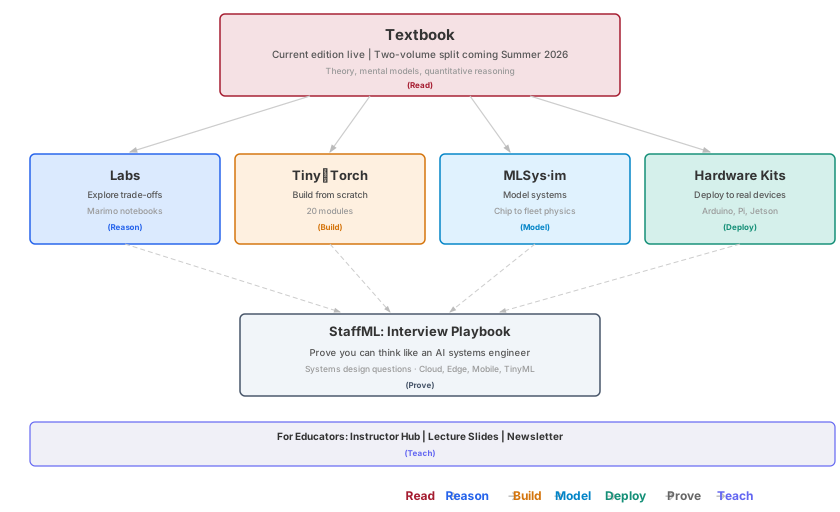
This is a complete, integrated curriculum for machine learning systems engineering from Harvard’s Edge Computing lab. It spans two textbook volumes (MIT Press hardcopy coming 2026), interactive labs, a from-scratch ML framework called TinyTorch, hardware deployment kits for Arduino and Raspberry Pi, an infrastructure simulator, and even interview prep under the StaffML brand. Everything lives in one repository by design — the author found that students who only read don’t internalize, and students who only code don’t generalize.
The interesting bit
The ambition is explicit and quantified: 100,000 learners this year, 1 million by 2030. The project frames “AI engineering” as a discipline distinct from software and computer engineering — focused on building systems that are efficient, reliable, safe, and robust in the real world, not just training models in isolation. The curriculum map diagram actually shows how the pieces connect, which is rarer than it should be in open education.
Key highlights
- Two-volume textbook with theory and quantitative reasoning as the foundation
- TinyTorch: 20 progressive modules building an ML framework from scratch
- MLSys·im: simulator for reasoning about infrastructure scales you can’t physically access
- Hardware kits for Arduino, Seeed, Grove, and Raspberry Pi with real memory and power constraints
- Full educator package: 16-week syllabi, Beamer slides with four themes, rubrics, TA handbook
- CC BY-NC-SA 4.0 license, with IEEE 2024 citation available
- Translated into Chinese, Japanese, and Korean
Caveats
- Some adjacent projects (Socratiq, MLPerf EDU, ML Systems Design Grammar) are explicitly marked as experimental or under construction
- The hardcopy edition is promised for 2026; current materials are web-first
- License is non-commercial (NC), which limits certain reuse cases
Verdict
Self-learners and instructors looking for a structured, systems-level ML curriculum should start here — it’s unusually complete and actually integrated. Researchers seeking novel algorithms or practitioners wanting drop-in tools will find this is pedagogy, not a framework to adopt.
Frequently asked
- What is harvard-edge/cs249r_book?
- A free, end-to-end ML systems curriculum that treats the repository itself as the course — textbook, build-your-own framework, hardware kits, simulator, and interview prep included.
- Is cs249r_book open source?
- Yes — harvard-edge/cs249r_book is an open-source project tracked on heatdrop.
- What language is cs249r_book written in?
- harvard-edge/cs249r_book is primarily written in Python.
- How popular is cs249r_book?
- harvard-edge/cs249r_book has 29.6k stars on GitHub and is currently accelerating.
- Where can I find cs249r_book?
- harvard-edge/cs249r_book is on GitHub at https://github.com/harvard-edge/cs249r_book.