harshbg/Sign-Language-Interpreter-using-Deep-Learning
A 24-hour hackathon build that reads sign language from your webcam
Built in 24 hours to give deaf users a personal, always-available ASL translator without relying on human interpreters.
Not currently ranked — collecting fresh signals.
star history
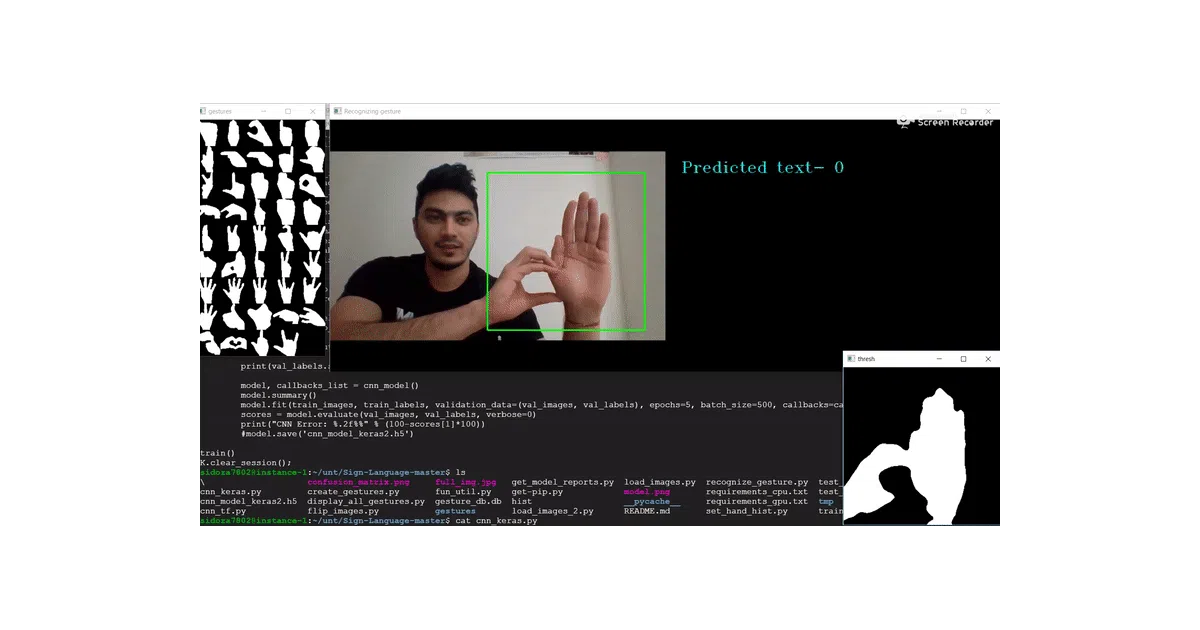
What it does The project captures live video through a webcam, isolates hand gestures with OpenCV, and classifies them using a Keras CNN trained on 44 characters of American Sign Language. It acts as a local translator that converts static ASL signs into text. The authors claim the model achieves above 95 percent accuracy on that limited vocabulary.
The interesting bit The entire pipeline—from calibrating a hand histogram to collecting training data, augmenting images by flipping them, and training the classifier—was built during a single 24-hour hackathon and won HackUNT-19. It is less a polished product than a complete proof-of-concept that happens to work end-to-end.
Key highlights
- Built in 24 hours at the University of North Texas HackUNT-19 and won first place.
- Recognizes 44 ASL characters using a custom CNN built with Keras and TensorFlow.
- Ships with a full data-collection toolkit for histogram calibration, gesture capture, image augmentation, and dataset splitting.
- Runs locally using only a webcam and a Python environment.
- The team published a 2025 preprint on Research Square and links to a follow-up advanced repository.
Caveats
- The vocabulary is limited to 44 ASL characters; the README explicitly lists expanding it as future work.
- The pipeline requires manual histogram calibration and gesture collection unless you rely entirely on the authors’ pre-built datasets.
- The project is marked as finished, and active development appears to have moved to a separate linked repository.
Verdict A useful reference if you want to see how a full gesture-recognition pipeline fits together with OpenCV and Keras. Look elsewhere if you need a maintained, cloud-deployed API or support for full ASL sentences rather than isolated characters.
Frequently asked
- What is harshbg/Sign-Language-Interpreter-using-Deep-Learning?
- Built in 24 hours to give deaf users a personal, always-available ASL translator without relying on human interpreters.
- Is Sign-Language-Interpreter-using-Deep-Learning open source?
- Yes — harshbg/Sign-Language-Interpreter-using-Deep-Learning is open source, released under the MIT license.
- What language is Sign-Language-Interpreter-using-Deep-Learning written in?
- harshbg/Sign-Language-Interpreter-using-Deep-Learning is primarily written in Python.
- How popular is Sign-Language-Interpreter-using-Deep-Learning?
- harshbg/Sign-Language-Interpreter-using-Deep-Learning has 777 stars on GitHub.
- Where can I find Sign-Language-Interpreter-using-Deep-Learning?
- harshbg/Sign-Language-Interpreter-using-Deep-Learning is on GitHub at https://github.com/harshbg/Sign-Language-Interpreter-using-Deep-Learning.