ginlix-ai/LangAlpha
Claude Code, but your intern is a quant analyst
LangAlpha treats investing as an iterative, compounding process rather than a one-shot chat query.
Velocity · 7d
+44
★ / day
Trend
↗accelerating
star history
What it does
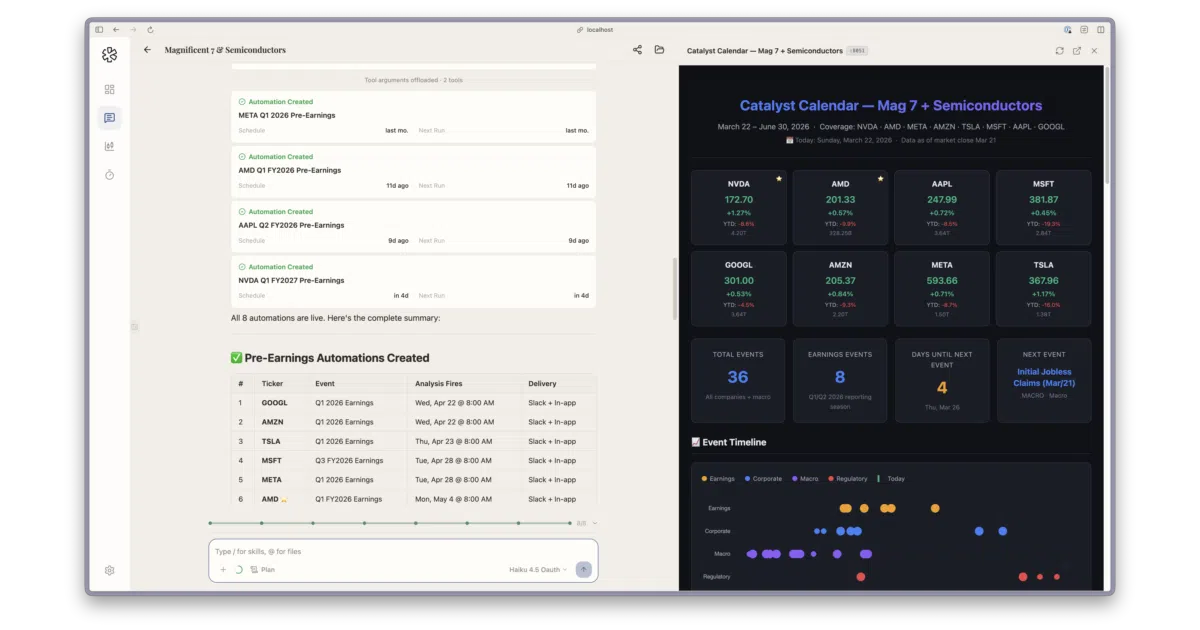
LangAlpha is an agent harness for financial research that borrows the “vibe coding” persistence model from tools like Claude Code and applies it to investment workflows. You create a workspace per thesis (“Q2 rebalance,” “energy sector rotation”), and the agent interviews you, produces deliverables, and saves everything to a structured sandbox filesystem. Come back days later and your threads, charts, and accumulated research are still there, compounding in an agent.md notes file that gets injected into every subsequent model call.
The interesting bit The core trick is Programmatic Tool Calling (PTC): instead of dumping raw financial API responses into the LLM context window, the agent writes and executes Python inside a Daytona cloud sandbox, then returns only the processed result. This sidesteps context limits for multi-year data analysis while cutting token waste. A separate “Flash mode” handles quick lookups and secretary duties—managing workspaces, dispatching deep analyses, and monitoring background tasks through conversation.
Key highlights
- Persistent per-thesis workspaces with structured directories, cross-session memory stores, and a user-managed memo store for uploaded PDFs and research notes
- 25-layer middleware stack handling skill loading, plan mode, auto-compaction, and live mid-execution steering via a Redis-backed queue
- Multi-provider abstraction with BYOK OAuth (ChatGPT, Claude, Kimi, GLM, MiniMax), encrypted at rest via PostgreSQL pgcrypto, plus automatic failover on error
- Pre-built financial skills: DCF models, initiating coverage, earnings analysis, morning notes, document generation
- Agent swarm with parallel async subagents, checkpoint-based resume, and real-time progress monitoring
- Price-triggered automations and scheduled tasks; Slack/Discord integrations with full feature parity
- SSE-streamed activity with Redis-buffered reconnection replay, decoupled background execution, and LangGraph checkpointer in PostgreSQL
Caveats
- The README is extensive but cuts off mid-sentence in the “Financial Data Ecosystem” section, leaving the native toolset vs. MCP server boundary unclear
- Heavy infrastructure footprint: PostgreSQL dual pool, Redis, Daytona sandboxes, and multiple financial API keys required for full functionality
- 1,342 stars suggests early traction, but the project is young enough that production battle-testing at scale is unproven
Verdict Worth a look if you’re a developer-investor who wants to automate deep, iterative research workflows rather than ask one-off questions. Skip it if you need a simple chatbot for quick price lookups—you’re paying for orchestration complexity you won’t use.
Frequently asked
- What is ginlix-ai/LangAlpha?
- LangAlpha treats investing as an iterative, compounding process rather than a one-shot chat query.
- Is LangAlpha open source?
- Yes — ginlix-ai/LangAlpha is open source, released under the Apache-2.0 license.
- What language is LangAlpha written in?
- ginlix-ai/LangAlpha is primarily written in Python.
- How popular is LangAlpha?
- ginlix-ai/LangAlpha has 2.1k stars on GitHub and is currently accelerating.
- Where can I find LangAlpha?
- ginlix-ai/LangAlpha is on GitHub at https://github.com/ginlix-ai/LangAlpha.