galleonlabs/hypergrok-trading-desk
A trading desk where six of the seven employees are LLMs
HyperGrok splits Hyperliquid trading into analyst, risk, execution and review roles so no single agent ever holds both the idea and the keys.
Collecting fresh signals — velocity needs a few days of history.
collecting data…
star history
What it does
HyperGrok is a Hyperliquid trading desk built for AI agents — seven role profiles, seventeen skills in the portable SKILL.md format, and read-only Python tools. It runs in Grok Bot, Claude Code, Cursor, Codex, Gemini CLI and Grok Build. The desk starts keyless: market data, funding, open interest and book depth come from Hyperliquid’s public /info endpoint with no wallet needed. Execution only happens after you supply a trade-only API wallet and approve an exact ticket by id.
The interesting bit
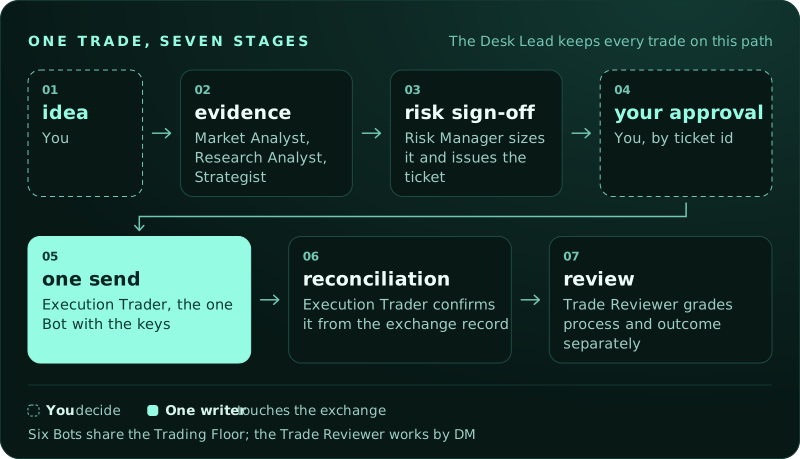
The separation of duties is the whole point. Six Bots sit in a shared Trading Floor chat and can only read; one Execution Trader holds the keys and sends each approved order exactly once. The approval gate deliberately lives outside the chat — in a Grok Bot Auto-review “Ask first” rule — because, as the README puts it, a Bot that can read an approval could also write one. That is a threat model most agent projects still pretend doesn’t exist.
Key highlights
- Seven roles with a fixed trade lifecycle: idea → evidence → risk sign-off → your approval → one send → reconciliation → review.
- The Risk Manager sizes trades on a stressed stop — assumed adverse fills plus taker fees on both legs — and can refuse you.
opening_bell.pyanddesk_doctor.pyrun on Python’s standard library alone, with--schema/--jsonfor automation and explicit reporting of partial depth.research_dataset.pycollects verifiable history bundles (captured responses, hashed manifest) and never fills gaps with synthetic data.- Your limits file can only tighten the desk’s caps, never loosen them; testnet rehearsal comes before mainnet.
Caveats
- The multi-Bot desk experience is Grok Bot-specific; other tools get the skills but not the Trading Floor group chat.
- Stressed-stop sizing is an assumption — the README is candid that actual losses can exceed it.
- The README’s worked ticket is an illustrative example, not a live trade.
Verdict
Worth a look if you trade on Hyperliquid and want agents with real checks instead of a single prompt with your keys. If you wanted a fire-and-forget autonomous bot, this is explicitly the opposite — and that’s the pitch.
Frequently asked
- What is galleonlabs/hypergrok-trading-desk?
- HyperGrok splits Hyperliquid trading into analyst, risk, execution and review roles so no single agent ever holds both the idea and the keys.
- Is hypergrok-trading-desk open source?
- Yes — galleonlabs/hypergrok-trading-desk is open source, released under the MIT license.
- What language is hypergrok-trading-desk written in?
- galleonlabs/hypergrok-trading-desk is primarily written in Python.
- How popular is hypergrok-trading-desk?
- galleonlabs/hypergrok-trading-desk has 502 stars on GitHub.
- Where can I find hypergrok-trading-desk?
- galleonlabs/hypergrok-trading-desk is on GitHub at https://github.com/galleonlabs/hypergrok-trading-desk.