fmind/mlops-python-package
MLOps boilerplate bringing software rigor to Python ML pipelines
It exists to give MLOps projects a software-engineering backbone instead of a pile of ad-hoc notebooks.
Not currently ranked — collecting fresh signals.
star history
What it does
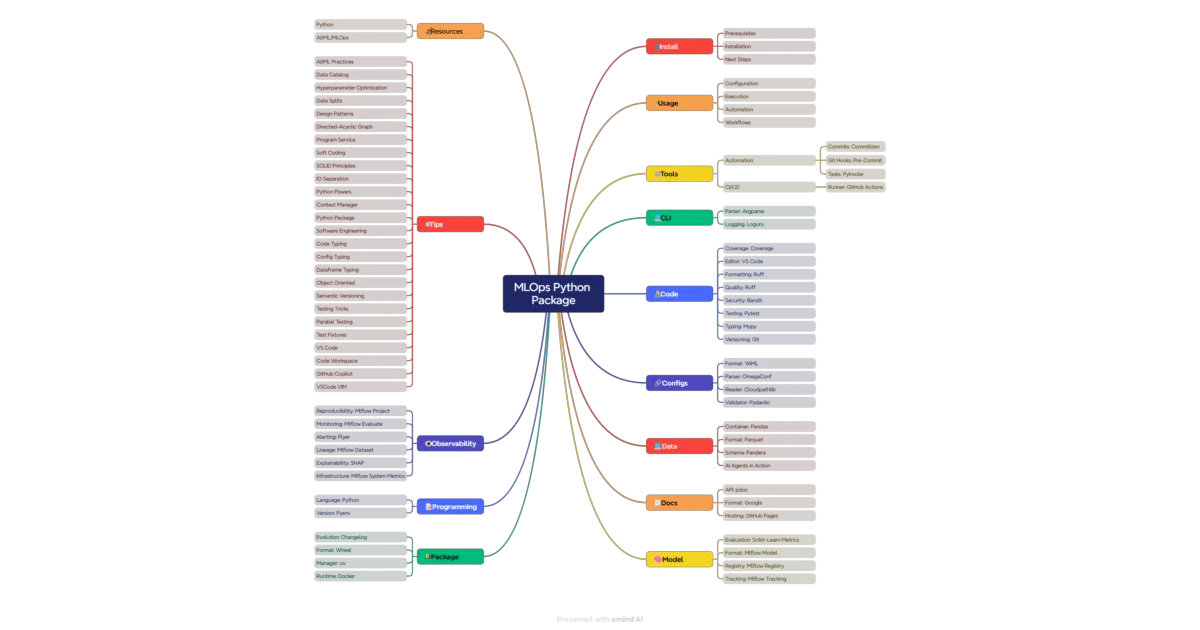
This repository is an opinionated Python template for MLOps workflows. It glues together a modern stack—uv, ruff, mypy, pytest, mlflow, pandera, and docker—into a single project structure. You define jobs like training or inference in YAML files, and the code dispatches them using Pydantic discriminated unions. It is essentially high-quality glue code: it enforces software-engineering standards without pretending to be a new framework.
The interesting bit
The clever angle is treating MLOps as a config-driven software package rather than a tangle of scripts. Pydantic validates both your data schemas via Pandera and your runtime job selection via discriminated unions, so the same codebase handles training, tuning, promotion, and inference without branching into spaghetti. It is a rare template that remembers ML code still needs type checking and unit tests.
Key highlights
- Heavy use of modern Python tooling:
uvfor environment management,rufffor linting/formatting,mypyfor typing, andpytestwith parallel execution. - Configuration-driven execution via YAML and OmegaConf, with Pydantic discriminated unions automatically routing to the correct job task.
- Integrated MLflow for experiment tracking, model registry, dataset lineage, and system metrics collection.
- Data validation through Pandera schemas on Parquet-backed Pandas containers.
- CI/CD via GitHub Actions and packaging as both a wheel and Docker image.
Caveats
- You must adapt the code to your specific compute platform or registry; it is a starter, not a turnkey platform.
- It pins you to a very modern stack—Python 3.13 and
uv—which may exclude teams on older toolchains.
Verdict
Worth a look if you are starting a new MLOps codebase and want software-engineering guardrails from day one. Skip it if you already have a settled stack or need a framework rather than a structured template.
Frequently asked
- What is fmind/mlops-python-package?
- It exists to give MLOps projects a software-engineering backbone instead of a pile of ad-hoc notebooks.
- Is mlops-python-package open source?
- Yes — fmind/mlops-python-package is open source, released under the MIT license.
- What language is mlops-python-package written in?
- fmind/mlops-python-package is primarily written in Python.
- How popular is mlops-python-package?
- fmind/mlops-python-package has 1.4k stars on GitHub.
- Where can I find mlops-python-package?
- fmind/mlops-python-package is on GitHub at https://github.com/fmind/mlops-python-package.