flybirdxx/ComfyUI-Qwen-TTS
ComfyUI Nodes That Actually Speak
It wires Alibaba's open-source Qwen3-TTS into ComfyUI so you can clone, design, and script voices by dragging nodes instead of writing Python.
Not currently ranked — collecting fresh signals.
star history
What it does
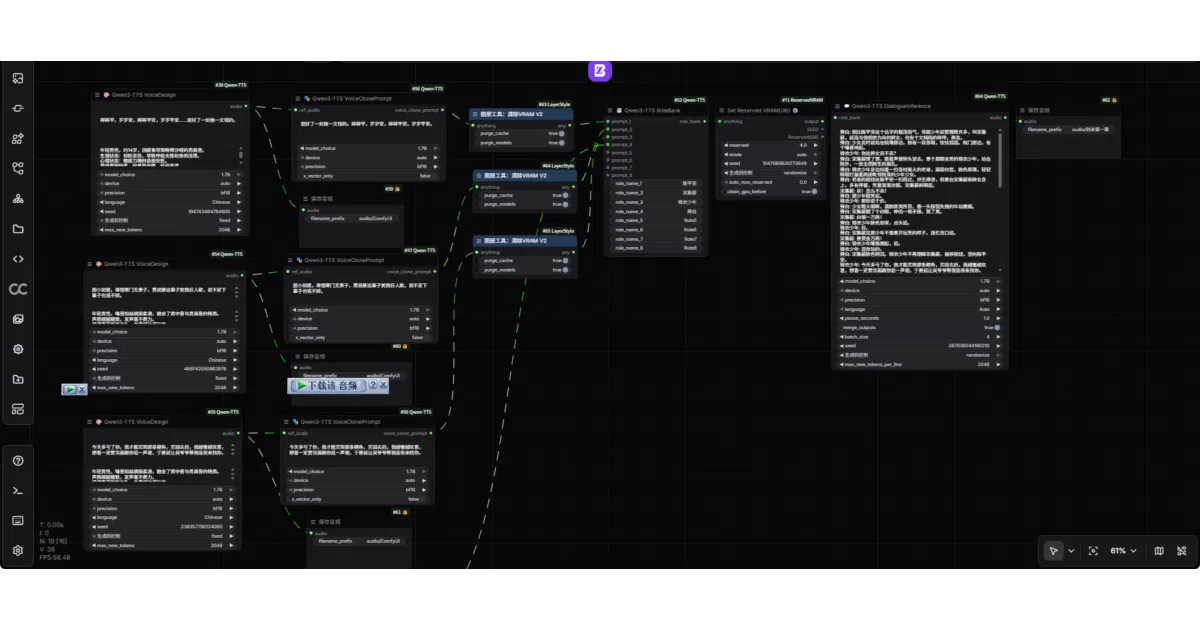
Wraps Alibaba’s Qwen3-TTS into a suite of ComfyUI custom nodes for text-to-speech, zero-shot voice cloning from short audio clips, and voice design via natural language prompts. It also adds a full dialogue system that can cast up to eight distinct speaker roles from a script and render them into a single merged audio file. Model loading is handled on-demand with global caching, and every node offers an optional VRAM unload toggle for tighter GPUs.
The interesting bit
The project treats voice work like a production pipeline. A VoiceClonePromptNode extracts reusable voice features that can be fed into a RoleBankNode to cast up to eight characters, then passed to a DialogueInferenceNode that renders the whole script into one continuous audio file. It is essentially a casting and recording studio built out of ComfyUI noodles.
Key highlights
- Supports both 0.6B (fast) and 1.7B (quality) model variants across synthesis, cloning, and dialogue nodes.
- Auto-detects attention backends—
sage_attn,flash_attn,sdpa, oreager—with graceful fallback and per-mechanism model caching. - Includes dedicated
SaveVoiceNodeandLoadSpeakerNodefor building a persistent voice library without re-extracting features. - Multilingual out of the box: Chinese, English, Japanese, Korean, German, French, Russian, Portuguese, Spanish, and Italian.
- Optional
unload_model_after_generatetoggle specifically recommended for GPUs with less than 8GB of VRAM.
Caveats
- Hard dependency on
transformers==4.57.3; versions 5.0+ will break model loading entirely. - The
QwenTTSConfigNodewas removed in v1.0.7 due to voice inconsistency issues. - Fine-tuning support is currently labeled experimental; the README recommends sticking with zero-shot cloning for best results.
Verdict
Worth a look if you already live in ComfyUI and need to generate dialogue, clone voices, or design characters without leaving the node graph. If you prefer CLI pipelines or direct API calls, this wrapper adds little value.
Frequently asked
- What is flybirdxx/ComfyUI-Qwen-TTS?
- It wires Alibaba's open-source Qwen3-TTS into ComfyUI so you can clone, design, and script voices by dragging nodes instead of writing Python.
- Is ComfyUI-Qwen-TTS open source?
- Yes — flybirdxx/ComfyUI-Qwen-TTS is an open-source project tracked on heatdrop.
- What language is ComfyUI-Qwen-TTS written in?
- flybirdxx/ComfyUI-Qwen-TTS is primarily written in Python.
- How popular is ComfyUI-Qwen-TTS?
- flybirdxx/ComfyUI-Qwen-TTS has 2k stars on GitHub.
- Where can I find ComfyUI-Qwen-TTS?
- flybirdxx/ComfyUI-Qwen-TTS is on GitHub at https://github.com/flybirdxx/ComfyUI-Qwen-TTS.