flipped-aurora/gin-vue-admin
A Chinese admin scaffold that now talks to your AI editor
A Go/Vue3 boilerplate with built-in MCP server so Cursor and friends can generate CRUD, assign permissions, and vibe-code your enterprise admin panel.
Not currently ranked — collecting fresh signals.
star history
What it does
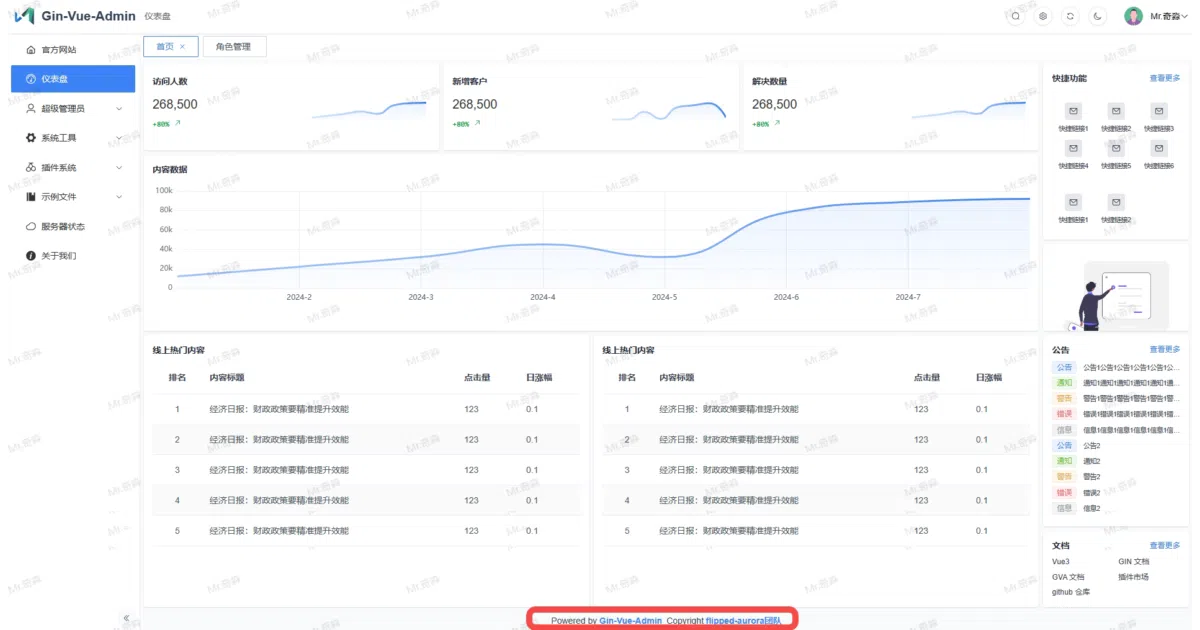
Gin-vue-admin is a full-stack starter kit: Gin backend, Vue 3 + Element Plus frontend, JWT and Casbin for auth, dynamic menus, code and form generators, file uploads to the major Chinese cloud providers, and the usual CRUD suspects. It has been around long enough to accumulate 24k stars and a small plugin economy.
The interesting bit
The newer pitch is AI integration. The project ships an MCP (Model Context Protocol) service and a “skills” management layer, which means your AI editor can theoretically scaffold tables, generate front and back code, and wire up RBAC in one shot. The README advertises “one minute to generate basic front and back code” via AI. Whether that minute includes debugging the generated code is, as always, left as an exercise.
Key highlights
- Go 1.22+ / Gin backend with Gorm, Redis for JWT session tracking, and Swagger docs
- Vue 3 + Vite + Element Plus frontend with TS/JS mix allowed
- Built-in MCP server and “skills” system for AI-assisted development
- Code generator, form builder (Variant Form), dynamic routing, and multi-point login blocking
- BSL 1.1 license: free for learning and evaluation; commercial use or removal of copyright requires a paid license
- Extensive Chinese-language documentation and Bilibili video tutorials
Caveats
- The AI/MCP features are heavily marketed but the README gives almost no technical detail on how the protocol is implemented or which editors are tested beyond a Bilibili video link
- BSL 1.1 with commercial licensing requirement; not pure open source
- Requires meaningful Go and Vue experience; the maintainers explicitly do not offer free technical support
Verdict
Worth a look if you are building yet another Chinese enterprise admin system and want your AI editor to do the boilerplate. Skip it if you need a permissive license, a minimal footprint, or first-class English documentation.
Frequently asked
- What is flipped-aurora/gin-vue-admin?
- A Go/Vue3 boilerplate with built-in MCP server so Cursor and friends can generate CRUD, assign permissions, and vibe-code your enterprise admin panel.
- Is gin-vue-admin open source?
- Yes — flipped-aurora/gin-vue-admin is open source, released under the Apache-2.0 license.
- What language is gin-vue-admin written in?
- flipped-aurora/gin-vue-admin is primarily written in Go.
- How popular is gin-vue-admin?
- flipped-aurora/gin-vue-admin has 25.1k stars on GitHub.
- Where can I find gin-vue-admin?
- flipped-aurora/gin-vue-admin is on GitHub at https://github.com/flipped-aurora/gin-vue-admin.