firecrawl/fire-enrich
Giving every email in your CSV its own private investigator
An open-source lead-enrichment tool that treats web scraping like an assembly line, with each AI agent passing its notes to the next.
Not currently ranked — collecting fresh signals.
star history
What it does
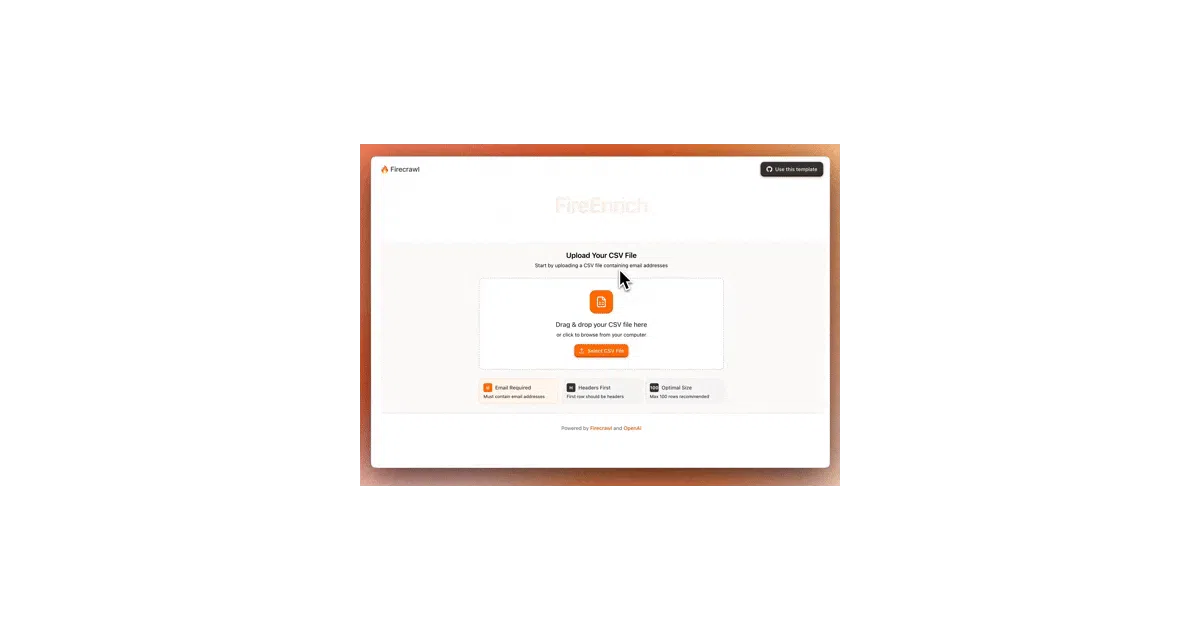
Fire Enrich ingests a CSV of email addresses, extracts the domains, and dispatches a sequence of specialized agents to investigate each company. The system hunts down industry classifications, funding rounds, tech stacks, and leadership details, then synthesizes the findings into a structured table with citations. It is essentially a web-scraping research assistant built on Firecrawl and OpenAI’s GPT-4o, wrapped in a Next.js interface.
The interesting bit
Instead of firing off a single prompt and hoping for the best, the project runs a five-phase assembly line—Discovery, Profile, Financial, Tech Stack, and General Purpose—where each agent builds on the last one’s notes. This sequential handoff is the core gimmick: the funding agent uses the industry context found by the profile agent to search the right databases, and a final synthesis layer resolves conflicts before anything reaches the user.
Key highlights
- Specialized agents: Each phase has a dedicated agent with its own Zod schema, search strategy, and expected output (e.g.,
FundingResult,ProfileResult). - Parallel within, sequential across: Every agent fires multiple Firecrawl searches at once, but the phases themselves run in order to share context and validate prior results.
- Cited sources: Every data point is traced back to a URL—Crunchbase, TechCrunch, GitHub, or the company’s own site.
- Extensible schemas: Adding a new data field means editing a Zod schema and updating the orchestrator’s routing logic; the General Purpose agent catches anything unmapped.
- Real-time UI: Results populate live in a Next.js table as the multi-agent pipeline finishes each row.
Caveats
- Hard API dependency: The tool requires active, paid API keys for both Firecrawl and OpenAI to function at all.
- Unclear coverage: The examples and architecture diagram center on corporate domains (the diagram explicitly flags “Corporate email detected”); the README never addresses what happens with personal or public email providers.
- Opaque economics: Each enrichment triggers numerous external API calls across five phases plus a final GPT-4o synthesis, yet the README provides no guidance on cost, rate limits, or caching.
Verdict
Sales teams and recruiters tired of manually researching prospects will find this a ready-made force multiplier, but anyone looking for a cheap, offline, or fully self-hosted enrichment pipeline should keep scrolling.
Frequently asked
- What is firecrawl/fire-enrich?
- An open-source lead-enrichment tool that treats web scraping like an assembly line, with each AI agent passing its notes to the next.
- Is fire-enrich open source?
- Yes — firecrawl/fire-enrich is open source, released under the MIT license.
- What language is fire-enrich written in?
- firecrawl/fire-enrich is primarily written in TypeScript.
- How popular is fire-enrich?
- firecrawl/fire-enrich has 1.2k stars on GitHub.
- Where can I find fire-enrich?
- firecrawl/fire-enrich is on GitHub at https://github.com/firecrawl/fire-enrich.